
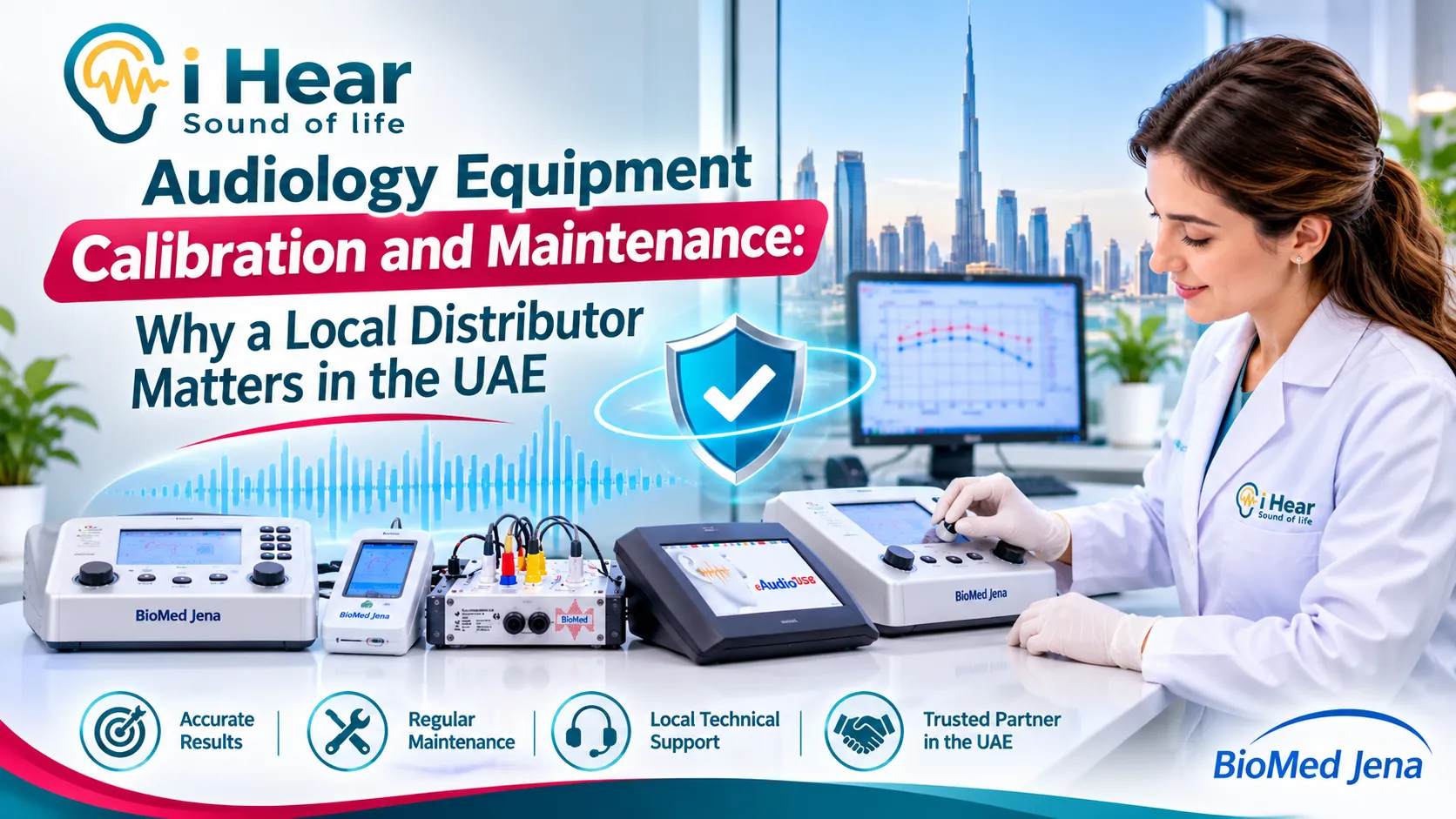
Quick answer: Audiology equipment calibration is a periodic check that compares what a device such as an audiometer actually produces (sound level and frequency) with accepted reference values, so the result on screen matches what the patient really hears. Annual calibration is commonly recommended, with simple daily checks in between, but the manufacturer’s schedule and your health authority’s requirements always take priority. A local authorised distributor matters because calibration, maintenance, technical support and training are available inside the UAE, without shipping the device abroad.
Imagine an audiology clinic in the UAE testing dozens of patients every week. One day the audiologist notices that two patients in a row show weaker hearing in the right ear than expected, then discovers that the audiometer’s right earphone is delivering a lower level than the screen shows. Every test carried out in the previous weeks is now in doubt: hearing aids fitted on inaccurate results, patients referred unnecessarily, others reassured by a result that did not deserve it. This is exactly what audiometer calibration and regular maintenance are there to prevent.
In this guide we explain audiology equipment calibration in practical terms for clinic managers, technicians and audiologists: what calibration means, how electroacoustic calibration differs from the biological check and the daily listening check, how often it should be done, how to maintain devices such as audiometers and tympanometers, and what happens when it is neglected. Then we answer the question that matters to anyone buying this equipment: why does a local authorised distributor make a real difference to technical support for medical devices in the UAE, to after-sales service and to staff training?
We write from day-to-day experience at iHear, the exclusive authorised distributor of German BioMed Jena devices in the UAE. We are based in Al Ain with a branch in Abu Dhabi, and we serve clinics and hospitals across all the emirates.
Please note: this article is general information. Calibration intervals and procedures follow the manufacturer’s recommendations and the requirements of your licensing health authority (the Ministry of Health and Prevention, the Department of Health – Abu Dhabi or the Dubai Health Authority), and this article does not replace them.
What Is Audiology Equipment Calibration?
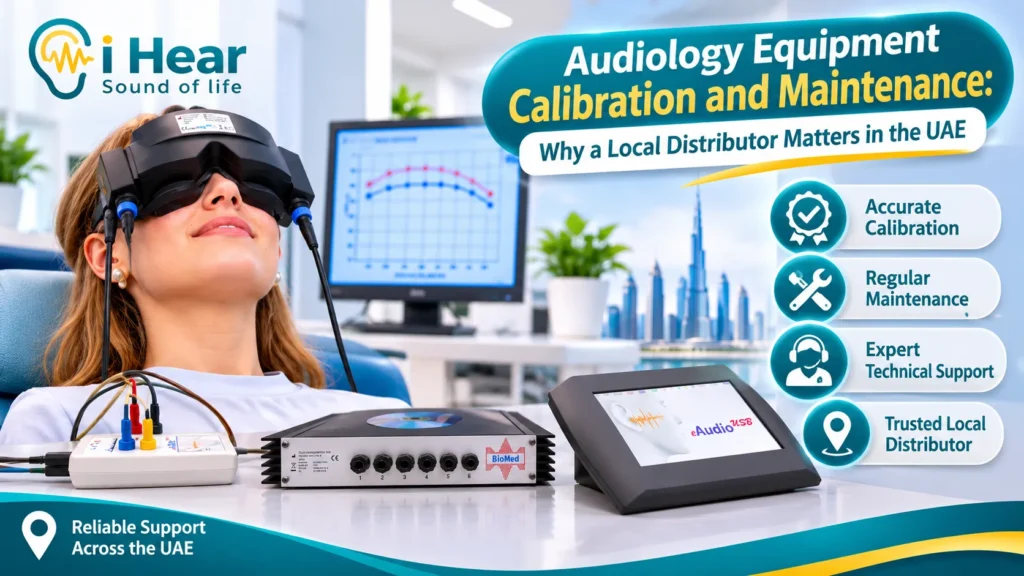
Calibration is the comparison of a device’s measurements with known reference values, confirming that they fall within permitted tolerances and correcting them if they drift. For audiology equipment this means that a device which is supposed to produce a 1000 Hz tone at 40 dB HL must actually produce it at the patient’s ear, no louder and no softer.
Because an audiometer measures hearing thresholds relative to an internationally agreed reference zero, audiometer calibration checks several things together:
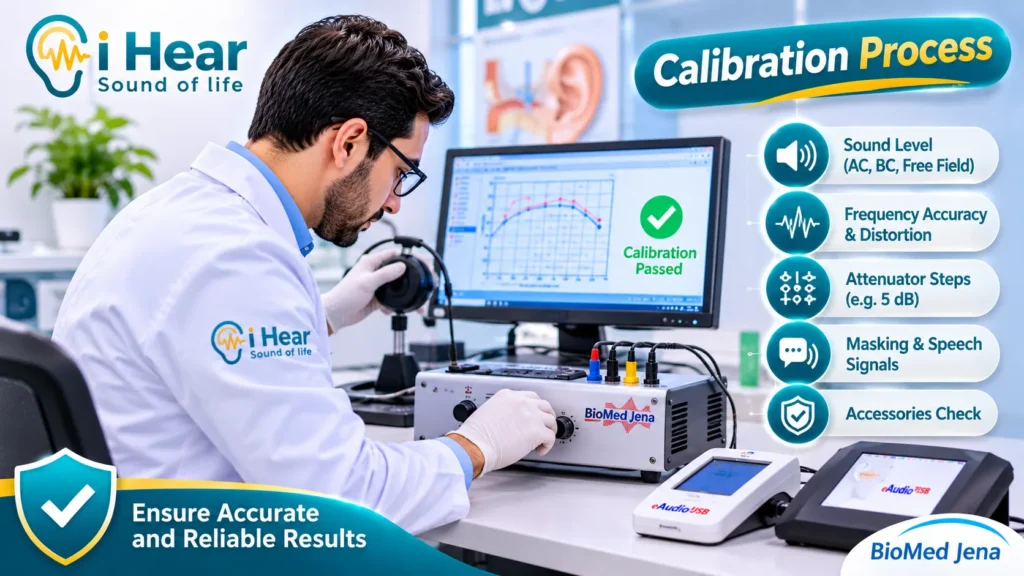
- The sound level delivered by air-conduction earphones, the bone vibrator and the free-field loudspeakers at each frequency.
- Frequency accuracy and freedom from distortion.
- The accuracy and steps of the attenuator (for example, 5 dB steps).
- The performance of masking and speech signals, where applicable.
- The condition of accessories: cables, cushions and the patient response button.
These checks rest on international standards, including the ISO 389 series for reference levels, IEC 60645-1 for audiometer specifications, ISO 8253-1 for audiometric test methods and ANSI S3.6 in the US market. According to our audiology diagnostic devices page, the BioMed Jena devices we supply are certified to DIN EN 60645, IEC 60601 and Directive 93/42/EEC.
Calibration is not limited to audiometers. A tympanometer (a middle ear analyser) also needs its pressure and compliance accuracy verified. The eTYMP USB specifications, for example, list a pressure accuracy of ±5% or 10 daPa and a compliance accuracy of ±5% or 0.1 ml. Otoacoustic emissions (OAE) devices and auditory brainstem response (ABR) systems need their stimuli, probes and electrodes verified too.
Why Does Audiometer Calibration Matter for Every Clinic and Hospital?
Almost every audiology decision starts with the audiogram. If the audiometer drifts, every decision that follows drifts with it:
- Inaccurate diagnosis: hearing loss may appear that does not exist, or a real loss may be hidden. A small error in level can move a result from one degree of hearing loss to another.
- Hearing aids programmed on inaccurate numbers: a hearing aid is programmed from the audiogram. If the results are off, the amplification comes out too high or too low, and the patient complains of echo or of not hearing well. The fault may even be blamed on the hearing aid when it lies in the audiometer. You can read how everything starts with an accurate test in our guide on how to choose the right hearing aid.
- Wrong decisions in newborn and child screening: early follow-up and referral depend on reliable devices, and errors mean delay or unnecessary worry.
- Occupational hearing programmes: testing employees exposed to noise requires equipment that meets the standards. In Abu Dhabi, for example, the OSHAD occupational noise code of practice (CoP 3.0), as we cite on our page, requires pure-tone air-conduction audiometry for employees exposed to 85 dB(A) or more, using audiometers that meet ANSI S3.6-2010 or ISO 8253-1:2010. Requirements differ between emirates, so check with your own authority.
- Reputation and accountability: an up-to-date calibration record and a clear certificate protect the clinic during audits and in front of patients.
Types of Calibration: Electroacoustic, Biological and Daily Checks
When someone says “we calibrated the device”, people can mean different things. It helps to separate three levels that complement each other, and none of which replaces the others:
Type | What it is | Who does it | When |
|---|---|---|---|
Daily check (listening check) | Listening to the tones in each ear and checking cables, buttons and the absence of crackle or noise | The audiologist or technician | Every day before the first patient |
Biological check | Testing a person with known normal hearing from your team and comparing the result with a recorded baseline | Clinic staff | Periodically, according to the clinic’s programme, and after moving the device |
Electroacoustic calibration | Actual measurement with reference instruments such as acoustic couplers, an artificial ear and a sound level meter | An engineer or a qualified calibration body | Commonly once a year, and after any repair |
The biological check is useful because it flags a problem quickly between calibrations, but it cannot replace electroacoustic calibration: it does not measure level precisely, it only reveals a large deviation. Electroacoustic calibration needs reference equipment and knowledge of the standards, so it is usually carried out by the authorised distributor or a qualified calibration body, and it ends with a certificate showing the measured values and whether they comply.
How Often Should Audiology Equipment Be Calibrated?
This question comes up constantly, and the honest answer is that two parties set the interval: the manufacturer, who states the recommended period in the device manual, and the health or regulatory authority that licenses your facility. The common international practice is a full electroacoustic calibration once a year, with a daily listening check in between, and many references in this field say the same. We do not state a fixed interval for a particular device here, so ask iHear for the calibration schedule that applies to your BioMed Jena device.
Whatever the schedule says, recalibrate immediately in these cases:
- After the device, an earphone or the bone vibrator is dropped or knocked.
- After replacing an earphone, probe, cable or any acoustic component.
- After a repair or a major software update.
- After moving the device to another room or building.
- When results look doubtful: repeated odd results, an unexplained difference between ears, or a failed biological check.
Remember also that test accuracy depends on the noise level in the test room. A device that is perfectly calibrated in a noisy room still gives inaccurate results.
Audiometer Maintenance: What the Clinic Team Does and What Needs a Specialist
Regular maintenance does not replace calibration; it is what keeps calibration valid. It has two levels: what the clinic team can do itself, and what needs a specialist.
Daily and weekly maintenance by the clinic team
- Inspect cables, connectors and cushions for cracks, kinks or wear.
- Clean probes and the tips of the tympanometer and OAE devices according to the manufacturer’s instructions and remove wax and debris. A blocked probe is one of the most common causes of wrong readings.
- Test the patient response button and make sure it works.
- Listen to the tones in each ear for crackle, noise or a difference between ears. This is the daily listening check.
- Watch the test room: background noise, temperature and humidity. The eTYMP USB specifications, for instance, list an operating range of 10°C to 40°C and humidity up to 90%.
- Update the software and back up the patient database. The manufacturer states that free online software updates are available for eAUDIO.
Preventive maintenance by a specialist
- Internal inspection of the device, amplifiers and connectors.
- Electroacoustic calibration and a certificate of results.
- Replacement of consumables such as probe tips, cushions and cables.
- Software updates and checks that they are compatible with the operating system.
- Documentation of everything in a log for each device.
Corrective maintenance, after a failure, is almost always more expensive and slower than preventive maintenance. A single fault in the clinic’s only audiometer means testing stops until the device comes back.
Calibration and Maintenance for Each BioMed Jena Device
Each device has its own characteristics. These practical notes cover the devices we supply to clinics and hospitals, and they come from the manufacturer’s specifications published on our audiology diagnostic devices page.
eAUDIO USB audiometer
The eAUDIO USB audiometer is a computer-based two-channel audiometer with three active free-field channels for loudspeakers. That means its calibration covers several paths: air-conduction earphones, the bone vibrator and the free-field speakers. Make sure the calibration certificate covers everything you actually use in your clinic, not just part of it.
eTYMP USB middle ear analyser
In the eTYMP USB middle ear analyser, the key calibration values are stored in the probe itself, and the probe is small, light and easy to clean. Its specifications list a pressure accuracy of ±5% or 10 daPa and a compliance accuracy of ±5% or 0.1 ml, which are the values a calibration technician verifies. Maintenance focuses on a clean probe and an intact small tube that carries pressure.
eABR USB auditory brainstem response system
The eABR USB system selects the appropriate calibration values automatically, according to the manufacturer, and includes automatic electrode impedance control. Its maintenance therefore focuses on electrodes, cables and insert earphones, the parts that wear with daily use.
eOAE newborn hearing screening device
The eOAE device is portable, with a probe that is easy to clean and sterilise, and a 3880 mAh battery that supports at least 400 tests according to the specifications. Because it is used on newborns, what matters most is cleaning and sterilisation according to your facility’s protocol, periodic probe checks, and making sure the battery is fully charged before screening rounds.
AudioBox free-field amplifier
The AudioBox extends an audiometer for free-field testing of children, and each input channel can be calibrated at up to 50 frequency points. Calibration is therefore a core part of setting it up, and it should be rechecked whenever the loudspeaker positions or the room change.
eDM Diagnostic Manager software
The eDM software gathers the results of BioMed Jena devices in one database and lets you launch AnyDesk remote support directly from inside the program. Many software problems can therefore be solved with a call and a remote session, without a site visit.
What Happens When Calibration and Maintenance Are Neglected?
The trouble with skipping calibration is that it makes no noise at first. The device keeps working and gives numbers that look reasonable, until the problem surfaces months later as a complaint or an audit finding:
- Unreliable test results, forcing the audiologist to repeat tests or doubt earlier records.
- Errors in hearing aid fitting, which affect patient satisfaction and the clinic’s reputation.
- Newborn and child screening you cannot rely on, so referral is delayed or happens unnecessarily.
- Sudden downtime because of a fault that preventive maintenance could have caught.
- Findings from regulators if up-to-date calibration certificates and maintenance records are missing.
- Higher long-term cost, because emergency repair costs more than scheduled maintenance.

Why Is a Local Authorised Distributor Important for Calibration and Maintenance?
Now to the question in the title. Precision medical devices are not finished business at delivery; the relationship starts there. These are the reasons a nearby authorised distributor makes a practical difference rather than a marketing one.
1. Fast response instead of shipping abroad
When a device needs calibration or repair, sending it to the manufacturer’s country means packing, transport, customs clearance and a place in the workshop queue, and the clinic is without the device throughout. With a local distributor the matter is handled inside the country. Our pages state that technical support and maintenance are available locally in the UAE, without the need to ship the device to Germany.
2. Genuine spare parts and accessories
Probe tips, cushions, cables, earphones and bone vibrators are consumables that you will certainly need to replace. As the authorised distributor, iHear supplies spare parts locally, as stated by the manufacturer’s distribution arrangements. Relying on non-original parts can affect calibration itself, because calibration values are defined for each specific component.
3. Hands-on training, face to face
A written manual is not enough. Your team needs someone to show them on the device itself, in their own clinic, in their own language. That is what we offer with a purchase, and we cover it in the training section below.
4. Knowledge of UAE health authority requirements
Requirements differ between the Ministry of Health and Prevention, the Department of Health – Abu Dhabi and the Dubai Health Authority. A distributor that works in this market every day knows which documents are usually requested, such as device data, calibration certificates and maintenance records. To confirm the current registration status and paperwork for a specific device, ask iHear directly.
5. One accountable party from sale to service
When you buy from an unauthorised source and the device fails, the hunt for who is responsible begins: the seller, the intermediary or the manufacturer? An exclusive authorised distributor is a single point of contact that knows your device and its history.
6. Remote support and on-site visits
Many problems, especially software ones, are solved remotely through a support session, as with the eDM software. What cannot be solved remotely needs a technician who is present in your country.
This table summarises the difference between the two options:
Comparison | Local authorised distributor | Unauthorised source or direct import |
|---|---|---|
Technical support | Local, inside the UAE | Often by correspondence with an overseas party |
Calibration and maintenance | Inside the country, without shipping to the manufacturer | May require shipping the device |
Spare parts | Available locally from the authorised source | May be hard to obtain or to verify as genuine |
Training | Hands-on at your clinic | Limited or unavailable |
Responsibility | One point of contact | Spread across several parties |
Documents | Device paperwork available on request | Needs separate follow-up |
After-Sales Service: What to Expect and What to Ask Before You Buy
Real after-sales service shows in the details, not in general statements. Before you sign a contract to buy audiology equipment, put these questions to the distributor and get the answers in writing:
- What is the scope and length of the warranty for each device and accessory? What is excluded?
- Who carries out calibration? Which reference equipment is used, and do you receive a calibration certificate with the results?
- What calibration schedule does the manufacturer recommend for my device?
- How long does a repair usually take? Is a temporary replacement device available during service?
- Are consumable spare parts available locally?
- Which support channels exist? Phone, WhatsApp, remote support or on-site visits?
- Does the purchase include training? For whom, and are refresher sessions available later?
- Which documents are available for my device (technical data, conformity, registration status with the health authority)?
- Are annual service contracts available covering calibration and preventive visits?
As we state, iHear provides clinics and hospitals with sales, training, technical support and spare parts locally. Warranty details and the calibration scope available for a particular device vary by type and model, and our team confirms them when you request a quote through the contact page.
Audiology Equipment Training: An Investment That Protects Your Results
A first-class device in untrained hands gives mediocre results. Many testing errors come from the way the device is used rather than from the device: a probe that is not seated properly, earphones placed incorrectly, unclear instructions to the patient, or a misread results curve. That is why audiology equipment training is part of quality, not an add-on to the deal.
Good training on devices such as the audiometer, tympanometer, OAE and ABR systems usually covers:
- Basic operation: preparing the device and the patient, and placing probes, earphones and electrodes.
- Test protocols: choosing the right test for each case, and testing children and newborns in a way that suits each age.
- Interpreting results: understanding the audiogram, tympanometry curves and OAE and ABR results.
- Daily checks and light maintenance: listening checks, cleaning and replacing consumables, which extends the life of the calibration.
- Using the software: organising patient files and exporting reports with eDM.
- Troubleshooting common problems: what to do when readings change and when to call support.
As stated on our pages, iHear provides hands-on training with a purchase, together with ongoing technical support, and BioMed Jena devices are used in medical colleges and teaching hospitals to train students. Remember that training for new staff and refresher sessions belong in your quality programme as well.
How to Build a Calibration and Maintenance Programme for Your Clinic in Six Steps
You do not need a complicated system. Start with these simple steps:
1. Register your assets. For each device, note the model, serial number, purchase date and accessories (earphones, bone vibrator, probes).
2. Adopt a calibration schedule. Ask the distributor for the manufacturer’s recommended interval, and put the dates in the clinic calendar weeks ahead so service never stops.
3. Use a daily check sheet. Who performs the listening check, when, what it covers and where it is recorded.
4. Create a biological baseline. Record the result of a normal-hearing tester from your team to compare against later, and repeat it after every calibration or move.
5. Document every event. Drops, part replacements, repairs and calibration results. This log is the first thing requested in an audit.
6. Agree a contact and a response time with your distributor. Keep the support number within reach of the whole team.
What Does iHear Offer Your Clinic or Hospital?
At iHear we are the exclusive authorised distributor of German BioMed Jena devices in the UAE. We supply clinics, hospitals and audiology centres with an integrated range: audiology diagnostic devices, including audiometers, tympanometers and OAE and ABR systems, and vestibular and balance diagnostic devices, all running from one management software. With every device we provide sales, training, technical support and after-sales service locally, from our branches in Al Ain and Abu Dhabi and across all the emirates. To learn more about us, read about iHear.
Frequently Asked Questions About Audiology Equipment Calibration and Maintenance
Conclusion: An Accurate Device Today, Nearby Support Tomorrow
Audiology equipment calibration is not a formality. It is what makes the number on the screen honest, and what puts diagnosis, hearing aid fitting and referral decisions on solid ground. It consists of a daily check, a biological check and a periodic electroacoustic calibration, supported by preventive maintenance, organised records and a trained team. And a local authorised distributor shortens the road: nearby technical support, spare parts, hands-on training and an after-sales service that knows your device.
If you are equipping a new clinic or reviewing the maintenance programme of an existing one, get in touch and we will build a calibration and maintenance plan with you that suits your equipment.
Request a quote or a technical consultation now on WhatsApp or through the contact page:
- Abu Dhabi: Sultan Bin Zayed the First Street (Muroor Road), Building 1210, Offices M6, tel. 02 681 3841
- Al Ain: Al Humaireh, 136 Khalifa Bin Zayed Street, Mezzanine 2, Office 3, tel. 03 768 5563
For more information
Feel free to contact us anytime. Our team is always ready to help you.

No comment