VNG/vHIT Combi Mask: One Video Goggle for Both VNG and vHIT Testing

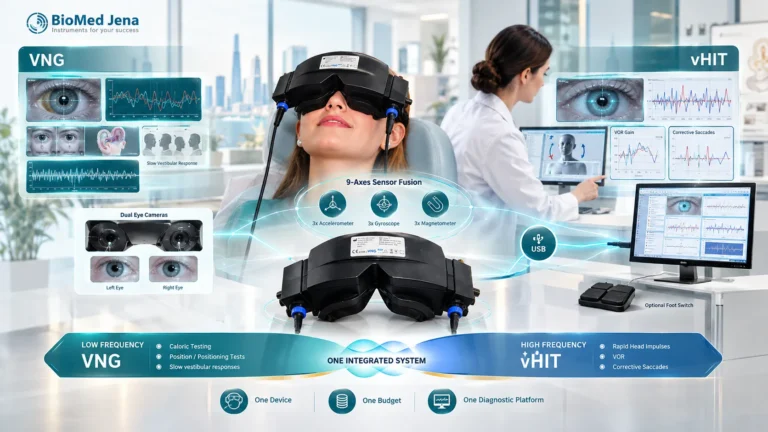
The VNG/vHIT Combi Mask is BioMed Jena’s combined video goggle that brings two tests, video nystagmography (VNG) and the video head impulse test (vHIT), into one mask, so a clinic does not need to buy and maintain a separate mask for each test. BioMed Jena is a German company.

The mask uses 9-axis sensor fusion and two separate cameras that record each eye on its own, and it is USB-powered. A foot switch can be added for hands-free use. With one device, a single vestibular diagnostic unit can cover both the lower-frequency response (VNG, through caloric and positioning tests) and the high-frequency response (vHIT, through fast head impulses).

iHear is the exclusive authorized distributor of BioMed Jena in the UAE. It offers the mask to hospitals and ENT centers that want to build an integrated vestibular diagnostic unit without doubling the cost of equipment.

Why Combine VNG and vHIT in Vertigo Testing?

The two tests measure the response of the vestibular system in two different ranges. VNG records a relatively slow response (caloric irrigation, changes in head position, and spontaneous nystagmus), while the vHIT measures a very fast response to a sudden head movement that other tests do not reproduce. A patient’s result may be normal in one test and abnormal in the other, so using only one test can leave a gap in the assessment. The Combi Mask can run both tests in one session, without scheduling two separate appointments or moving the patient between two devices.

A note on eye recording: some patients have an artificial eye or a separate eye movement disorder in each eye, and a goggle that records only one eye may not be enough to assess them. A binocular goggle records each eye with its own camera, at the same time, which allows each eye to be analyzed separately when needed.

Three ways to combine VNG and vHIT testing, and what each involves
Design How it works What you give up for it
Two separate goggles One goggle for the VNG test and another for the vHIT test, with the two combined at the software and patient-file level Two pieces to buy, maintain, and clean, and a goggle swap during the session
Monocular vHIT goggle One camera that is moved between the eyes, lightweight and designed for head impulses Only one eye is recorded at a time, so you may need to switch to a binocular goggle when both eyes' movements must be recorded together
Binocular combined mask (BioMed Jena's design) One mask with two cameras that performs both tests, plus the additional modules One piece, one training, and one space, in exchange for a mask that is somewhat heavier than a dedicated monocular goggle

Designs and specifications differ by manufacturer and model. Check each manufacturer's current information, and contact iHear to discuss the setup that suits your clinic.

Why Use One Mask Instead of Two Separate Masks for VNG and vHIT?
01
Capital cost: Two separate masks can mean paying twice for the cameras and sensors, and maintaining each mask on its own.
02
Clinical workflow: Swapping masks between patients, depending on the test requested, can slow down the daily workflow, especially in busy clinics.
03
Workspace and storage: One mask means one calibration, one storage box, and one point of maintenance, instead of dealing with two separate systems.
A Note on the Market
A combined mask for VNG and vHIT is a design that several manufacturers now offer. BioMed Jena's 2020 datasheet already lists a combined video mask that can be used for tests in darkness or with visual stimulation. Designs and options differ by manufacturer and model, so compare each manufacturer's current information.
VNG/vHIT Combi Mask: One Video Goggle for Both VNG and vHIT Testing

How Does the VNG/vHIT Combi Mask Work?

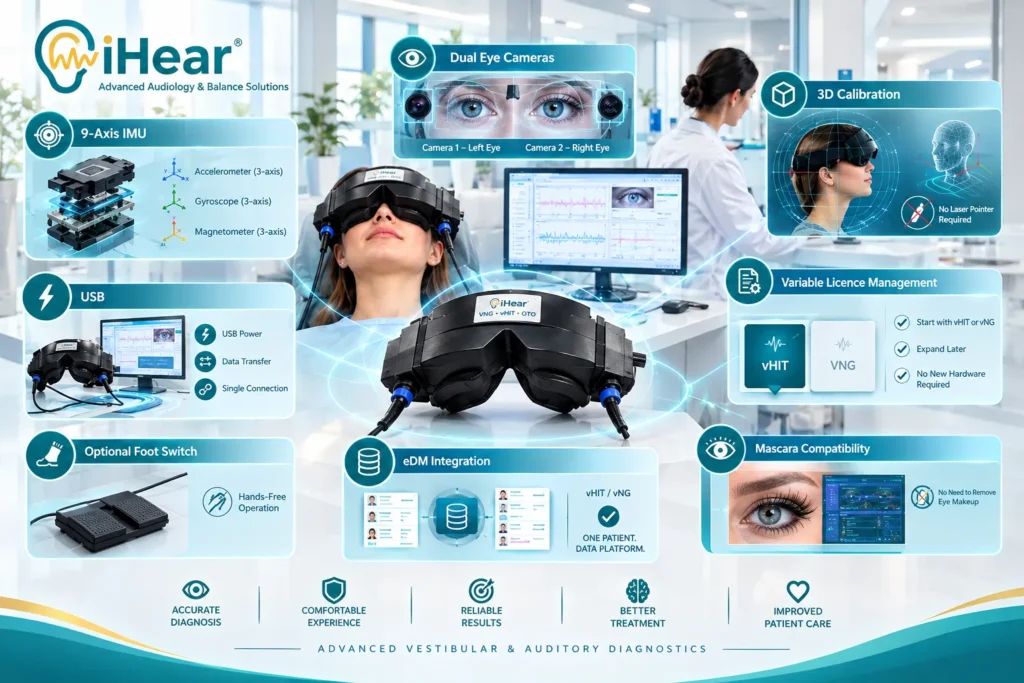
9-Axis Sensor Fusion 01
Combines the data of several motion sensors (acceleration, rotation, and magnetic field) to track head movement during the fast head impulses of the vHIT.
Binocular Recording With Two Cameras 02
Each eye is recorded by its own camera, which allows binocular analysis in VNG tests.
USB Power 03
The system is USB-powered, so it runs from the USB connection to the computer.
Foot Switch 04
A foot switch can be added for hands-free operation during caloric testing or manual head impulses.
Darkness or Visual Stimulation 05
The mask can be used in darkness (for example for spontaneous nystagmus) or with visual stimulation (for example for optokinetic tests).
Focusable Video Image 06
The video image is focusable and can be adjusted both horizontally and vertically on the eye of each patient.
Lightproof Cushion 07
A soft cushion that gives a comfortable, lightproof fit to the face, so the patient is comfortable and outside light does not reach the cameras.
Integrated Operational Efficiency 08
An integrated engineering design that supports stable signals, quick setup, and reliable operation for advanced clinics.
Mascara Option
Like the related devices (the eVNG and the eHIT), the Combi Mask is described with a mascara option that allows patients wearing eye makeup to be tested without removing it. Ask iHear to confirm the option for your configuration.

Which Tests Can Be Performed With the Combi Mask?

With the Combi Mask, a diagnostic center can perform a range of vestibular tests without changing the goggle:
Vestibular tests that can be performed with the Combi Mask
Category Available tests
eVNG software module(lower-frequency tests)
Spontaneous nystagmus, caloric test, position and positioning tests, optokinetic tests, smooth pursuit test, rotational testing (with the VESTAR 100 USB rotary chair connected), and the manual pendulum test (MPT, optional).
eHIT software module(high-frequency tests)
Head impulse test (vHIT) of all six semicircular canals, which records the head impulse step of the HINTS exam quantitatively (the HINTS exam is performed and interpreted by the clinician), and the optional SHIMP test.

Availability and configuration of each module should be confirmed with iHear.

VNG/vHIT Combi Mask Key Features

Stable, Binocular Video Goggle
A stable binocular video goggle with a mask cover, with 9-axis sensor fusion (9-axis IMS) for tracking head movement.
Independent Binocular Recording
Both eyes are recorded with two separate cameras instead of one fixed camera, so each eye can be analyzed separately when needed.
USB Power
The system is USB-powered, so it runs directly from the USB port.
3D Calibration
Real World 3D Calibration, which can be done without an external laser pointer (no laser pointer required).
Foot Switch (Optional)
An optional foot switch for hands-free operation during clinical tests.
Additional Mascara Option
An option for testing patients who wear eye makeup without removing it. Ask iHear to confirm the option for your configuration.
Flexible Licensing (Variable Licence)
Start with a vHIT or a VNG licence only, then expand later to the other test without buying a new mask or new hardware.
Compatible With the eDM
Compatible with the eDM (Diagnostic Manager), which manages and stores all patient data from one central database.

Licensing options and configurations should be confirmed with iHear.
VNGvHIT Combi Mask One Video Goggle for Both VNG and vHIT Testing

Who Is the VNG/vHIT Combi Mask For?

Before a hospital or clinic considers equipment like this, its patients go through a search of their own: they look up their symptoms online. Knowing the questions they ask helps a clinic explain why testing matters. Common questions include:
What causes dizziness, and when should I see a doctor?
A common question. General descriptions of symptoms are easy to find, and the next question is usually which test is done, and by whom.
Benign paroxysmal positional vertigo (BPPV)
BPPV is one of the most common causes of vertigo, and position and positioning tests, such as those in the eVNG USB software, are used in assessing it.
Which doctor should I see?
Patients are often unsure whether to see an ear, nose, and throat (ENT) doctor or a neurologist, and which test is needed.
Most dizziness is not dangerous, but some is
Most dizziness has a benign cause. A smaller share has a serious cause, such as stroke, which the clinician looks for with warning signs and the HINTS exam. The eHIT USB records the head impulse step of that exam quantitatively.
Why This Matters for a Combined Mask
A center that offers both tests can follow the patient's questions from the common, benign cause (BPPV, assessed with VNG position tests) to the question of a serious cause (where the head impulse step of HINTS is recorded with the vHIT), without referring the patient elsewhere for equipment reasons. The clinician interprets all the results. A clinic can also use these questions to explain to patients why an accurate assessment matters, rather than guessing or waiting.

VNG/vHIT Combi Mask vs. Other Combined Goggle Systems: What to Compare

VNG/vHIT Combi Mask compared with other combined goggle systems
Criterion VNG/vHIT Combi Mask (BioMed Jena, through iHear) Other combined goggle systems
Country of origin Germany Varies by manufacturer
Design for combining the two tests One mask designed to perform both tests. BioMed Jena's 2020 datasheet already lists a combined video mask. Some are one mask for both tests, and others add the second test as an optional upgrade to a basic system. Check each manufacturer's design.
Eye recording Two separate cameras, one for each eye Depends on the model
Unified data management platform Compatible with the eDM, which manages the data of the BioMed Jena audiology and vestibular devices listed as compatible Depends on the manufacturer's software and its licence
Local distributor in the UAE iHear, the exclusive authorized distributor of BioMed Jena (Al Ain and Abu Dhabi) Ask each manufacturer for its UAE distributor
Arabic content and local support Local technical support and training in Arabic and English, from iHear Ask the manufacturer or its distributor

BioMed Jena values are from its datasheet and catalogue, and from iHear's services. Designs, options, and licensing of other systems differ by manufacturer and model and change over time, so check each manufacturer's current information. The right system depends on your protocols, patient volume, and budget; contact iHear to discuss it.

VNG/vHIT Combi Mask: Compatible Modules and Technical Specifications

The VNG/vHIT Combi Mask from Germany’s BioMed Jena is a vestibular testing goggle that records both eyes with two independent cameras and performs video nystagmography (VNG) and the video head impulse test (vHIT) with the same piece of hardware. It is available in the UAE through iHear, from its headquarters in Al Ain.

Designs for combining VNG and vHIT testing
Design In the market Eye recording
Two separate goggles, combined in software Offered by some manufacturers; check each manufacturer's design Depends on the model
One monocular goggle for both tests Offered by some manufacturers; check each manufacturer's design One eye in both tests
One binocular mask for both tests BioMed Jena: this mask Both eyes in both tests

Designs differ by manufacturer and model and change over time, so check each manufacturer's current information.

Modules and tests listed for the Combi Mask
Module Test
eVNG USB Nystagmus, position and positioning tests, caloric testing, optokinetic tests
eHIT USB Head impulse test for the six semicircular canals
eDVA USB Dynamic visual acuity
eFRENZEL USB Positioning maneuvers with synchronized video
ePOSTURO USB / MPT Posture analysis and the manual pendulum test

Ask iHear which of these modules are available for your facility and which run with the Combi Mask.

Combi Mask technical specifications
Item Details
Configuration Binocular, with two independent cameras
Motion sensors 9-axis sensor fusion
Sample rate Binocular, 100 Hz
Connection USB-powered, with no other computer hardware required
Hot mirror Adjustable in 3 steps
Consumables Replaceable cushion and foam
Software Windows 10/11

Specifications are from BioMed Jena's datasheet and catalogue. Download the eVNG USB datasheet (PDF).

FAQ about the BioMed Jena VNG/vHIT Dual Examination Mask
The VNG/vHIT Combi Mask is BioMed Jena's combined video goggle for video nystagmography (VNG) and the video head impulse test (vHIT). It records both eyes with two independent cameras, and one mask performs both tests, so a clinic does not need to buy and maintain a separate mask for each test. It is available in the UAE through iHear.

The clinical aim is the same: testing with VNG and with vHIT. The difference is the hardware. The Combi Mask brings both tests into one mask, instead of one mask for the eVNG and another for the eHIT, which can reduce the initial investment and simplify maintenance and calibration. The details depend on the configuration, so ask iHear.

Yes. BioMed Jena lists a combined video mask that can be used for tests in darkness or with visual stimulation, and the eHIT and eVNG can be combined in one system on request. The test is selected in the software.

With the eVNG software: spontaneous nystagmus, the caloric test, position and positioning tests, optokinetic tests, the smooth pursuit test, and rotational testing with the VESTAR 100 USB rotary chair connected, plus the optional manual pendulum test (MPT). With the eHIT software: the head impulse test of all six semicircular canals, and the optional SHIMP test. Ask iHear to confirm the availability of each module.

Some dedicated vHIT goggles are lighter and record one eye, to reduce slippage during head impulses. The Combi Mask records both eyes and covers a wider range of tests with one piece, in exchange for a mask that may be somewhat heavier. Designs differ by manufacturer and model.

The eHIT USB is BioMed Jena's vHIT system. The Combi Mask adds VNG testing on the same mask, so one goggle can be used for both tests.

Sensor fusion combines the data of several motion sensors (acceleration, rotation, and magnetic field) to track head movement during the fast head impulses of the vHIT. The mask also records both eyes with two cameras for binocular VNG. The datasheet we reviewed does not give accuracy figures for the head-tracking sensors, so ask iHear for the specifications.

Yes, when needed. The Combi Mask records each eye with its own camera, which allows each eye to be analyzed separately, for example in a patient with an artificial eye or a different eye movement disorder in each eye. The clinician decides how to test and interpret the results.

According to iHear's product information, the Combi Mask is offered with variable licensing, so you can start with a vHIT or a VNG licence and expand later to the other test without buying a new mask or new hardware. BioMed Jena's datasheet also lists the eHIT and eVNG in one system on request. Confirm the licensing options with iHear.

It depends on the hardware version you have now. Contact iHear to assess the possibility of an upgrade based on the model and version you own.

BioMed Jena's eVNG datasheet states that its improved algorithm can extract the pupil from the video stream even if the patient wears make-up, and the eHIT datasheet lists an additional mascara option so that patients with eye makeup on can be tested without removing it. Ask iHear to confirm the option for the Combi Mask in your configuration.

BioMed Jena lists the eHIT USB mask as suitable for adult and pediatric patients. The Combi video goggle has a soft cushion and a video image that can be focused and adjusted horizontally and vertically on the patient's eye. Whether testing suits a particular child depends on the child's age, ability to cooperate, and the clinician's judgment.

According to iHear's product information, the Combi Mask uses Real World 3D Calibration, which does not need an external laser pointer. Ask iHear to confirm this for your configuration.

BioMed Jena's eVNG datasheet states that the eVNG USB software can remote control the KALORIstar Arctic air irrigator, so the test can be run with one button. The KALORIstar CT is BioMed Jena's newer air caloric irrigator, so ask iHear about its compatibility with your configuration.

BioMed Jena's eVNG datasheet, which includes the Combi video goggle, states that no other computer hardware is required, that the system is USB-powered, and that the software runs on Windows 10/11. Ask iHear to confirm the requirements for the Combi Mask in your configuration.

Yes. BioMed Jena's catalogue lists the eVNG USB and the eHIT USB among the devices compatible with the eDM (Diagnostic Manager), so VNG and vHIT results can be managed in one patient database, together with the data of other BioMed Jena devices.

HINTS (Head Impulse, Nystagmus, Test of Skew) is a three-step bedside eye-movement examination for patients with acute vestibular syndrome. In the reference study (Kattah et al., Stroke, 2009), its findings were 100% sensitive and 96% specific for stroke when performed by a neuro-ophthalmology specialist in patients with continuous vertigo with nystagmus. The Combi Mask can record the head impulse step quantitatively with its vHIT module, but it is not a stroke test and does not replace the clinical examination or imaging. Sudden vertigo with weakness, trouble speaking, double vision, numbness, or a severe sudden headache needs urgent medical care. See the eHIT USB page.

Centers that perform both types of tests regularly, such as comprehensive ENT clinics and neurology emergency departments, may benefit most, because they would not need to buy and maintain two masks. The decision depends on your protocols, patient volume, and budget.

A combined mask for VNG and vHIT is a design that several manufacturers now offer. BioMed Jena's 2020 datasheet already lists a combined video mask. Designs, options, and licensing differ by manufacturer and model and change over time, so compare each manufacturer's current information. For buyers in the UAE, local support also matters: iHear is the exclusive authorized distributor of BioMed Jena and provides local technical support and training.

iHear (ihear.ae) is the exclusive authorized distributor of BioMed Jena devices in the UAE, headquartered in Al Ain with a branch in Abu Dhabi. To request a quote or a consultation, contact iHear on WhatsApp at +971 50 208 4569.

The price depends on the configuration, for example which test modules and licences you choose and whether you add a foot switch or other options. Contact iHear for a quote based on your facility's needs.

iHear offers technical support and training for BioMed Jena devices in the UAE, in Arabic and English, from its offices in Al Ain and Abu Dhabi. Ask iHear what applies to your purchase, including the warranty and service terms.

BioMed Jena's eVNG datasheet, which includes the Combi video goggle, lists the applied standards EN 60601-1 / 1-1 / 1-2 and the Medical Device Directive (MDD). CE marking is a European conformity marking, and use in the UAE is subject to the requirements of the relevant UAE health authority, so ask iHear for the conformity documents and the current registration status for your facility.
دون عنوان 200 x 200 بيكسل

For more information

Feel free to contact us anytime. Our team is always ready to help you.
VNG/vHIT Combi Mask: One Video Goggle for Both VNG and vHIT Testing