eHIT USB Video Head Impulse Test (vHIT) System: Analysis of All Six Semicircular Canals
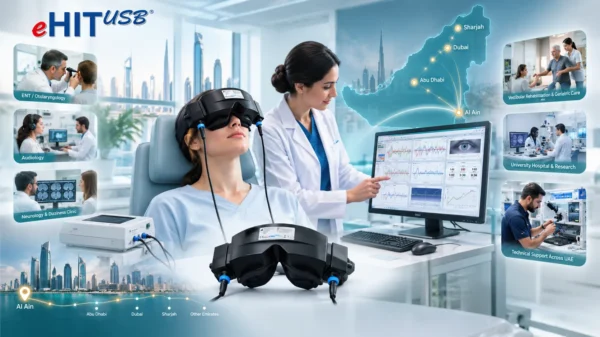
The eHIT USB is BioMed Jena’s video head impulse test (vHIT) system, developed to perform a detailed quantitative analysis of all six semicircular canals of the inner ear. BioMed Jena is a German company. The system uses specially designed, lightweight goggles with two fast, high-resolution 200 Hz cameras and 800 Hz 3-D inertial motion sensors (IMS), which give exceptional tracking of eye and head movement while the eye’s response to a sudden head movement is recorded.
The eHIT can show corrective (covert) saccades, small eye movements that are hard to see in a manual bedside examination. This is information that helps the clinician in assessing the cause of vertigo, for example telling a peripheral cause, such as vestibular neuritis, from a central cause, such as stroke, which is an urgent decision in the emergency department. The clinician interprets the results and decides on the diagnosis.
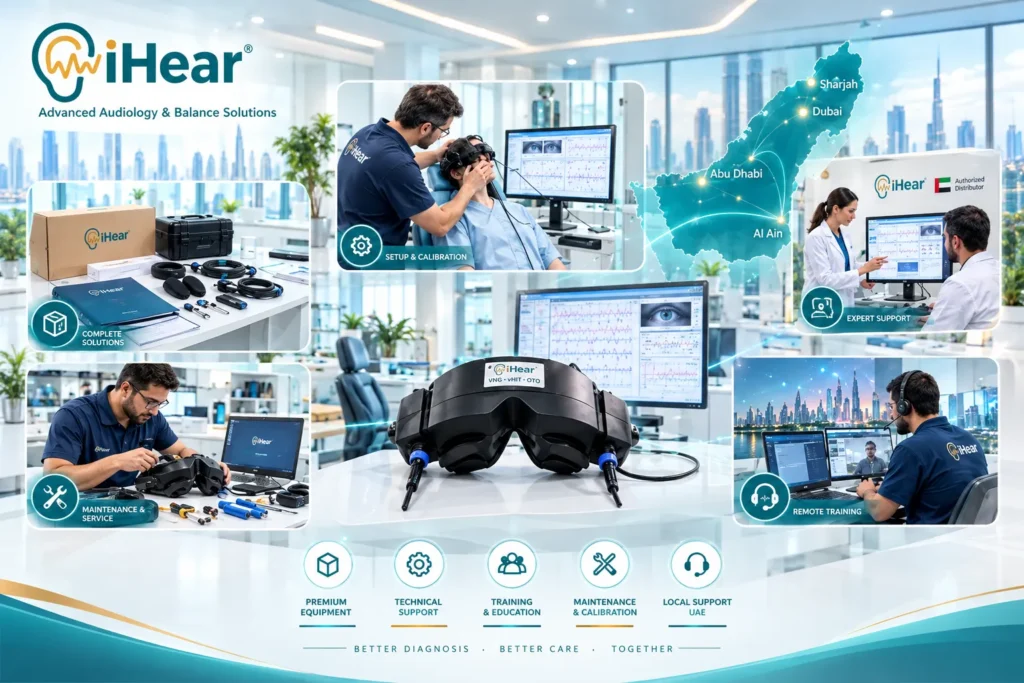
iHear is the exclusive authorized distributor of BioMed Jena in the UAE. It offers the eHIT to hospitals, emergency departments, ENT clinics, and neurology clinics that diagnose dizziness and vertigo.
What Is the Video Head Impulse Test (vHIT), and How Is It Different From VNG?
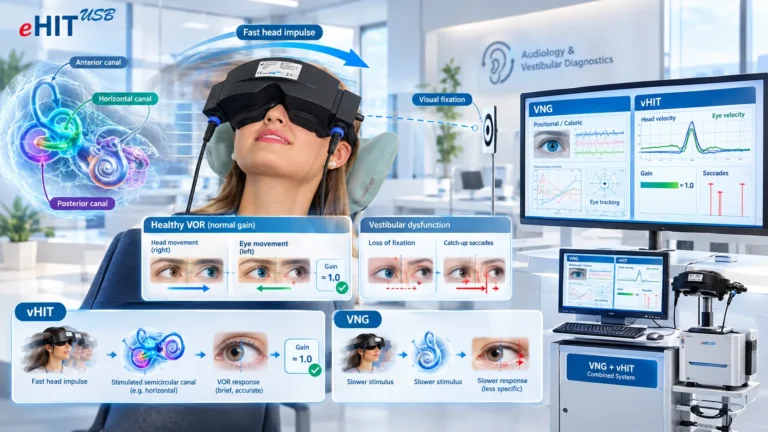
The vHIT works on a precise physiological principle: the canal being tested is always the one in the direction of the head impulse. A fast head turn to the right activates the right canal, and the opposite is true for a turn to the left. The same principle applies to the vertical (anterior and posterior) canals, which lie at about a 45° angle to the sagittal plane. When the vestibular system is working normally, the eyes move automatically in the direction exactly opposite to the head movement, and the gain between head and eye movement is close to 1. When a canal is not working properly, the patient loses the target, and corrective (compensatory) saccades appear.
The key difference from the eVNG: the eVNG assesses the vestibular system’s response to relatively slow stimuli (caloric irrigation and changes in head position), while the eHIT measures the response to a very fast head movement that other tests do not reproduce. The two are complementary tests and neither replaces the other, and BioMed Jena offers a VNG/vHIT Combi Mask that can perform both with one device.
How Does the eHIT USB Work? Testing the Six Semicircular Canals
The rule behind the device is simple: the canal being tested is always the one in the direction of the head impulse. When the head is turned to the right, the right canal is activated, and the opposite is true for a turn to the left. The same principle applies to the vertical canals, where the test uses the anterior and posterior planes of the canals, which lie at about a 45° angle to the sagittal plane.
| Plane | Head movement | Semicircular canal |
|---|---|---|
| Horizontal | Leftward | Left |
| Horizontal | Rightward | Right |
| LARP (left anterior, right posterior) | To the front | Left anterior |
| LARP (left anterior, right posterior) | To the back | Right posterior |
| RALP (right anterior, left posterior) | To the front | Right anterior |
| RALP (right anterior, left posterior) | To the back | Left posterior |
The impulse starts from the center position, randomly to the right or left, and then the head is slowly returned to the starting position. Advantage: the patient cannot predict the direction of the stimulus.
The head is moved slowly to one side and then turned quickly to the center position. Advantage: it is easier for a beginner examiner, because it gives more control over the angles of the impulse.
Results are displayed in real time. The gain is calculated for each attempt, and a healthy ratio between eye movement and head movement is close to 1. If only one side is affected, two separate clouds of dots appear on the graph.
In addition to showing the gain and the movement, the eHIT USB software offers a 3-D depiction of the eye response and a six-plane canalogram. Corrective saccades can show up as prominent peaks, which helps the clinician see a vestibular deficit visually.
eHIT USB Technical Specifications
| Item | Details |
|---|---|
| Test type | Video head impulse test (vHIT) for all six semicircular canals |
| Goggle | Binocular goggle with two cameras. With the double camera registration system, the recorded eye can be changed quickly without removing the goggle |
| Cameras | Two fast, high-resolution 200 Hz cameras |
| Motion sensors | Embedded 800 Hz 3-D inertial motion sensors (IMS), with 9-axis sensor fusion |
| Calibration | Automatic Real World 3D Calibration, with automatic eye centering |
| Software | Real-time results, automatic gain calculation, a 3-D depiction of the eye response, a six-plane canalogram, and a multilingual user interface |
| Connection | PC interface: USB 2.0, with replaceable cables |
| SHIMP test | Available as an additional option (Suppression Head Impulse Paradigm) |
| Control | Foot switch, for hands-free operation |
| Age group | Mask suitable for adult and pediatric patients |
| Computer requirements | Intel Core i5 or higher, 1920 × 1080 screen, and Windows (ask iHear to confirm the supported version) |
| Expandability | Can be upgraded with VNG, SVV, DVA, and Frenzel modules on the same platform |
| Replaceable parts | Cables, cushion, and foam |
| Country of origin | Germany: BioMed Jena GmbH, Jena |
eHIT USB Video Head Impulse Test System: Key Features.
Detailed quantitative analysis of all six semicircular canals.
Two fast, high-resolution 200 Hz cameras for recording eye movement.
Embedded 800 Hz 3-D inertial motion sensors (IMS) in the goggle, for exceptional tracking of the head and eyes together.
Double camera registration system, so the recorded eye can be changed quickly without removing the goggle from the patient.
Goggle optimized for robustness against artifacts when testing in both the horizontal and vertical planes.
Optional mascara feature, so patients wearing eye makeup can be tested without removing it, and still feel comfortable.
Real World 3D Calibration, with an innovative sensor technology that is easy, fast, and reliable, and shows the movement of the head in space in all axes in real time.
Real-time results, with the option to analyze and remove each impulse individually, and to record more impulses without repeating the whole test.
3-D depiction of the eye response and a six-plane canalogram. Corrective saccades can show up as prominent peaks in the graph.
Automatic eye centering.
Mask suitable for adult and pediatric patients, with an easy-to-use, multilingual user interface.
Can be upgraded later with VNG, SVV, DVA, and Frenzel modules, to extend the range of diagnosis on the same system.
Replaceable cables, cushion, and foam, for easy maintenance.
Foot switch, for hands-free operation during the test.
HINTS Exam: How the Head Impulse Test Helps Tell Stroke From Vestibular Neuritis
HINTS (Head Impulse, Nystagmus, Test of Skew) is a three-step bedside eye-movement examination used in patients with acute vestibular syndrome (sudden, continuous vertigo with nystagmus). It helps the clinician tell a central cause, such as stroke, from a peripheral cause, such as vestibular neuritis. The three steps are:
Horizontal head impulse test (HIT). In this setting, a normal result points toward a central cause, and an abnormal result points toward a peripheral cause.
Direction-changing nystagmus in eccentric gaze, which points toward a central cause.
Skew deviation, a vertical misalignment of the eyes caused by an imbalance of vestibular tone between the two sides. It is usually found with the alternate cover test, and it points toward brainstem involvement.
In the reference study (Kattah et al., Stroke, 2009;40:3504-3510), a normal horizontal head impulse test, direction-changing nystagmus, or skew deviation was 100% sensitive and 96% specific for stroke in patients with acute vestibular syndrome who had at least one stroke risk factor. The authors found the bedside examination more sensitive than early MRI with diffusion-weighted imaging. The examinations were performed by a specialist in neuro-ophthalmology, so results may differ in other settings, and HINTS applies to continuous vertigo with nystagmus, not to brief positional vertigo such as BPPV.
The eHIT USB records the head impulse step quantitatively. It calculates the gain automatically and can show corrective saccades, instead of relying on visual observation alone. The eHIT is not a stroke test, and the clinician interprets all the findings.
Sudden vertigo with weakness, trouble speaking, double vision, numbness, or a severe sudden headache needs urgent medical care and should not wait for a test.
What Features Does the eHIT USB Offer? A Look at Its Main Strengths
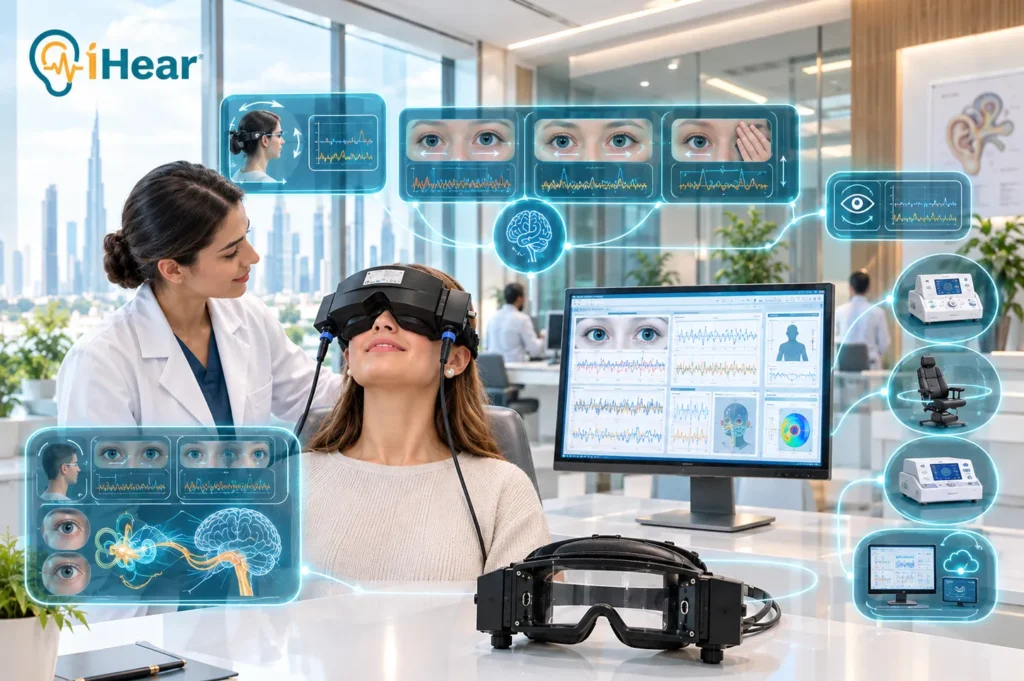
The embedded sensor technology gives a fast, reliable calibration that shows the movement of the head in space, in all axes, in real time. BioMed Jena also lists new opportunities in training, measurement, and diagnosis, for example for training new examiners.
The VNG/vHIT Combi Mask works in darkness or with visual stimulation, and records both eyes with two cameras. In practice, one device and one space in the clinic can cover both tests, which can matter for clinics with limited space or budget.
An additional option that allows patients wearing eye makeup to be tested without removing it, while still feeling comfortable, and without affecting pupil tracking.
The eHIT USB is compatible with the eDM (Diagnostic Manager), which brings the data of BioMed Jena devices into one patient database: the eVNG USB, eVEMP USB, KALORIstar CT, ePOSTURO USB, eDVA USB, and the audiology devices. The result is one diagnostic file for each patient, automatic PDF export, and a GDT interface included, with HL7 on request.
Clinical Uses of the Video Head Impulse Test
Vestibular neuritis: may be used to identify the affected side and to follow central compensation over repeated sessions.
Telling peripheral from central vertigo: in acute vestibular syndrome, the head impulse test is one of the three steps of the HINTS exam, which helps the clinician decide whether urgent brain imaging with MRI is needed.
Ménière's disease: may be used to document the state of the canals over time, often together with vestibular evoked myogenic potentials (VEMP) and caloric testing.
Benign paroxysmal positional vertigo (BPPV): may be part of the differential assessment, to rule out an accompanying vestibular deficit.
Ototoxic medication: may be used to monitor patients on treatments known to affect the vestibular system.
Fall risk in older adults: may contribute to the assessment by showing a weak vestibulo-ocular reflex alongside balance problems, together with posture analysis.
Before and after cochlear implantation: may be used to document vestibular function before and after surgery.
Aviation and sports medicine: may be used to assess gaze stability in groups whose performance depends on precise balance.
These uses are described in the clinical literature, not in the device datasheet. The clinician decides when a vHIT is appropriate and interprets the results.
eHIT USB vs. Other vHIT Systems: What to Compare
Other manufacturers also offer vHIT systems, some of them as add-on modules to a larger VNG platform. Specifications, options, and licensing differ by model and change over time, so compare the points below and check each manufacturer's current information.
| Criterion | eHIT USB (BioMed Jena) | Other vHIT systems |
|---|---|---|
| Scope of testing | All six semicircular canals (horizontal, anterior, and posterior) | Ask which canals and options are included in the package |
| Cameras and motion sensors | Two 200 Hz cameras and 800 Hz 3-D inertial motion sensors | Ask for the camera rate and sensor type |
| SHIMP test | Available as an option | Depends on the model and package |
| Mascara option (eye makeup) | Available as an additional option | Ask the manufacturer |
| Age group | Mask suitable for adult and pediatric patients | Ask the manufacturer |
| Later upgrades (VNG, DVA, SVV, Frenzel) | Yes, on the same device | Depends on the manufacturer's options and licensing |
| Local distributor in the UAE, with technical support | iHear, the exclusive authorized distributor of BioMed Jena (Al Ain and Abu Dhabi) | Ask the manufacturer for its UAE distributor |
| One patient database (eDM) | Compatible with the eDM, which is listed with no workplace licence | Depends on the database software and its licence |
eHIT USB values are from BioMed Jena's datasheet and catalogue. The right system depends on your protocols, patient volume, and budget; contact iHear to discuss it.
Who Is the eHIT USB Video Head Impulse Test System For?
A video head impulse test system is not a consumer device. It is specialized diagnostic equipment for healthcare facilities. The groups we supply in the UAE:
Ear, Nose, and Throat (ENT) Clinics
ENT clinics and departments that see complaints of vertigo and unsteadiness every day.
Audiology Centers
Audiology centers that want to extend their services from hearing to balance.
Neurology Departments and Dizziness Clinics
Neurology departments and specialized dizziness clinics that need to help tell a peripheral cause from a central one.
Vestibular Rehabilitation Centers
Vestibular rehabilitation centers and geriatric medicine, to measure progress before and after treatment (for example with PhysioSensing's Otoneuro System, also offered through iHear).
University Hospitals and Research Centers
University hospitals and research centers that need quantitative data that can be exported and published.
iHear serves healthcare facilities in Al Ain, Abu Dhabi, Dubai, Sharjah, and the other emirates, from its headquarters in Al Ain, with local technical support.
📞 Contact the iHear team in Al Ain or Abu Dhabi to request an audiometer quote for your clinic on WhatsApp
Start a WhatsApp ChatOther BioMed Jena Devices to Consider for Your Clinic
| Device | What it measures | When to consider it alongside the eHIT USB |
|---|---|---|
| eVNG USB | Video nystagmography: spontaneous nystagmus, position and positioning tests, caloric testing, and optokinetic tests | Usually the first complementary device. It covers the lower-frequency responses that the vHIT does not, and it can share the same mask. |
| KALORIstar CT / KALORIstar Arctic | Air caloric irrigation to stimulate the horizontal canal thermally, with active cooling. The KALORIstar CT covers 20 to 51 °C, and the KALORIstar Arctic 20 to 50 °C. | When you need a standard test to document a weakness on one side, for example in Ménière's disease. |
| eVEMP USB | Vestibular evoked myogenic potentials: cVEMP to assess the saccule and oVEMP to assess the utricle, with multiple-frequency analysis (500 / 750 / 1000 Hz) | When the question is about the otolith organs rather than the canals, and in assessing Ménière's disease, where the frequency of the maximal response may shift. |
| eFRENZEL USB | Video Frenzel goggles: observing and recording nystagmus without visual fixation, with synchronized video of the maneuver | Dix-Hallpike maneuvers, and documenting benign paroxysmal positional vertigo (BPPV) on video. |
| eDVA USB | Dynamic visual acuity: how stable the visual image stays during head movement, for each canal separately | To assess the functional effect on the patient, and for groups whose performance depends on steady gaze, such as pilots and athletes. |
| ePOSTURO USB | Posture analysis: center of gravity, Romberg ratio, stability indicators, and a fall-risk score | For rehabilitation centers and geriatric medicine, and to measure a patient's progress before and after vestibular treatment. |
| O.C.S.B. | Optokinetic stimulation box: voluntary saccades, smooth pursuit, optokinetic nystagmus, and fixation suppression | To complete the oculomotor part of the examination that helps in telling peripheral from central causes. |
| Rotary chair (VESTAR 100 USB) | Sinusoidal and rotation-stop tests at medium frequencies, up to 200 °/s | For reference centers that need the full frequency range, and for assessing bilateral vestibular loss. |
| MPT (manual pendulum test) | Manual sinusoidal pendulum test: assessing central compensation after a loss of vestibular function | A lower-cost alternative to an electric rotary chair. It can be done with an ordinary office chair, as a software module within the eVNG USB. |
Ask iHear which of these devices are available for your facility.
| Device | Function | Typical use |
|---|---|---|
| eAUDIO USB | Diagnostic audiometer with pure tones and speech | The basic hearing test in everyday clinic work |
| eTYMP USB | Middle ear analyzer: tympanometry, the acoustic reflex, and Eustachian tube function | Assessing the middle ear before referring a dizzy patient for vestibular testing |
| eABR USB | Auditory brainstem response (ABR), with an optional VEMP module | When a retrocochlear lesion is suspected, an important differential diagnosis in vertigo |
| eOAE | Otoacoustic emissions (TEOAE and DPOAE) | Newborn hearing screening, and monitoring the effect of ototoxic drugs on the ear |
| eDM Diagnostic Manager | The software that manages the data of all the devices above | One patient database, a measurement schedule for each patient, PDF import and export, a GDT interface included, and HL7 on request |
Buy the eHIT USB Video Head Impulse Test (vHIT) System in the UAE From iHear
Buying the device is the start of the relationship, not the end. What iHear offers with each eHIT USB:
Supply and Documents
The device and its accessories, with the supplier's documents and the conformity documents that your facility needs for its procedures with the health authorities.
On-Site Installation
Installing the software, setting up the calibration, and checking the operation inside your clinic.
Staff Training in Arabic and English
On impulse delivery technique, reading the gain, and recognizing corrective saccades, because the quality of a vHIT result depends on the examiner as much as on the device.
Maintenance and Spare Parts
Maintenance, replacement cushions and cables, and follow-up on software updates. Ask iHear for the warranty and service terms that apply to your purchase.
Local Technical Support
Direct contact in Arabic, in the same time zone.
eHIT USB FAQ: Common Questions About the Video Head Impulse Test (vHIT) System
For more information
Feel free to contact us anytime. Our team is always ready to help you.