eAUDIO USB Audiometer: Computer-Based 2-Channel Pure-Tone and Speech Audiometry
The eAUDIO USB is a modern computer-based 2-channel audiometer from BioMed Jena (Germany) for pure-tone and speech audiometry. It is designed for everyday clinical use, with standardized diagrams built into a clearly structured user interface, and, according to the manufacturer, it sets new standards in 2-channel audiometry.
iHear is the authorized distributor of BioMed Jena devices in the UAE. Headquartered in Al Ain, iHear offers the eAUDIO USB with technical consultation, installation, training, and after-sales support.
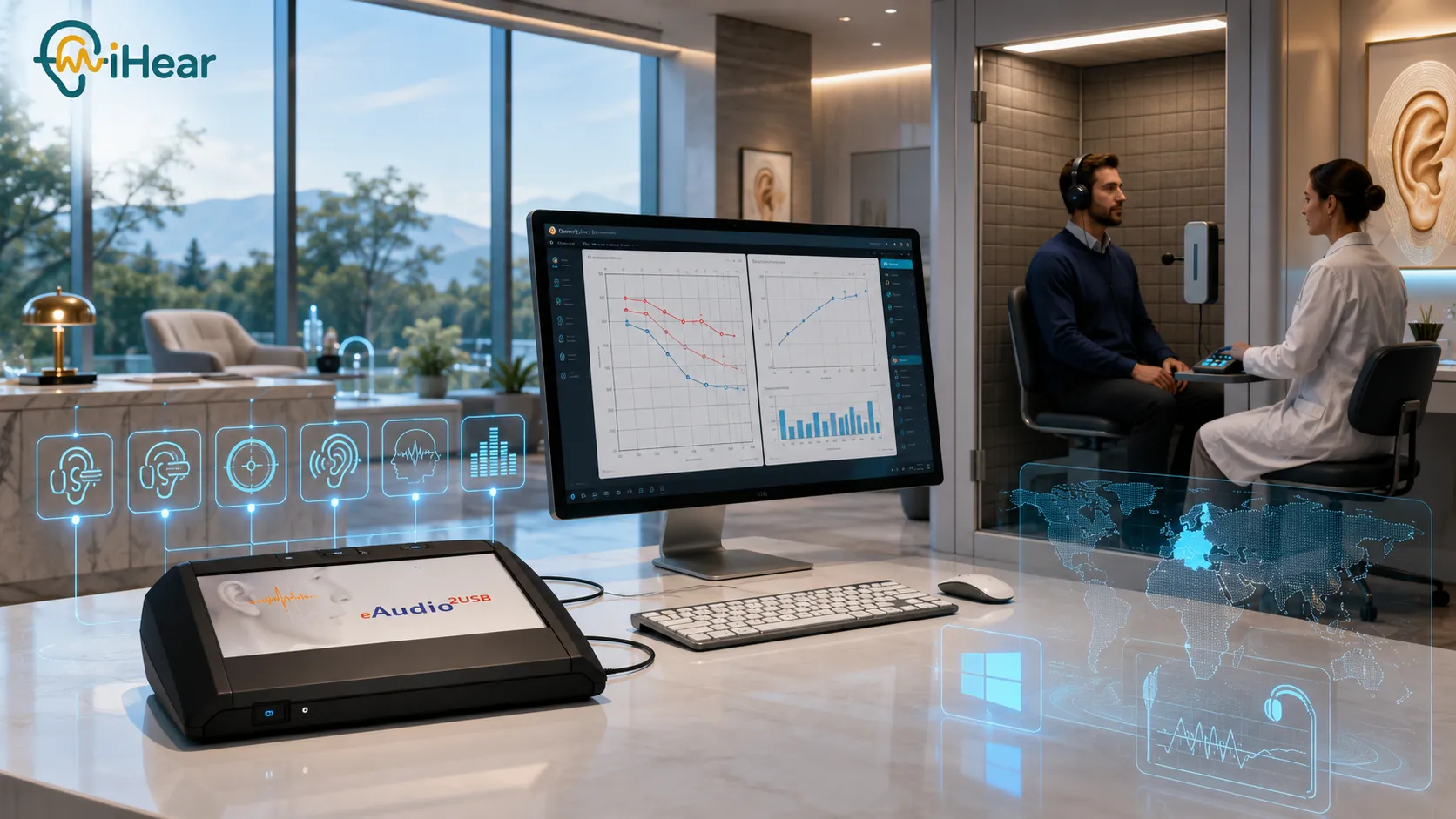
The eAUDIO USB is a German 2-channel audiometer for pure-tone and speech audiometry. Its datasheet lists EN 60645-1 Class 2 and EN 60645-2 Class B(E), supra-threshold tests, tinnitus tone selection and masking, and compatibility with Windows 10 and 11. It is available in the UAE through iHear, which offers training and after-sales support.
What Is the eAUDIO USB Audiometer, and Why Choose It?
The BioMed Jena eAUDIO USB is more than a basic hearing-test device: it is an integrated, computer-based system that combines pure-tone audiometry and speech audiometry in one unit. According to the manufacturer’s datasheet, it uses a 2-channel design and supports a range of clinical tests, including supra-threshold tests, masking, automatic audiometry, and tinnitus tone selection and masking, through a clearly structured, keyboard-and-mouse user interface designed for everyday use.
Key technical feature: three power channels for passive speakers. The datasheet lists 3 power channels for passive speakers, so free-field speakers can be driven directly by the audiometer without a separate speaker amplifier. It also lists 2 line-out channels, 2 line-in inputs, microphone in and out, and speech-in-noise and tone-in-noise test signals.
If you run an audiology center, an ENT clinic, or a hospital department, the eAUDIO USB offers 2-channel pure-tone and speech audiometry with standardized diagrams, speech test results for numbers and words with or without a hearing aid, and a compact design that can be mounted on a wall or desk (310 × 205 × 45 mm, 1 kg without accessories). The manufacturer states that it is made in Germany.
| Field | Details |
|---|---|
| Device name | eAUDIO USB (also written eAUDIOUSB) |
| Manufacturer | BioMed Jena GmbH, Germany (founded 1997) |
| Manufacturer's quality management | BioMed Jena holds an EN ISO 13485:2016 + AC:2018 + A11:2021 certificate (quality management system for medical device manufacturers) |
| Type | Computer-based 2-channel pure-tone and speech audiometer |
| Connection | USB 2.0; requires a PC running Windows 10 or 11 |
| Frequency range (air conduction) | 125–8,000 Hz with the Radioear DD65v2; 125–20,000 Hz with the HDA 300 / DD450 |
| Output level (air conduction) | −10 to 120 dB HL with the Radioear DD65v2; −10 to 110 dB HL with the HDA 300 / DD450 |
| Standards listed in the datasheet | EN 60645-1 Class 2 (pure-tone audiometers); EN 60645-2 Class B(E) (speech audiometry) |
| Weight / dimensions | 1 kg (without accessories) / 310 × 205 × 45 mm |
| Distributor in the UAE | iHear, Al Ain, UAE |
Why Choose the eAUDIO USB Audiometer?
The eAUDIO USB datasheet lists EN 60645-1 Class 2 and EN 60645-2 Class B(E), the European standards for pure-tone audiometers and for speech audiometry equipment. Ask iHear for the conformity documentation and for the current regulatory status of the device in the UAE.
- Tone-in-noise and speech-in-noise tests
- Weber and Rinne tests, which help clinicians distinguish conductive from sensorineural hearing loss
- Supra-threshold tests: SISI, Lüscher, Langenbeck, Stenger, and Fowler (ABLB)
- A tinnitus tone selector and tinnitus masking, which help characterize a patient's tinnitus during testing (these are testing tools, not a treatment)
The device includes an automatic audiometry module (Hughson-Westlake and Békésy methods) and an automatic calibration function.
- Air conduction with the Radioear DD65v2 (125–8,000 Hz) or the HDA 300 / DD450 (125–20,000 Hz), which extends testing to the extended high-frequency range
- Bone conduction with the B81 bone conductor
- 3 power channels for passive free-field speakers, 2 line-out channels, 2 line-in inputs, and microphone in and out
- Compact: 310 × 205 × 45 mm and 1 kg without accessories
- Can be mounted on a wall or placed on a desk, depending on your clinic's space
- Patient response input for patient-controlled testing
- Compatible with Windows 10 and 11
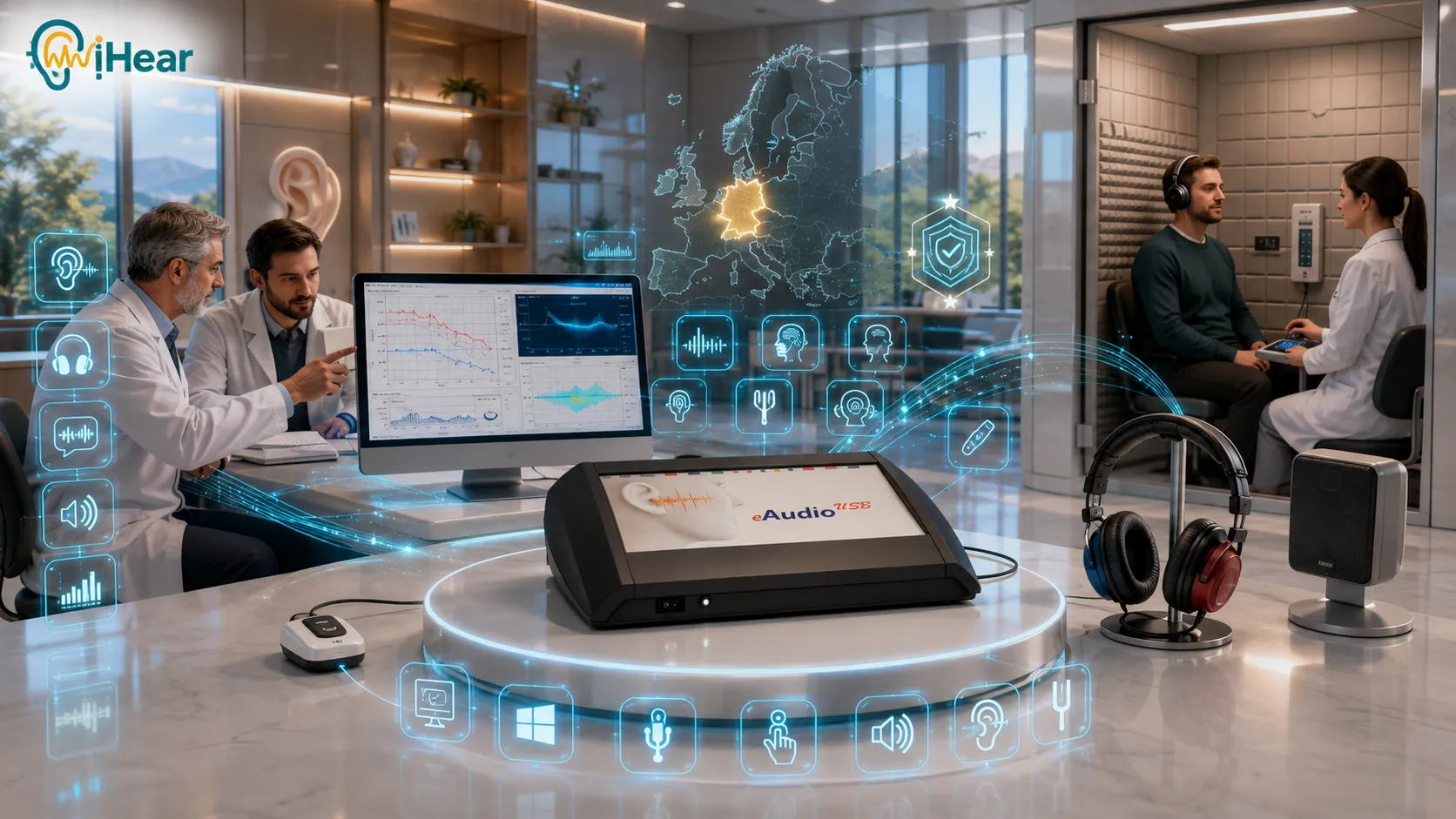
eAUDIO USB Audiometer Technical Specifications
| Type | Model | Frequency range | Output level |
|---|---|---|---|
| Air conduction (standard) | Radioear DD65v2 | 125 – 8,000 Hz | −10 to 120 dB HL |
| Air conduction (extended high frequency) | HDA 300 / DD450 | 125 – 20,000 Hz | −10 to 110 dB HL |
Bone conduction: B81 bone conductor.
- 3 power channels for passive free-field speakers
- 2 line-out channels and 2 line-in inputs
- Microphone in and out
- Patient response input
- USB 2.0 connection to the PC
- Test signals: manual, continuous, pulsing, and warble
- Masking signals: narrow-band, white, and speech noise
- Also: tone-in-noise and speech-in-noise tests
| Specification | Value |
|---|---|
| Dimensions | 310 × 205 × 45 mm |
| Weight | 1 kg (without accessories) |
| Power consumption | 42 W maximum |
| Operating temperature | 10 to 40 °C |
| Humidity | Less than 80% |
| Mounting | Wall or desk |
- EN 60645-1 Class 2: standard for pure-tone audiometers
- EN 60645-2 Class B(E): standard for speech audiometry equipment
- EN ISO 13485:2016: BioMed Jena's quality management system certificate for medical device manufacturers (held by the manufacturer, not by the device)
Compatible with Windows 10 and 11, with an automatic calibration function. Calibration requirements and intervals are set by the manufacturer and local regulations, so ask iHear what applies to your clinic.
Tests Available on the eAUDIO USB Audiometer
- Pure-tone audiometry: determines hearing thresholds by air and bone conduction across the tested frequencies.
- Speech audiometry: assesses how well the patient understands speech, not only whether they hear tones. The datasheet's sample report includes number and word tests, with or without a hearing aid.
- Weber test: shows which ear a bone-conducted tone is heard in, which can help distinguish conductive from sensorineural hearing loss.
- Rinne test: compares air and bone conduction in the same ear, to help identify the type of hearing loss.
- SISI test: measures the patient's sensitivity to small increases in sound intensity. Clinicians have used it as an aid in judging whether a hearing problem is cochlear or neural.
- Lüscher test: measures the smallest change in intensity the patient can detect (the intensity difference limen), historically used to assess loudness recruitment, which is associated with cochlear hearing loss.
- Langenbeck test: measures the threshold of a tone in the presence of masking noise.
- Stenger test: helps identify unilateral non-organic (functional) hearing loss, where a patient's responses may not reflect true thresholds.
- Fowler test (ABLB): compares loudness between the two ears, used in unilateral hearing loss to assess loudness recruitment.
The interpretation of these tests remains with the audiologist or physician.
- Automatic Hughson-Westlake: a widely used procedure for determining hearing thresholds, run automatically by the device's automatic audiometry module.
- Békésy audiometry: tracks the hearing threshold continuously as the patient presses a button while the tone is audible. It can help characterize some patterns of hearing loss.
- Automatic calibration function: listed in the datasheet. Calibration requirements and intervals are set by the manufacturer and local regulations, so ask iHear what applies to your clinic.
- Tone-in-noise and speech-in-noise tests: assess hearing for tones and speech with background noise. Speech-in-noise results give an idea of how a patient may cope in noisy places such as restaurants and meetings.
- Tinnitus tone selector and tinnitus masking: help the clinician characterize the patient's tinnitus (such as its pitch and loudness) and test masking sounds during the examination. These are testing tools, not a treatment. Some hearing aids, such as several Beltone hearing aids with Tinnitus Breaker Pro, include tinnitus sound features that can help ease tinnitus; whether they suit a patient is a decision for the clinician.
Who Is the eAUDIO USB Audiometer For?
The eAUDIO USB is suited to settings that need regular clinical hearing assessment, such as:
ENT (ear, nose, and throat) clinics: for routine audiometric testing as part of the ear assessment.
Audiology and hearing aid fitting centers: for the audiogram that guides hearing aid selection and programming.
Hospitals and institutional audiology departments: as part of a hospital's clinical hearing assessment services.
Universities and audiology training centers: as a teaching and research tool, working with the clinical measurement methods listed in the datasheet.
The eAUDIO USB software is integrated with eDM (Diagnostic Manager), BioMed Jena’s data management software. BioMed Jena describes eDM as one software for all of its devices, with a single patient database. Combined with other BioMed Jena devices, such as the eABR USB (auditory evoked potentials) and the eOAE (otoacoustic emissions), the eAUDIO USB can be part of a diagnostic center that displays all relevant data at a glance.
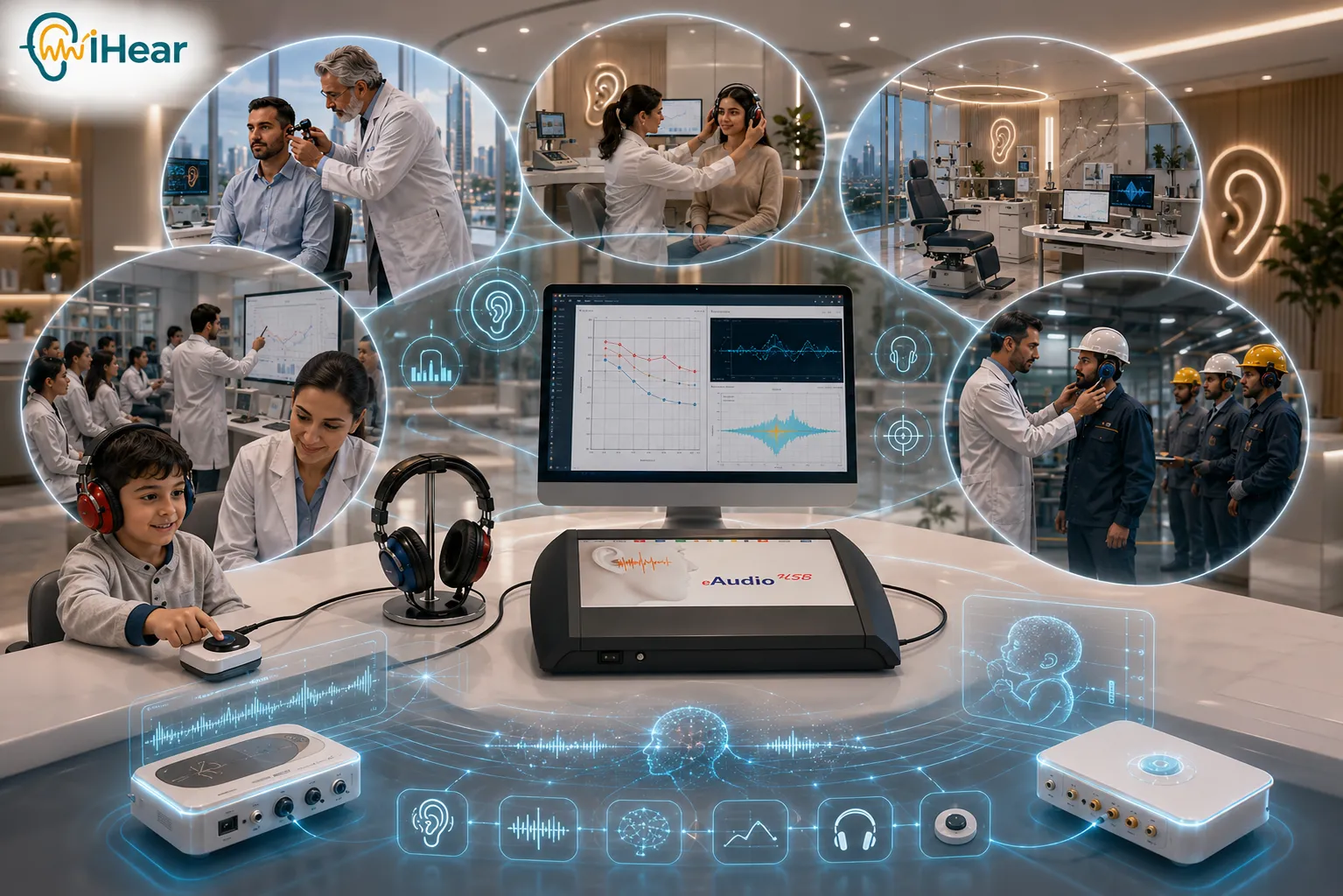
The eAUDIO USB performs behavioral testing, which needs a conscious response from the patient, such as pressing a response button when a sound is heard. The datasheet does not state an age range, so whether it suits a particular child depends on the child's ability to respond and on the clinician's method.
For patients who cannot give behavioral responses, such as newborns, objective tests that do not depend on patient cooperation are used instead, such as otoacoustic emissions (OAE) and auditory brainstem response (ABR). BioMed Jena offers the eOAE and the eABR USB for these tests, and both are also available through iHear. The choice of test is a decision for the audiologist or physician.
The eAUDIO USB and Occupational Audiometry
In Abu Dhabi, the Occupational Safety and Health System Framework (OSHAD-SF, now ADOSH-SF) requires employers to run a hearing conservation program for employees exposed to noise of 85 dB(A) or more over an 8-hour time-weighted average, including an audiometric testing program with a baseline audiogram and annual audiograms (see the official Occupational Noise Code of Practice, CoP 3.0). Requirements in other emirates may differ, so confirm what applies to your facility. The code sets requirements for who performs the tests, the audiometers used (it names ANSI S3.6-2010 or ISO 8253-1:2010), calibration, and the test room. The eAUDIO USB offers pure-tone air and bone conduction testing at 125–8,000 Hz, which includes the frequencies the code lists as a minimum (500 to 6,000 Hz), and its datasheet lists EN 60645-1 Class 2 and EN 60645-2 Class B(E). Occupational health centers and medical examination providers should confirm with iHear that the device and their test setup meet the code’s requirements. Occupational audiometry programs typically include:
Baseline Audiogram
A baseline audiogram (pre-employment hearing test) at the start of employment, documenting each worker's original hearing level.
Periodic Audiogram
Periodic follow-up audiograms to detect any noise-induced hearing loss that develops over time.
Exit Audiogram
An exit audiogram at the end of employment to document final hearing levels for potential insurance and compensation claims.
eAUDIO USB is well suited to occupational hearing testing. Its automatic Hughson-Westlake protocol speeds up high-volume testing of large groups of workers, while the Stenger test gives occupational health teams a reliable way to verify the validity of results in cases that may involve compensation claims. Digital record archiving also makes it easy to compare the same worker’s audiograms year after year.
Types of Audiometers: Screening vs Diagnostic vs Clinical — Where Does the eAUDIO USB Fit?
Here is a question that can save you more money and time than any other detail: which type of audiometer does your clinic actually need? Many clinics find out too late that the audiometer they bought is either too basic for their more complex cases, or more advanced and expensive than their day-to-day work requires. Audiometers are generally grouped into three clear categories:
1. Screening Audiometer
The simplest and least detailed category. Used for quick hearing screening only, giving a basic "pass/refer" result without determining the type or degree of hearing loss. Commonly used in school hearing screening programs and fast, large-scale screening campaigns.
2. Diagnostic Audiometer
Identifies the type and degree of hearing loss (conductive or sensorineural) through air conduction and bone conduction testing. Most often used in private clinics and ENT clinics for routine hearing evaluations.
3. Clinical Audiometer (Full-Featured) — Top Category
The most advanced of the three: adds a complete set of special (supra-threshold) tests needed for complex cases and precise differential diagnosis. Typically used in hospitals, specialist centers, pediatric cases, and complex neurological cases.
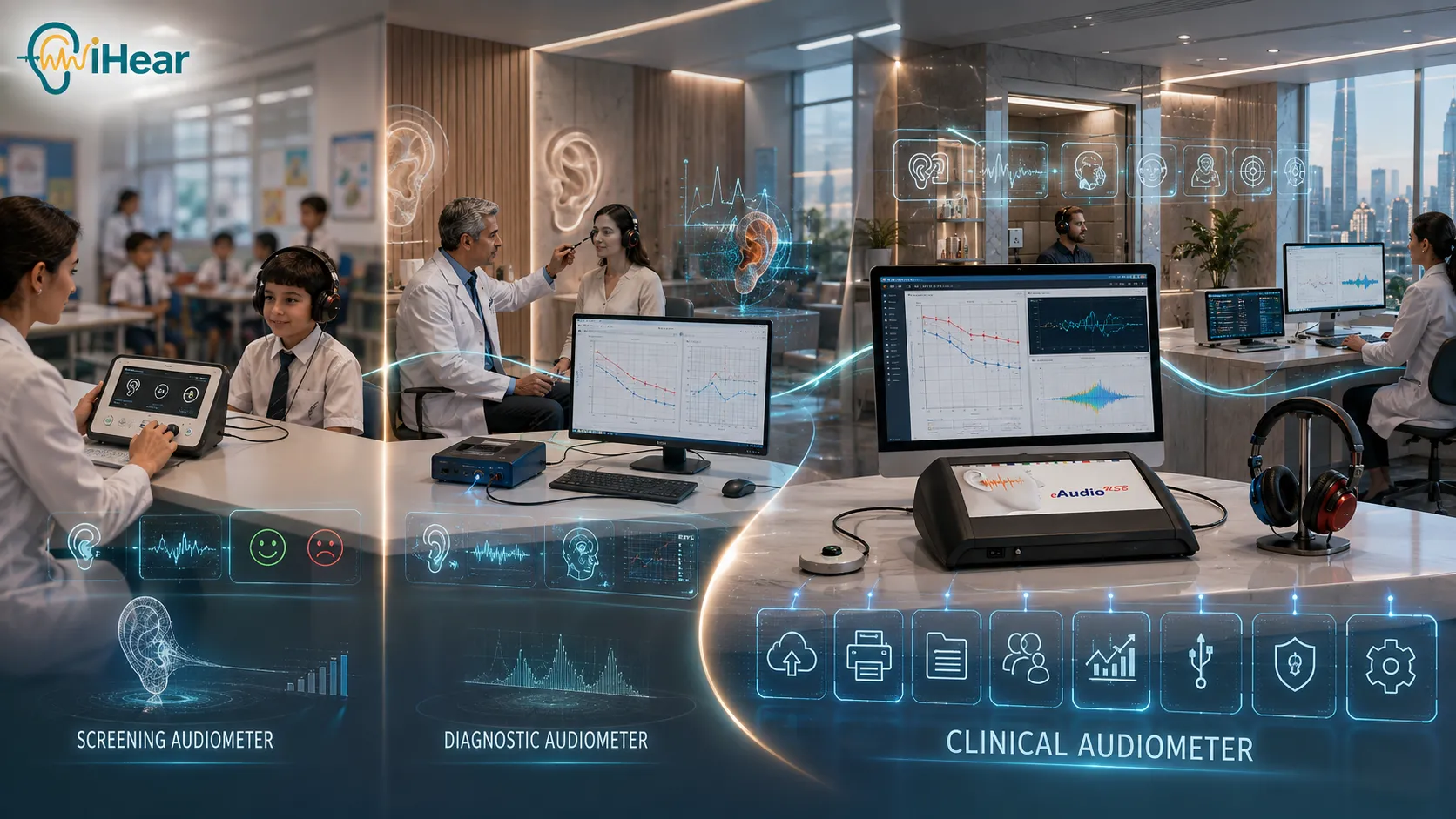
Where does the eAUDIO USB fit? With its five special supra-threshold tests (SISI, Lüscher, Langenbeck, Stenger and Fowler/ABLB) plus the internationally recognized automatic protocols (Hughson-Westlake and Békésy), the eAUDIO USB falls into the full-featured clinical audiometer category, not just the basic diagnostic one. In practice, this means the audiometer serves your clinic today and keeps serving it if you later expand to handle more complex cases, with no need to replace it or upgrade to another device.
Why Choose a PC-Based Audiometer Over Traditional Standalone Models?
Digital record storage: every audiogram is saved electronically instead of relying on paper records that can be lost or damaged.
Instant, professional printed reports instead of plotting audiograms by hand on paper charts.
Fast archiving and comparison of a patient's results over time, which is especially important for periodic occupational hearing testing programs.
Future-ready through software updates, with no need to replace the physical device.
eAUDIO USB vs Other Audiometers in the UAE Market
Two Types of Competition in the UAE Audiometer Market
Type 1: General Medical Equipment Distributors (Non-Specialist)
Companies such as KREND Medical, Medprix, Medworld Trade and Paramount UAE typically sell audiometers as part of a broad general medical catalog, ranging from basic examination tools to assorted medical supplies. They are not audiology specialists, so focused audiology training and maintenance support may be limited.
Type 2: Direct Global Brands (e.g., Interacoustics)
Denmark's Interacoustics is the leading direct competitor worldwide, with audiometers such as the AC40, AD528 and AD629, more than 50 years of experience and a well-established reputation. Its products fall into the same three categories described in the previous section. The key differences from the eAUDIO USB are shown in the table below:
| Criteria | eAUDIO USB (BioMed Jena) | Equivalent Interacoustics Audiometers |
|---|---|---|
| Country of manufacture | Germany | Denmark |
| Category | Full-featured clinical audiometer (clinical-grade) | Clinical or diagnostic, depending on the model |
| Channels | Two channels (pure tone + speech) | Two channels (e.g., AC40) |
| Quality certification | ISO 13485:2016 | ISO 13485 (industry standard) |
| Included software | eDM Diagnostic Manager, with no per-workplace licence | Diagnostic Suite PC software, usable standalone or with Noah / OtoAccess databases |
| Integration with other devices | One patient database across the BioMed Jena line (audiometry, tympanometry, ABR, OAE and vestibular testing) | Diagnostic Suite covers Interacoustics audiometers and tympanometers, with OtoAccess or Noah databases |
| Free-field outputs | 3 built-in power channels for passive free-field speakers | Built-in free-field amplifier (AC40) |
| Local support in the UAE | Direct through iHear (Al Ain) | Through regional distributors |
There is no single "best" audiometer. The right choice depends on your clinic's size and needs. But if you are looking for a full-featured clinical audiometer with an included software suite, no per-workplace licence, and direct local support from Al Ain across the UAE, the eAUDIO USB is a genuine contender. It is worth requesting a quote and comparing it side by side.
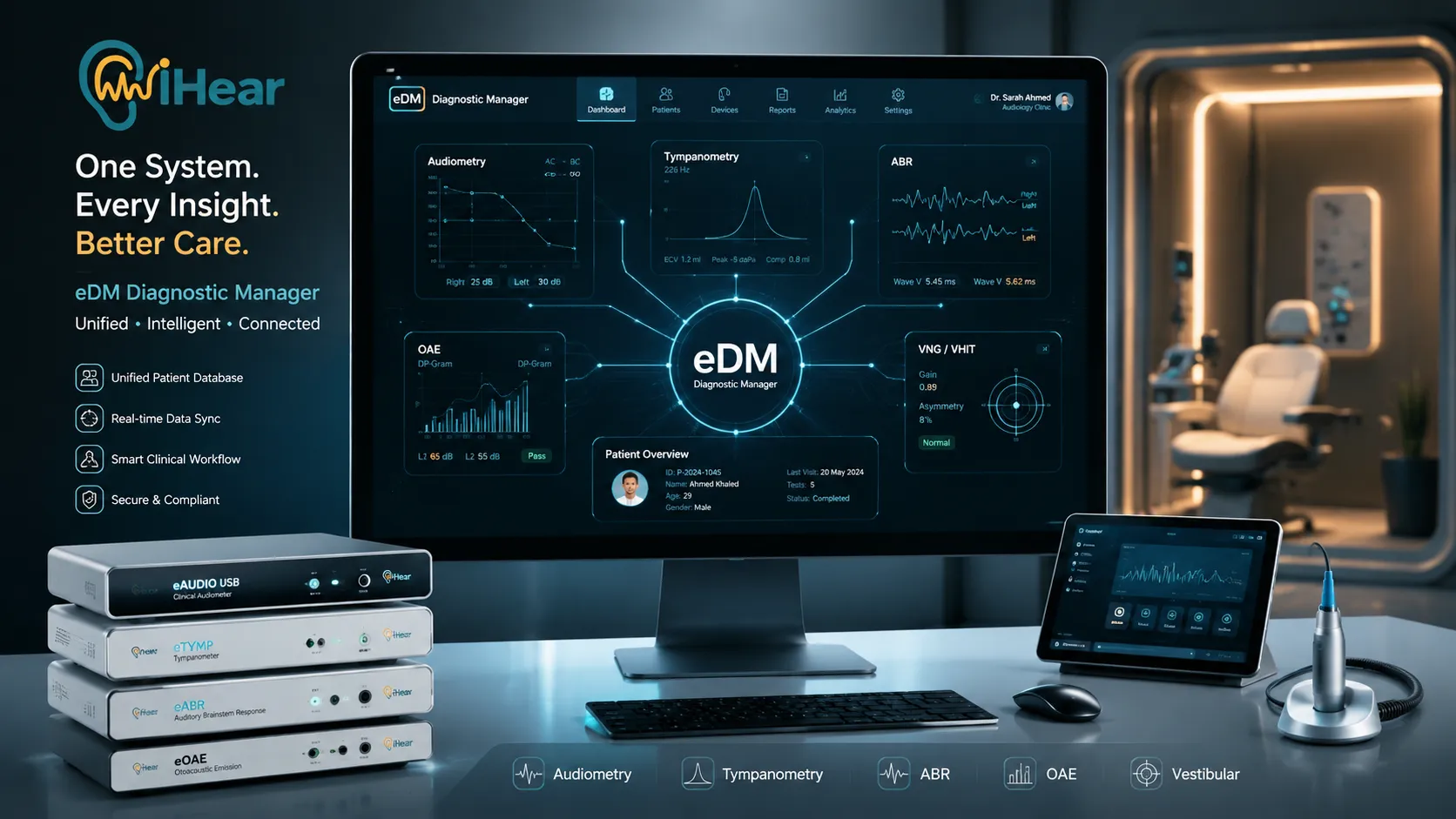
eDM Diagnostic Manager: Connect All Your Audiology Devices in One Patient Database
All BioMed Jena devices, from the eAUDIO USB audiometer to the eTYMP USB tympanometer, the eABR USB and the eOAE, and all the way to the vestibular balance testing systems, run on a single software platform: eDM (Diagnostic Manager). This matters in practice for any clinic that plans to expand later:
This means that buying the eAUDIO USB today is an investment in a scalable system you can expand later, not just an isolated device.
Why Buy the eAUDIO USB from iHear in the UAE?
Authorized UAE Distributor
iHear is the authorized UAE distributor of BioMed Jena's German-made devices. BioMed Jena is ISO 13485 certified.
Support & Training
Direct technical support and training for your clinic team on using the audiometer and the eDM software.
Maintenance & Calibration
Periodic maintenance and calibration to keep your clinical test results accurate over time.
Genuine Spare Parts
Documented spare parts and warranty, supplied through a single official distribution channel.
Local Office in Al Ain
A local office in Al Ain, UAE, close to your clinic and not just remote support.
📞 Contact the iHear team in Al Ain or Abu Dhabi to request an audiometer quote for your clinic on WhatsApp
Start a WhatsApp ChatOther BioMed Jena Audiology Devices Your Clinic May Need
| Device | Use | When You Need It with the eAUDIO USB |
|---|---|---|
| eTYMP USB | Tympanometer: middle ear analyzer (tympanometry + acoustic reflex testing) | For a complete middle ear assessment alongside every audiogram |
| eOAE | Otoacoustic emissions (OAE) testing, ideal for newborn hearing screening | For screening newborns and infants who cannot give a behavioral response |
| eABR USB | Auditory brainstem response (ABR) testing + VEMP | For objective testing that does not depend on patient cooperation, and for complex neural hearing loss cases |
| AudioControl | Convenient 16-button control panel for quiet operation with the eAUDIO USB | To improve the examiner's experience during intensive daily use |
eAUDIO USB Audiometer – Frequently Asked Questions
What is the eAUDIO USB audiometer and what is it used for? +
The eAUDIO USB is a full 2-channel clinical audiometer from the German manufacturer BioMed Jena. It performs pure tone and speech audiometry through a computer and is used every day in ENT clinics, audiology centers, and hospitals.
What is a computer-based (PC-based) audiometer, and how is it different from a standalone audiometer? +
A computer-based audiometer connects to a Windows PC through USB and is controlled by software instead of a built-in screen and dedicated buttons. This makes it easier to store results, overlay and compare audiograms, print reports, and share data with other systems. The eAUDIO USB works this way: it connects through USB 2.0 and runs on Windows 10 and Windows 11.
What tests can the eAUDIO USB perform? +
The eAUDIO USB supports pure tone audiometry (air and bone conduction), speech audiometry, tone-in-noise and speech-in-noise testing, and the Weber and Rinne tests. It also includes supra-threshold tests (SISI, Lüscher-Zwislocki, Langenbeck, Stenger, and Fowler ABLB), automatic audiometry, a tinnitus tone selector, and tinnitus masking.
What is the difference between screening, diagnostic, and clinical audiometers, and where does the eAUDIO USB fit? +
Audiometers are generally grouped into three classes: screening devices (pass/fail results only), diagnostic devices (identify the type and degree of hearing loss), and full clinical devices (add specialized tests for complex cases). Because it includes the complete SISI, Stenger, Fowler, Lüscher, and Langenbeck test set, the eAUDIO USB falls in the full clinical class, the highest of the three.
Is the eAUDIO USB available as a diagnostic or a clinical version? +
Yes. According to BioMed Jena's 2025/2026 catalogue, the eAUDIO USB is available as both a diagnostic version and a clinical version. Contact iHear to confirm which version fits your clinic's needs and budget.
How many channels does the eAUDIO USB support, and why does it matter? +
It supports two channels (2-channel), which allows tests that stimulate both ears at the same time or independently, such as masking tests and binaural tests like Fowler (ABLB).
What are the eAUDIO USB's frequency range, intensity range, and compatible transducers? +
With Radioear DD65 V2 headphones, air conduction covers 125–8,000 Hz at −10 to 120 dB HL. With HDA 300 / DD450 headphones, it covers 125–16,000 Hz at −10 to 110 dB HL. The B81 bone conductor reaches up to 85 dB HL, and the system supports the use of different transducers.
Does the eAUDIO USB support automatic audiometry and automatic calibration? +
Yes. It includes an automatic audiometry module using the Hughson-Westlake and Békésy methods, plus an automatic calibration function. The software also provides age-dependent normative values and an overlay function that lets you compare results across all tests.
Does the eAUDIO USB support tinnitus testing? +
Yes. It includes a built-in tinnitus tone selector (up to 16 kHz) and tinnitus masking in the same device.
Can the eAUDIO USB be used to test children? +
Yes, but it relies on a conscious behavioral response (pressing a button when a sound is heard), so it is suitable for adults and for children from about 4 years old. For newborn and infant screening, the right device is the eOAE, also available from iHear.
Is the eAUDIO USB suitable for occupational hearing screening programs in the UAE? +
Yes. The automatic Hughson-Westlake protocol speeds up testing of large groups of workers, and the Stenger test helps verify the reliability of results in occupational and insurance assessments.
Can free-field speakers be connected to the eAUDIO USB without extra equipment? +
Yes. The device has 3 built-in power outputs for passive free-field speakers, so you can run advanced tests such as ILD and BILD without external amplifiers.
What standards does the eAUDIO USB meet, and is the manufacturer certified? +
The device complies with the European standards EN 60645-1 Class 2 (pure tone audiometry) and EN 60645-2 Class B(E) (speech audiometry), and includes automatic calibration. The manufacturer, BioMed Jena, is certified to EN ISO 13485:2016 for quality management in medical device manufacturing.
Is the eAUDIO USB compatible with Windows 10 and Windows 11? +
Yes. It is fully compatible with both Windows 10 and Windows 11.
What are the dimensions and weight of the eAUDIO USB, and can it be wall-mounted? +
The eAUDIO USB measures 310 × 205 × 45 mm and weighs about 1 kg without accessories, with a maximum power consumption of 42 W. Its slim design allows wall or desk mounting.
Can the eAUDIO USB integrate with hospital electronic medical record (EMR) systems? +
The eAUDIO software is integrated into eDM (Diagnostic Manager), which works over a network and keeps data from all BioMed Jena devices in one patient database. eDM includes a GDT interface, offers HL7 on request, and exports results as PDF. For details on integrating with your hospital's system, contact iHear's technical team.
What is the difference between the eAUDIO USB and the eABR USB? +
The eAUDIO USB is designed for pure tone and speech audiometry, a subjective test that requires the patient's participation. The eABR USB measures the auditory brainstem response, an objective test that does not require a conscious response from the patient and is often used with infants and children or in cases where conventional audiometry is difficult.
Is the eAUDIO USB an alternative to the Interacoustics Equinox 2.0 or AC40? +
It covers the same clinical applications: pure tone and speech audiometry in ENT clinics, audiology centers, and hospitals. The practical difference for UAE buyers is local support. iHear is the authorized distributor of BioMed Jena in the UAE, providing installation, training, technical support, and spare parts locally.
Does the eAUDIO USB software require annual licenses or subscription fees? +
No. The included eDM software comes with free lifetime updates from BioMed Jena and no recurring annual license fees, unlike some competing systems.
How much does the eAUDIO USB audiometer cost in the UAE? +
The price depends on the configuration and accessories you need (headphones, free-field speakers, and a sound-treated booth if required). Contact iHear for a custom quote for your clinic or hospital.
What warranty comes with the eAUDIO USB? +
The eAUDIO USB comes with the manufacturer's warranty from BioMed Jena, managed and documented locally in the UAE by iHear as the authorized distributor. Contact iHear for the exact warranty period and terms.
Is the eAUDIO USB registered with the UAE Ministry of Health and Prevention (MOHAP)? +
Registration with MOHAP is a basic requirement for supplying any diagnostic medical device in the UAE. Contact iHear for the device's registration documents before completing any institutional purchase.
Does iHear provide training and local service in the UAE? +
Yes. iHear is the authorized distributor of BioMed Jena in the UAE. We provide installation, training, technical support, and spare parts locally from our branches in Al Ain and Abu Dhabi, serving the entire UAE.
How often does an audiometer need calibration? +
Health authorities generally recommend periodic calibration of audiometers, typically once a year, to keep clinical results accurate. iHear provides calibration and routine follow-up services for BioMed Jena devices across the UAE.
Do I need a soundproof booth to use the eAUDIO USB? +
Testing should ideally be done in a sound-treated room or booth to avoid ambient clinic noise, especially when measuring low-intensity thresholds. iHear can advise on the right setup for your clinic space.
For more information
Feel free to contact us anytime. Our team is always ready to help you.