
AudioBox Free Field Amplifier for Pediatric Audiometry: 6-Channel Sound Field Amplifier From BioMed Jena

The AudioBox is a computer-controlled free field amplifier (sound field amplifier) from BioMed Jena (Germany). It lets a conventional audiometer you already have play sound through up to six passive loudspeakers in the room, so hearing can be tested without headphones. According to BioMed Jena, it can be used to extend an audiometer for pediatric audiometry and lateralization analysis. It is an accessory, not a hearing test device on its own: it works with an audiometer.

iHear is the authorized distributor of BioMed Jena devices in the UAE.

Important Technical Note:

The AudioBox is not a standalone hearing test device. It is an extension accessory that works together with a conventional audiometer, such as BioMed Jena's eAUDIO USB. It adds free field (sound field) capability to that audiometer, so a clinic that already has an audiometer may not need to replace it. Ask iHear which audiometers are compatible with your setup.

AudioBox free field amplifier key specifications
Field Details
Device name AudioBox
Manufacturer BioMed Jena GmbH, Germany
Type Free field amplifier (sound field amplifier); an accessory, not a standalone hearing test device
Function Added to a conventional audiometer so that sound can be played through external loudspeakers instead of headphones
Channels 4 inputs and 6 outputs (the outputs can be assigned to the inputs); up to 6 passive loudspeakers
Main use Pediatric audiometry with loudspeakers (sound field), for example visual reinforcement audiometry (VRA), conditioned orientation reflex (COR), and play audiometry
Advanced use Lateralization analysis
Connection Isolated USB 2.0 interface; medical power supply
Distributor in the UAE iHear, Al Ain and Abu Dhabi, UAE

What Is the AudioBox Free Field Amplifier?

The AudioBox is a computer-controlled free field amplifier. Its main function is to drive external loudspeakers. It does not measure hearing itself: it gives a conventional audiometer the ability to play sound through loudspeakers in the room instead of headphones.

How it works: the device accepts up to 4 input signals and distributes them to up to 6 outputs connected to passive free field speakers. Each input channel can be calibrated individually at up to 50 calibration points (125 Hz, 250 Hz, and so on). Calibration across frequencies matters in sound field testing, which usually uses warble tones or narrow-band noise rather than steady pure tones, because a steady pure tone played through a loudspeaker in a closed room can create standing waves that make the measurement less reliable.
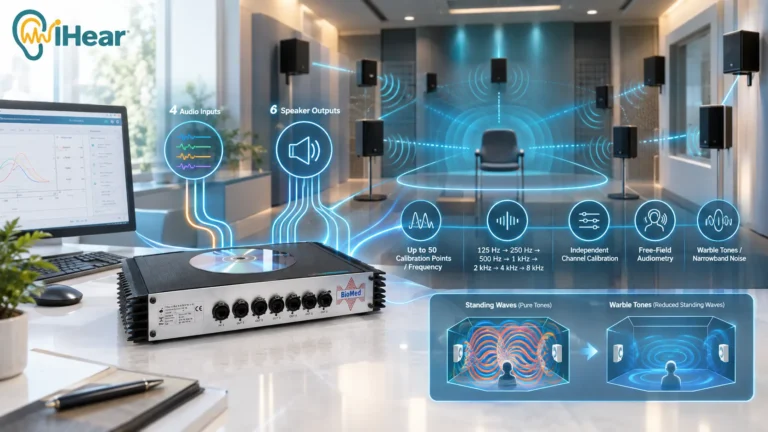
AudioBox Free Field Amplifier for Pediatric Audiometry 6 Channel Sound Field Amplifier From BioMed Jena

Why Use a Free Field Amplifier for Pediatric Audiometry? Testing Children Who Cannot Wear Headphones

Very young children, and children who cannot respond to conventional pure-tone testing (for example by pressing a button when they hear a sound), are usually tested with behavioral methods that often use loudspeakers (sound field) instead of headphones:
VRA (Visual Reinforcement Audiometry)

A sound is played from a loudspeaker at one side. When the child turns toward it, a visual reward (a lit toy or a video) reinforces the response. VRA is commonly used with infants and toddlers from about 6 months to around 2 to 2.5 years of age; ranges vary slightly between sources.

COR (Conditioned Orientation Reflex)

A variant of VRA that uses more than one sound source, for example loudspeakers on the child's left and right, so the audiologist can observe which way the child turns.

Conditioned Play Audiometry

Used with toddlers and preschoolers, roughly 2 to 5 years of developmental age, who can learn a simple task, such as placing a block in a box each time they hear a sound.

Where the AudioBox fits: sound field testing needs a calibrated setup of loudspeakers, an amplifier, and an audiometer in a suitable test room, and the AudioBox is the amplifier part of that setup. Sound field testing does not give ear-specific results, because both ears hear the sound at the same time (see the ASHA overview of pure-tone and sound-field testing). The audiologist chooses the method that suits the child's age and development.

Clinical Uses of a Free Field Amplifier: Pediatric Audiometry and More
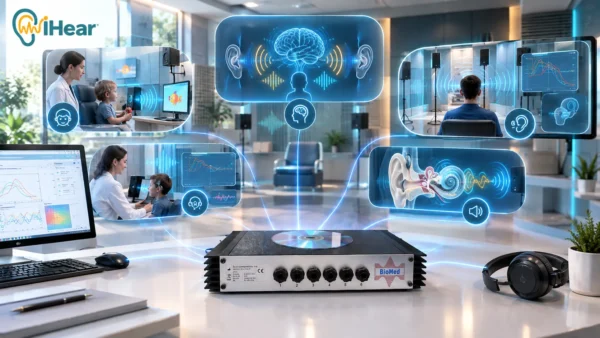
BioMed Jena's catalogue lists pediatric audiometry as one of the uses of the AudioBox. Infants and young children who are too young to cooperate with conventional testing are difficult to test with standard headphones, so behavioral techniques are used, such as visual reinforcement audiometry (VRA, commonly from about 6 months to around 2 to 2.5 years) and conditioned play audiometry (roughly 2 to 5 years). These methods often present sound through loudspeakers in the room, while the audiologist observes the child's response, such as turning toward the sound or stopping a play activity. In such a setup, the AudioBox is the amplifier that drives the loudspeakers, with each input channel calibrated individually.

After a hearing aid or cochlear implant is fitted, audiologists check that the device gives the patient a real benefit. One common approach is to measure hearing thresholds in the sound field while the patient wears the device (aided thresholds) and compare them with thresholds without it (unaided), which shows the functional gain. This is standard audiology practice and is not specific to the AudioBox, and the manufacturer's catalogue does not list it as a use. It does not replace real-ear (probe microphone) measurements, but aided sound field testing can still be useful, for example with young children who cannot complete standard speech tests. Sound field results are not ear-specific, because both ears hear the sound at the same time.

BioMed Jena's catalogue lists lateralization analysis among the uses of the AudioBox. On its website, BioMed Jena describes the eAUDIO USB audiometer as having active free field channels that make measurement of the intelligibility level difference (ILD) and the binaural intelligibility level difference (BILD) possible. These tests look at how the two ears work together to understand speech in noise. Which tests to use, and how to interpret them, is a decision for the audiologist. Ask iHear which combination of audiometer and AudioBox your protocol needs.

According to BioMed Jena's catalogue, the AudioBox can be used to extend a conventional audiometer. A clinic that already has an audiometer may therefore be able to add free field (sound field) capability without replacing it. Ask iHear which audiometers are compatible with your setup.
What Is the AudioBox Free Field Amplifier

How Does the AudioBox Free Field Amplifier Work?

01

Input Signals

The device accepts up to 4 input signals, each up to 5 V, typically coming from the audiometer or from the computer system.

02

Output Channels and Loudspeakers

It distributes these signals to 6 output channels of 100 W each, connected to passive loudspeakers placed in the room. Loudspeaker positions around the patient follow the test protocol and room design.

03

Independent Calibration

Each input channel can be calibrated individually at up to 50 calibration points (125 Hz, 250 Hz, and so on).

04

Optional Signal Channels

On customer request, the device also provides 6 signal channels with which an event can be displayed during testing, for example a signal that is synchronized with the presented sound.

05

Connection and Power

The device connects to the computer through an isolated USB 2.0 interface and uses a medical power supply.

06

API and Software

The device comes with Windows software and an API for C/C++, C#, Delphi, and LabVIEW, for developers who want to integrate it into a custom system.

AudioBox Technical Specifications

AudioBox free field amplifier technical specifications
Specification Value Why it matters in practice
Inputs 4 inputs, up to 5 V each Receives the audio signal, typically from the audiometer connected to it
Outputs 6 outputs, 100 W each Provides the power to drive passive free field loudspeakers in the test room
Channel assignment The 6 outputs can be assigned to the 4 inputs Flexibility to set up more than one loudspeaker per input channel, depending on the test room design
Calibration Each input channel can be calibrated individually at up to 50 calibration points (125 Hz, 250 Hz, and so on) Each input channel is calibrated on its own, instead of relying on one general calibration for the whole system
Interface Isolated USB 2.0 Connects to the computer that runs the audiometer through an electrically isolated interface
API API for C/C++, C#, Delphi, and LabVIEW Allows software developers to integrate the AudioBox into custom audiometry systems
Software Windows software Day-to-day use runs through the Windows software; the API is for those who want a custom integration
Power supply Medical power supply A power supply designed for medical use, not an ordinary consumer adapter. Ask iHear for the applicable standards and documents
Additional signal channels Up to 6 signal channels with which an event can be displayed (on customer request) Can be used to trigger an event, such as a visual reinforcer (for example a lit toy), in sync with the sound, as in VRA-type testing

Who Is the AudioBox Free Field Amplifier For?

01

Pediatric audiology centers and clinics

Behavioral hearing testing (such as VRA and play audiometry) for infants and young children.

02

Cochlear implant and hearing aid centers

Aided sound field testing, which helps check the benefit (functional gain) a hearing aid or cochlear implant gives.

03

Advanced assessment centers

Lateralization analysis, including ILD and BILD tests, which BioMed Jena describes with the eAUDIO USB.

04

Audiometer upgrades

Adding free field capability to an existing conventional audiometer instead of replacing it. Ask iHear about compatibility.

05

System developers and researchers

Building custom audiometry systems (OEM integration) through the available API for C/C++, C#, Delphi, and LabVIEW.

AudioBox vs. a Dedicated Free Field System: Which Setup Fits Your Clinic?

AudioBox compared with a dedicated free field device or system
Point of comparison AudioBox (add-on) Dedicated free field device or system
Investment required Works with your existing audiometer; the added equipment is the amplifier and the loudspeakers Depends on the product: a separate device, or an audiometer with a built-in free field amplifier
Flexibility 6 outputs that can be assigned to 4 inputs; each input channel calibrated individually Varies by product, for example the number of loudspeaker outputs and the calibration options
Integration with other systems API for C/C++, C#, Delphi, and LabVIEW for custom integration Varies by manufacturer; ask each supplier whether an API or another integration option is available
Use Needs to be connected to an existing conventional audiometer Some, such as handheld pediatric free field audiometers (for example the PA5), work as standalone devices; others are part of an audiometer

The Interacoustics PA5 is described by its manufacturer as a handheld free field audiometer for testing young children. Product features change, so check each manufacturer's current information. The right setup depends on your clinic's equipment, test room, and protocols; contact iHear to discuss it.

AudioBox vs. Other Pediatric Free Field Solutions

Interacoustics PA5
Handheld pediatric free field audiometer
Country of origin Denmark
Nature Handheld free field audiometer for testing young children
Number of channels Built-in loudspeaker (optional headphone)
Flexibility Standalone handheld device; supports COR, VRA, and APR tests
API Not stated on the product page
Local support in the UAE Ask the manufacturer for its UAE distributor
GSI AudioStar Pro
Two-channel clinical audiometer
Country of origin United States (Grason-Stadler)
Nature Clinical audiometer with built-in sound field outputs and VRA controls
Number of channels Two test channels; two internal loudspeaker outputs (25 W per channel) and line outputs for an external amplifier
Flexibility Works standalone or with a computer; the built-in VRA controls activate an external VRA system
API Not stated; data transfer to GSI Suite, NOAH, or EMR/EHR systems is listed
Local support in the UAE Ask the manufacturer for its UAE distributor
Summary of the Comparison:
If your clinic is starting from scratch, a clinical audiometer with built-in sound field outputs (such as the AudioStar Pro) or a handheld pediatric free field audiometer (such as the PA5) may be enough for your protocol. If you already have a good audiometer (such as the eAUDIO USB or another model) and want to add free field capability, the AudioBox is an option to consider; ask iHear about compatibility. The right choice depends on your protocols, test room, and budget. Specifications come from each manufacturer's published information and may change.

AudioBox and the BioMed Jena Device Family

Audiometer pairing 01

AudioBox + eAUDIO USB

The eAUDIO USB is BioMed Jena's 2-channel PC audiometer, and the AudioBox can extend a conventional audiometer for free field testing. BioMed Jena describes the eAUDIO USB as having active free field channels that make ILD and BILD measurement possible, alongside behavioral hearing testing for children. Ask iHear how to combine the two for your protocol.

Data management 03

AudioBox + eDM

The AudioBox is an audio amplifier, so it does not produce test results itself. The audiometer you use with it records the results. eDM (Diagnostic Manager) is BioMed Jena's software for managing and storing data from its devices in a single patient database, and BioMed Jena lists the eAUDIO USB among them. Ask iHear how your setup connects to eDM.

Buy the AudioBox Free Field Amplifier in the UAE From iHear

Authorized distributor of BioMed Jena devices (Germany) in the UAE.
Technical support and training for your team on the device and on setting up your test room.
Maintenance and calibration support for your free field setup.
Spare parts and warranty support. Ask iHear for the terms that apply to your purchase.
Headquartered in Al Ain, serving clinics and medical centers.
A branch in Abu Dhabi serving the medical sector.
📍 Al Ain Branch: Al Humaira, 136 Khalifa Bin Zayed Street, Mezzanine 2, Office 3
📍 Abu Dhabi Branch: Sultan Bin Zayed The First Street (Muroor Road), Building 1210, Offices M6
☎ Al Ain phone: +971 3 768 5563
☎ Abu Dhabi phone: +971 2 681 3841
📧 Email: Info@ihear.ae
📱 WhatsApp: +971 50 208 4569

📞 Contact the iHear team in Al Ain or Abu Dhabi to request an audiometer quote for your clinic on WhatsApp

Start a WhatsApp Chat

Other BioMed Jena Devices for Your Clinic

BioMed Jena devices related to the AudioBox
Device Use Relationship to the AudioBox
eAUDIO USB 2-channel diagnostic audiometer An audiometer that can be extended with an AudioBox for free field capability; ask iHear how to combine them
eOAE Newborn hearing screening Often the first step in a child's pathway, before behavioral testing in the sound field becomes possible as the child grows
eABR USB Auditory brainstem response (ABR) measurement An objective test that complements the behavioral assessment that sound field testing allows
AudioControl Audiometry keyboard for the eAUDIO USB software Another accessory from the same family; ask iHear whether it suits a setup that also includes an AudioBox

AudioBox FAQ: Common Questions About the Free Field Amplifier for Pediatric Audiometry
The AudioBox is a computer-controlled free field (sound field) amplifier from BioMed Jena (Germany). According to BioMed Jena's catalogue, it connects up to six passive loudspeakers and can be used to extend a conventional audiometer for pediatric audiometry and lateralization analysis.

No. The AudioBox is an amplifier accessory. It does not measure hearing itself. It works with an audiometer, which controls the test and records the results.

iHear (ihear.ae) is the authorized distributor of BioMed Jena devices in the UAE, headquartered in Al Ain with a branch in Abu Dhabi. To request a quote or a consultation, contact iHear on WhatsApp at +971 50 208 4569.

The price depends on your setup, for example the number of loudspeakers you need and the design of your test room. Contact iHear for a quote based on your clinic's needs.

Sound field (free field) audiometry tests hearing by playing sounds through loudspeakers in a sound-treated room instead of through headphones. Audiologists use it, for example, with young children or people who cannot tolerate earphones (see the ASHA overview). The sound reaches both ears at the same time, so it does not give ear-specific results.

Infants and toddlers are often too young to cooperate with conventional pure-tone testing, and some do not tolerate headphones. Behavioral methods are used instead. Visual reinforcement audiometry (VRA) is commonly used from about 6 months to around 2 to 2.5 years of age, and conditioned play audiometry from roughly 2 to 5 years. Ranges vary slightly between sources, and the audiologist chooses the method that suits the child's age and development.

Headphones or insert earphones present sound to one ear at a time, so they give ear-specific thresholds. Sound field testing plays the sound through loudspeakers, so both ears hear it and the result does not show which ear is responding. Sound field testing is used when headphones cannot be used, and for tests that need a real listening environment.

BioMed Jena's catalogue says the AudioBox can be used to extend a conventional audiometer. BioMed Jena's own audiometer is the eAUDIO USB. Compatibility with other audiometer brands is not stated in the catalogue, so ask iHear to confirm it for your current audiometer. The API for C/C++, C#, Delphi, and LabVIEW can support custom integrations.

Up to six passive loudspeakers. The AudioBox has 6 outputs of 100 W each, and the 6 outputs can be assigned to its 4 inputs.

Each input channel of the AudioBox can be calibrated individually at up to 50 calibration points (125 Hz, 250 Hz, and so on). Calibration matters because sound field testing depends on the loudspeakers, the room, and the signal level. It usually uses warble tones or narrow-band noise rather than steady pure tones, because a steady pure tone in a closed room can create standing waves that make the measurement less reliable.

A sound field setup typically includes a conventional audiometer, an amplifier such as the AudioBox, passive loudspeakers placed according to your test protocol, and a sound-treated test room, plus calibration. For infant testing, clinics also use visual reinforcers such as lit toys or videos. The exact requirements depend on your protocols and local guidance, so contact iHear to plan the setup.

The Interacoustics PA5 is described by its manufacturer as a handheld free field audiometer for testing young children, with a built-in loudspeaker and COR, VRA, and APR tests. The AudioBox is different: it is an amplifier that extends a conventional audiometer and can drive up to six external loudspeakers. They are different kinds of equipment, and the right choice depends on your protocols, test room, and budget.

Aided sound field testing, which measures thresholds while the patient wears a hearing aid or cochlear implant and compares them with unaided thresholds, is a common way to check the benefit of the device. This is general audiology practice and is not listed in BioMed Jena's catalogue as a use of the AudioBox. It does not replace real-ear (probe microphone) measurements, and sound field results are not ear-specific. Contact iHear to discuss whether your setup suits it.

BioMed Jena's catalogue lists lateralization analysis among the uses of the AudioBox. On its website, BioMed Jena describes the eAUDIO USB audiometer as having active free field channels that make measurement of the intelligibility level difference (ILD) and the binaural intelligibility level difference (BILD) possible. Ask iHear which combination of audiometer and AudioBox your protocol needs.

According to BioMed Jena's catalogue: 4 inputs (up to 5 V each), 6 outputs (100 W each) that can be assigned to the inputs, individual calibration of each input channel at up to 50 calibration points, an isolated USB 2.0 interface, Windows software, an API for C/C++, C#, Delphi, and LabVIEW, and a medical power supply. Six signal channels for displaying an event are available on customer request.

On customer request, the AudioBox provides 6 signal channels with which an event can be displayed. For example, such a signal could be used to trigger a visual reinforcer in sync with a presented sound, as in VRA-type testing. Ask iHear how to configure them for your protocol.

Day-to-day use runs through the AudioBox's Windows software. The API for C/C++, C#, Delphi, and LabVIEW is for developers who want to integrate the device into a custom system.

Yes. The AudioBox comes with an API for C/C++, C#, Delphi, and LabVIEW, so developers can integrate it into custom audiometry systems. Contact iHear's technical team to discuss compatibility with your project.

The catalogue does not list a regulatory status for the AudioBox. To confirm the registration status and the documents your facility needs, contact iHear before you buy.

iHear offers technical support, training, and maintenance and calibration support for the AudioBox in the UAE. Warranty and spare-part terms are set in your purchase documents, so ask iHear what applies to your purchase.
دون عنوان 200 x 200 بيكسل

For more information

Feel free to contact us anytime. Our team is always ready to help you.
What Is the AudioBox Free Field Amplifier