eTYMP USB Middle Ear Analyzer: Tympanometry & Acoustic Reflex Testing by BioMed Jena
The eTYMP USB is a tympanometer and middle ear analyzer from BioMed Jena, Germany, designed for everyday routine and clinical use in audiology clinics and ENT departments. It performs tympanometry, the standard test for assessing eardrum movement and middle ear pressure, along with acoustic reflex testing and Eustachian tube function testing. You can also build custom test protocols that combine several tests into a single sequence, such as a quick screening or a more in-depth evaluation.
iHear is the authorized BioMed Jena distributor in the UAE, providing local technical support, training, and servicing from our base in Al Ain.
Quick Summary: eTYMP USB
German-made tympanometer and middle ear analyzer for tympanometry, acoustic reflex testing, and Eustachian tube function testing. It offers three probe tone frequencies (226, 678 and 1000 Hz) and a unique triggered acoustic reflex measurement via direct cochlear implant stimulation. Complies with DIN EN 60645-5. Available exclusively in the UAE through iHear, with local training and servicing.
| Specification | Details |
|---|---|
| Device Name | eTYMP USB (also written eTYMPUSB) |
| Manufacturer | BioMed Jena GmbH, Germany (founded 1997; eTYMP USB introduced in 2017) |
| Device Type | Computer-based middle ear analyzer / tympanometer (immittance audiometer) |
| Main Functions | Tympanometry + acoustic reflex testing + Eustachian tube function testing |
| Connectivity | Isolated USB 2.0, requires a PC |
| Probe Tone Frequencies | 226 Hz (standard) + 678 Hz + 1000 Hz (800 Hz on request) |
| Weight & Dimensions | Approx. 1500 g / 310 × 105 × 250 mm (L × H × W) |
| Standards | DIN EN 60645-5 / DIN EN 60601-1 / EEC 93/42 |
| Authorized UAE Distributor | iHear, Al Ain, UAE |
What Is the eTYMP USB Tympanometer, and Why Does Multi-Frequency Tympanometry Matter?
The eTYMP USB is a computer-based middle ear analyzer, also known clinically as a tympanometer or acoustic immittance device. It varies the air pressure in the ear canal, measures how the eardrum responds, and plots the result as a graph called a tympanogram.
The key difference from an audiometer (eAUDIO USB): an audiometer measures what the patient can hear, while the eTYMP USB checks whether the middle ear is working mechanically, regardless of the patient’s conscious response. That makes it an objective test that doesn’t depend on patient cooperation, which is especially useful for young children and infants.
Why do multiple probe tone frequencies matter clinically?
According to ASHA guidance, the traditional 226 Hz probe tone is unreliable for infants younger than about 7 months, because the ear canal walls are naturally more compliant at that age. The accepted clinical solution is a higher-frequency probe tone (678 Hz or above). The eTYMP USB offers 226, 678 and 1000 Hz (800 Hz on request) in a single device, so it can test patients of every age, from newborns to older adults, without a separate device for each age group.
What Is a Tympanometry Test (Middle Ear Test)?
Tympanometry is a quick, painless test that shows how well the middle ear is working. A small probe gently changes the air pressure in the ear canal and records how the eardrum moves in response. The result is plotted as a graph called a tympanogram, which helps the doctor detect fluid behind the eardrum, a perforated eardrum (a hole in the eardrum), or Eustachian tube dysfunction. Tympanograms are usually grouped into three main types:
Normal eardrum movement: healthy middle ear function
Flat tympanogram with no clear peak: often indicates fluid behind the eardrum
Peak shifted toward negative pressure: usually points to Eustachian tube dysfunction
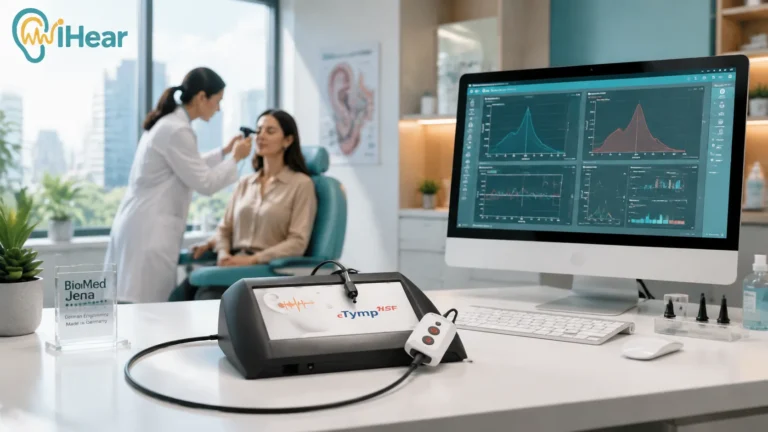
Tympanometry is often performed alongside a hearing test (audiometry) to give a complete picture of ear health. That is exactly the pairing the eTYMP USB and the eAUDIO USB offer together, as part of the BioMed Jena diagnostic range supplied by iHear in the UAE.
Why Doctors and Audiologists Choose the eTYMP USB Tympanometer
Multi-Frequency Tympanometry
Complete Acoustic Reflex Testing
Unique Feature: Cochlear Implant (CI) Triggered Reflex Measurement
Eustachian Tube Function (ETF) Testing for Intact and Perforated Eardrums
Automatic Altitude Correction and Stored Calibration
All calibration values are stored in the probe itself, so accuracy stays consistent even when probes are swapped between devices in the clinic.
Reliable acoustic reflex detection, even in borderline cases.
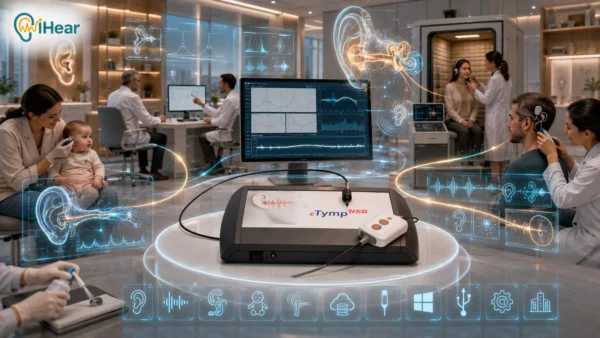
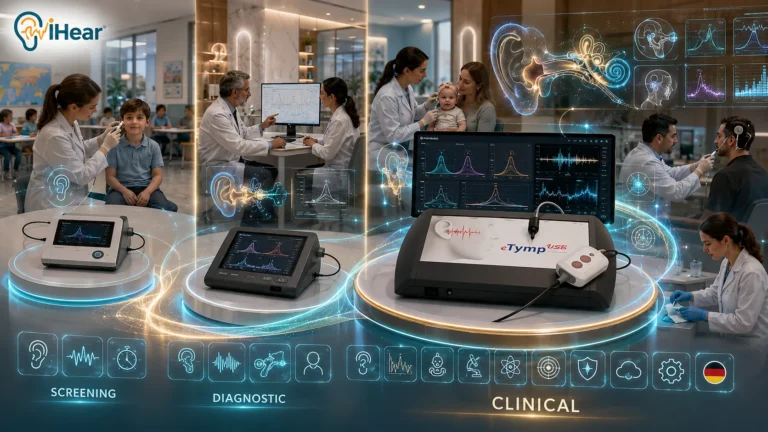
Types of Tympanometers: Screening vs Diagnostic vs Clinical – Where Does the eTYMP USB Fit?
Single 226 Hz probe tone with a quick pass/refer result. Suited to fast checks, with no in-depth diagnostic detail.
Adds acoustic reflex testing and Eustachian tube function analysis to standard tympanometry.
Adds multiple probe tone frequencies, reflex decay testing, and a Scientific Mode for research and complex cases.
Where does the eTYMP USB middle ear analyzer fit? With multiple probe tone frequencies (226 / 678 / 1000 Hz, plus 800 Hz on request), ipsilateral and contralateral acoustic reflex testing, reflex decay testing, Eustachian tube function testing for both intact and perforated eardrums, and an advanced Scientific Mode, the eTYMP USB is a full clinical middle ear analyzer, not just a basic screening tympanometer.
eTYMP USB Technical Specifications: Full Tympanometer and Middle Ear Analyzer Specs
| Specification | Value |
|---|---|
| Probe tone frequencies | 226 Hz (standard), 678 Hz, 1000 Hz (800 Hz on request) ± 1% |
| Probe tone levels | 85 / 80 / 75 dB SPL ± 3 dB |
| Total harmonic distortion (THD+N) | Less than 4% (acoustically measured) |
| Pressure range | +400 to -600 daPa |
| Pressure accuracy | ± 5% or 10 daPa |
| Compliance range | 0.1 to 6.0 ml (up to 8.0 ml on request) |
| Compliance accuracy | ± 5% or 0.1 ml |
| Pump speed | 100–400 daPa/sec |
| Pump control | Automatic or manual |
| Compliance unit | Equivalent air volume [ml] or mmho |
| Number of curves | One per page (overwriting) |
| LED indicator | Six colors and blinking pattern show the current device and probe status in real time |
| Specification | Value |
|---|---|
| Ipsilateral (IPSI) reflex stimulus | 500 / 1000 / 2000 / 4000 Hz ± 3% |
| Maximum IPSI intensity | 110 dB HL ± 3 dB |
| Contralateral (CONTRA) reflex stimulus | Same frequencies, plus a user-defined stimulus |
| Maximum CONTRA intensity | 120 dB HL ± 3 dB |
| CONTRA headphone | DD45 Contra |
| Total harmonic distortion (THD+N) | Less than 5% (acoustically measured) |
| Minimum intensity | 40 dB HL |
| Measurement mode | Automatic or manual |
| Automatic test | 5 dB / 10 dB steps per frequency |
| Manual test | Unlimited curves per frequency and ear |
| Stimulus duration | 0.4–1.5 seconds (reflex decay up to 60 seconds) |
| Special measurement | Cochlear implant (CI)-triggered acoustic reflex via direct CI stimulation (see the cochlear implant section above) |
| Eardrum Condition | Test |
|---|---|
| Intact eardrum | Williams test (3 curves per ear) |
| Perforated eardrum | Active and passive tube opening (Valsalva maneuver) |
| Specification | Value |
|---|---|
| Dimensions | 310 × 105 × 250 mm |
| Weight | Approx. 1500 g |
| Probe weight | Only 4 g |
| Power consumption | Max. 20 W |
| Interface | Isolated USB 2.0 (for patient safety) |
| Test types | Tympanometry, acoustic reflex threshold, reflex decay, Eustachian tube function (intact and perforated eardrum) |
| CONTRA output | 6.35 mm |
| Trigger input | 3.5 mm, 5 kV optocoupler, internally limited to 5–20 mA |
| Trigger output | 3.5 mm, 5 kV optocoupler, open collector |
| Operating environment | 10°C to 40°C, up to 90% humidity |
| Standards | DIN EN 60645-5 / DIN EN 60601-1 / EWG 93/42 EEC |
- Automatic altitude correction for accurate admittance values at any clinic location
- All calibration values are stored in the probe itself, so there is no need to recalibrate the main unit when replacing the probe
- Robust acoustic reflex detection
- Two operating modes: Easy Mode and Expert Mode
- Scientific Test Mode for research and advanced evaluations
- Continuous measurement
- Small, lightweight probe that is easy to clean and disinfect between patients
- Flexible trigger functions via electrically decoupled input and output
- Fully compatible with Windows 11
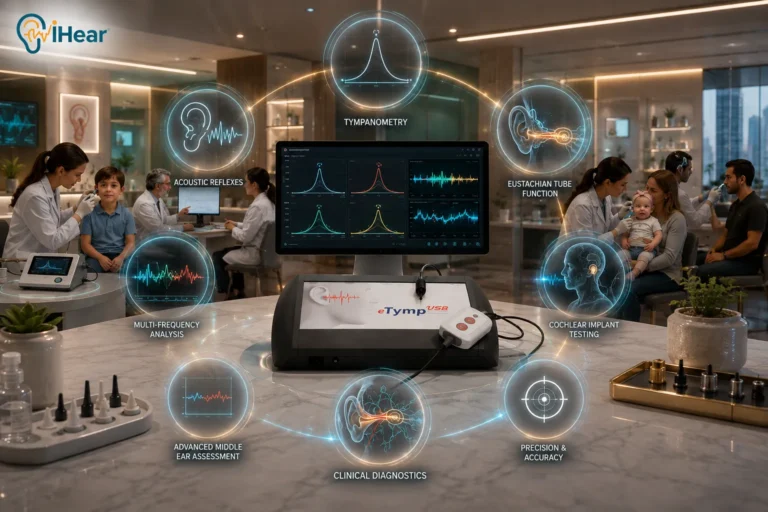
eTYMP USB Tests Explained: Tympanometry, Acoustic Reflex, and Eustachian Tube Function Testing
Who Needs the eTYMP USB Tympanometer? Conditions It Helps Detect
Tympanometry for Diagnosing Otitis Media with Effusion (Glue Ear) in Children
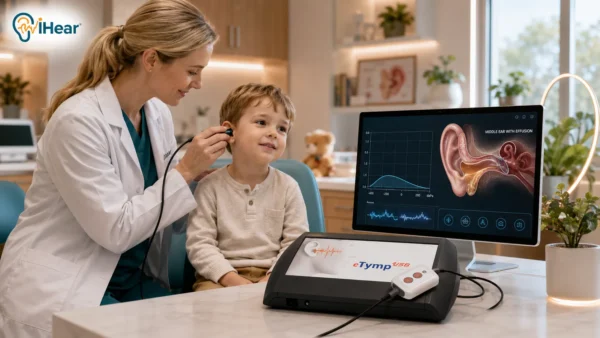
Otitis media with effusion (OME), often called glue ear, is one of the most common reasons children visit ENT clinics in the UAE. It is a buildup of fluid behind the eardrum that can affect hearing without the signs of an acute ear infection, and it is especially common in children under five. Tympanometry is the standard test for confirming middle ear fluid and for monitoring the condition before and after treatment, such as ear tube (grommet) insertion. The eTYMP USB tympanometer makes this quick and easy, even with young children, thanks to its small, lightweight probe and fast test time.
In young children, the Eustachian tube (the channel connecting the middle ear to the back of the throat) is shorter and more horizontal than in adults. This makes it easier for the tube to become blocked during a cold or an upper respiratory infection. When the tube is blocked, air and fluid cannot drain from the middle ear normally, so fluid builds up behind the eardrum. This is exactly what a tympanometry test measures and detects.
Unlike an acute middle ear infection, which usually comes with clear ear pain, fever, and crying, otitis media with effusion (glue ear) is often silent, with no noticeable pain. That is why it can go undiagnosed for a long time. Signs parents may notice include:
• Not paying attention, or often asking people to repeat themselves
• Turning up the TV or tablet volume higher than usual
• Mild speech or language delay when the condition lasts for a long time
• A mild feeling of discomfort or fullness in the ear, without sharp pain
Because there is often no obvious pain, parents' observations alone are not enough for a diagnosis. This is exactly where an objective hearing test becomes important.
With an otoscope, a doctor can see changes in the color of the eardrum or a bulging eardrum, but this visual impression alone may not be conclusive, especially in mild cases or with children who are not cooperative during the exam. Tympanometry adds an objective, measurable result: a Type B tympanogram (a flat curve with no clear peak, as explained above) confirms the presence of fluid with a measurement rather than a visual estimate. This is why combining both tests, otoscopy and tympanometry, is the most accurate approach in clinical practice.
In many cases, the doctor recommends "watchful waiting" for several weeks, because the fluid clears on its own in a large proportion of children without treatment. During this period, tympanometry is repeated at regular intervals to track whether the tympanogram improves from Type B toward Type A. If the fluid persists for a long time (usually more than three months) or noticeably affects hearing or speech, the doctor may refer the child for further assessment, which can lead to the insertion of small ear tubes (grommets) to drain the fluid. At every stage, from the first diagnosis to regular follow-up after any treatment, tympanometry remains the fastest, painless follow-up test the doctor returns to at each visit.
This section provides general information for educational purposes only and does not replace a medical evaluation by a qualified doctor for each individual child.
Tympanometer for Cochlear Implant Centers: Middle Ear Testing and ESRT
A cochlear implant is a medical device surgically placed behind the ear to help people with severe to profound hearing loss who do not get enough benefit from conventional hearing aids. Instead of relying on the ear’s natural mechanism, it stimulates the auditory nerve electrically. Cochlear implant programs are now available in several major hospitals across the UAE, and they involve a multidisciplinary team of ENT surgeons and audiologists.
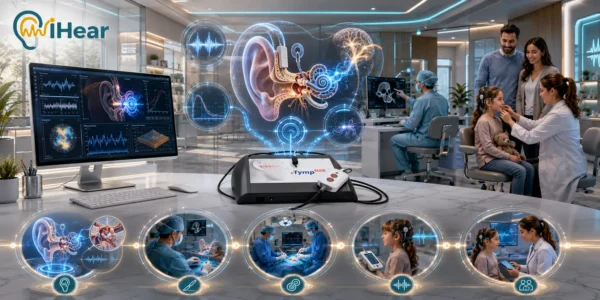
This is where the eTYMP USB plays a very different role from its everyday use in general audiology clinics. Because it can measure the acoustic reflex triggered directly by the electrical stimulation of the cochlear implant (ESRT), it becomes a valuable support tool for cochlear implant teams at two key stages: pre-surgical evaluation, and adjusting stimulation levels after surgery. Both are explained in the sections below.
Before any cochlear implant surgery, the medical team needs to confirm that the middle ear is free of problems that could complicate the operation or affect its outcome, such as fluid behind the eardrum, an eardrum perforation, or Eustachian tube dysfunction. Tympanometry is a core part of the pre-operative workup, alongside hearing tests and CT imaging, and it takes place long before the implant itself is placed.
After a cochlear implant is fitted, the clinical team must adjust the implant's electrical stimulation levels (mapping or programming) so that sound is clear and comfortable for the patient without being too loud. The challenge is that many cochlear implant users, especially young children, cannot give a reliable behavioral response to tell the audiologist "this level is comfortable" or "this is too loud."
This is where the electrically evoked stapedial reflex threshold (ESRT) comes in. It measures the acoustic reflex triggered directly by electrical stimulation from the implant itself, instead of by an external sound from a headphone, and this is exactly what the eTYMP USB provides. The measurement is fully objective and does not depend on the patient's cooperation, which makes it especially valuable when programming implants for infants and young children, who receive most cochlear implants (the ideal window for implantation is usually between 1 and 4 years of age).
• Before surgery (candidacy evaluation): confirming normal middle ear function as part of the full assessment of cochlear implant candidates
• At initial activation and early mapping: using the implant-triggered reflex as an objective guide to help set comfort levels, especially in children
• During regular follow-up visits: checking that middle ear function remains stable over time, and tracking any change that may call for reprogramming
Many middle ear analyzers on the market stop at standard tympanometry and external acoustic reflex testing. Measuring the reflex triggered by electrical stimulation from a cochlear implant is a specialized feature that is not listed as a standard capability on every competing device. This makes the eTYMP USB worth a close look for cochlear implant centers and hospital implant units, not only general audiology clinics.
This is a specialized technical feature. Cochlear implant centers and hospitals should confirm full compatibility with the implant brand and protocol they use (Cochlear, MED-EL, Advanced Bionics, and others) before purchase. Contact the iHear team for the exact technical details for your setup.
eTYMP USB vs Leading Tympanometers: Comparison with Titan, touchTymp and TympStar Pro
| Criteria | eTYMP USB (BioMed Jena) | Interacoustics Titan | MAICO touchTymp MI 34 | GSI TympStar Pro |
|---|---|---|---|---|
| Country of origin | Germany | Denmark | Germany | United States |
| Probe tone frequencies | 226 / 678 / 1000 Hz (800 Hz on request) | 226 Hz standard + 678 / 800 / 1000 Hz (optional) | 226 / 678 / 800 Hz + 1000 Hz optional | 226 / 678 / 1000 Hz |
| Ipsilateral / contralateral acoustic reflex | Yes (500–4000 Hz) | Yes | Yes (500–4000 Hz) | Yes |
| Reflex decay testing | Yes (ipsilateral and contralateral) | Yes | Yes (ipsilateral and contralateral) | Not explicitly listed in published specifications |
| Eustachian tube function (ETF) testing | Yes: intact and perforated eardrum | Yes: intact, perforated, and patulous | Yes: intact and perforated | Not explicitly listed in published specifications |
| Wideband tympanometry | Not available | Yes (optional add-on module) | Not available | Not available |
| Cochlear implant (CI) triggered reflex | Yes: listed as a standard feature | Not listed as a feature | Not listed as a feature | Not listed as a feature |
| Operation | PC-based, through the unified eAUDIO software | Standalone handheld device, with optional PC control | Built-in 10.4-inch touchscreen + handheld probe | Conventional desktop / portable unit |
| Integration with a unified diagnostic system | Yes: one database with eAUDIO, eABR, eOAE and eVNG through eDM | Integrates with Interacoustics OtoAccess / NOAH | Integrates with MAICO Sessions or OtoAccess / NOAH | Integrates with compatible NOAH software |
| Price and availability | Direct quote from authorized distributor iHear, with local support and training in the UAE | Modular system: price depends on the selected modules, through distributors | Modular system: price depends on the version (screening / diagnostic) | Quote on request from the distributor |
Buy the eTYMP USB Tympanometer in the UAE: Why Choose iHear?
📞 Contact the iHear team in Al Ain or Abu Dhabi to request an audiometer quote for your clinic on WhatsApp
Start a WhatsApp ChatOther BioMed Jena Audiology Devices Your Clinic May Need
| Device | Use | How It Works with the eTYMP USB |
|---|---|---|
| eAUDIO USB | Two-channel diagnostic audiometer for pure tone and speech audiometry | The natural companion test, almost always ordered together with tympanometry |
| eABR USB | Auditory brainstem response (ABR) testing + VEMP | Evaluates the neural pathway when eTYMP results are normal but the cause of hearing loss is unclear |
| eOAE | Otoacoustic emissions (OAE) newborn hearing screening | Covers newborn screening within the same eDM diagnostic system |
| AudioBox | 4 to 6 channel free field amplifier | Extends audiometry with free field testing for pediatric audiometry and lateralization analysis |
eTYMP USB Tympanometer FAQs: Common Questions About Tympanometry and Middle Ear Analyzers
What is a tympanometer and how does it work? +
What is the eTYMP USB and what is it used for? +
What is the difference between tympanometry and audiometry? +
Can tympanometry detect hearing loss? +
What is the difference between screening, diagnostic, and full clinical tympanometers? +
What is a normal tympanogram result? +
What do Type A, Type B, and Type C tympanograms mean? +
What conditions can tympanometry help detect? +
Can the eTYMP USB be used with infants and newborns? +
Is a tympanometry test painful? +
How long does a tympanometry test take? +
What is acoustic reflex testing, and what is the difference between ipsilateral and contralateral? +
What is Eustachian tube function testing, and when is it needed? +
Can tympanometry be performed if the eardrum is perforated? +
Can the eTYMP USB be used for cochlear implant programming (ESRT)? +
What is the difference between the eTYMP USB and the eAUDIO USB? +
Does the eTYMP USB need a computer? +
Can I create custom test protocols on the eTYMP USB? +
Does replacing the probe require recalibrating the whole device? +
How often does a tympanometer need calibration? +
What quality standards does the eTYMP USB follow? +
Does the software require a license fee for each computer in the clinic? +
Does the device integrate with hospital information systems? +
How does the eTYMP USB compare with the Interacoustics Titan? +
How much does the eTYMP USB cost in the UAE? +
Is the device registered with UAE health authorities (MOHAP/DHA)? +
Where can I buy the eTYMP USB in the UAE? +
Does iHear provide training and maintenance for the device? +
For more information
Feel free to contact us anytime. Our team is always ready to help you.