
PhysioSensing Posturography Station: Force Plate Balance Assessment and Fall-Risk Evaluation
The PhysioSensing Posturography Station is an advanced force plate system that adds objective, documented measurement to the clinical assessment of balance. It records the center of pressure (CoP) and sway, and PhysioSensing lists more than 30 CoP and sway parameters, to help clinicians identify subtle balance deficits. It is used for balance assessment and training in vestibular rehabilitation, to quantify postural control in neurological conditions such as stroke, Parkinson's disease, multiple sclerosis, and traumatic brain injury, and to assess fall risk, including in older adults.
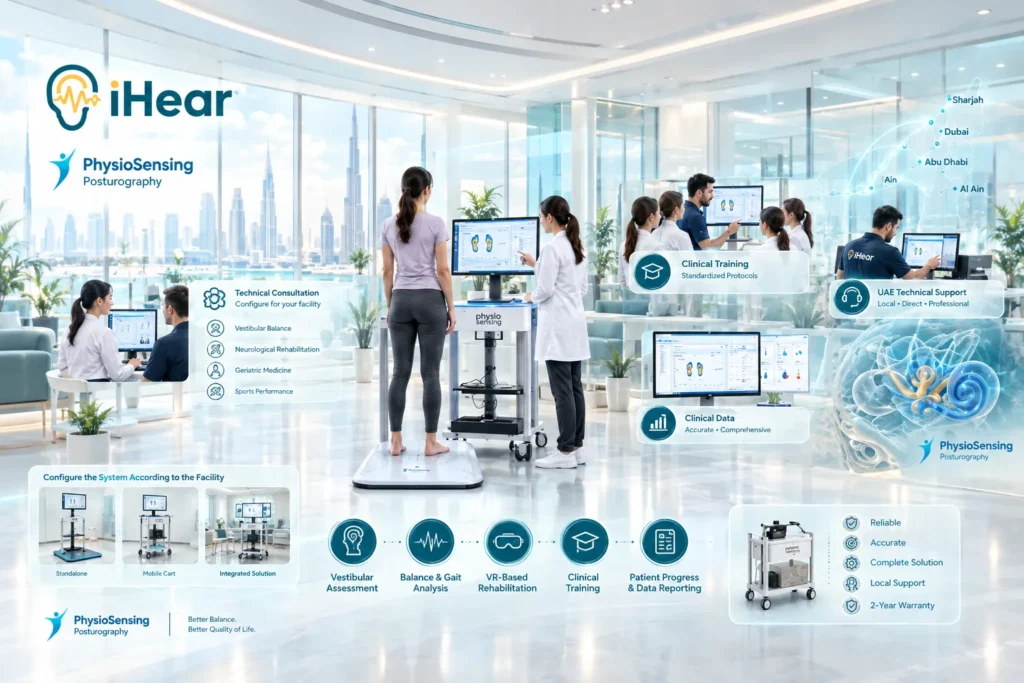
iHear is the authorized distributor of PhysioSensing (Sensing Future Technologies, Portugal) devices in the UAE. Headquartered in Al Ain, iHear offers them to clinics, hospitals, and rehabilitation centers across the UAE. Alongside the Posturography Station, iHear supplies the Otoneuro System for vestibular rehabilitation, Beltone hearing aids, and BioMed Jena (Germany) diagnostic devices for hearing and balance.
| Specification | Value |
|---|---|
| Size (L × W × H) | 55 × 55 × 3 cm |
| Thickness | 1.5 cm |
| Weight | 8.5 kg |
| Material | Aluminium AU4G |
| Minimum load | 20 kg |
| Maximum load | 250 kg |
| Sampling rate | 100 Hz |
| Analog-to-digital conversion | 24 bits |
| Computer interface | USB |
| Power supply | USB cable |
What Is Force Plate Posturography?
Advanced force measurement platform for balance and vestibular rehabilitation
The PhysioSensing Complete Posturography Station is an advanced clinical system to objectively assess balance, postural control and fall risk, specifically designed for physical therapy, vestibular rehabilitation and neurorehabilitation clinics.
This station integrates a high-precision balance dynamometer platform with specialized clinical software, allowing precise analysis of the center of pressure, postural fluctuation, and patient stability in both static and dynamic positions. With instant visual feedback, the station facilitates clinical assessment and therapeutic balance training.
It is an integrated, comprehensive solution that includes the platform, software, computer, display and transport cart, ready for immediate use in specialized clinical environments.
The PhysioSensing Posturographic Station turns balance assessment into a meaningful experience – combining scientific rigor with interactive feedback to assess, train and restore postural stability in patients with vestibular, neurological or age-related balance disorders, enabling confident movement and measurable recovery.


Clinical Applications of the Posturography Station: Balance Assessment and Fall-Risk Evaluation

- Vestibular Rehabilitation and Sensory Integration RebalancingRestore balance by retraining how the brain integrates visual, vestibular, and somatosensory inputs.
- Fall Risk Assessment and PreventionIdentify instability before it leads to a fall. Advanced force platform metrics (sway area, velocity, and path) quantify and objectively guide early preventive interventions.
- Neuro-Rehabilitation and Functional Follow-UpAssess postural control in patients with Parkinson’s disease, stroke, multiple sclerosis, or traumatic brain injury. Monitor recovery and tailor therapy using measurable data that reveal true functional progress.
- Stability Limits and Motor Control TrainingAssess and expand each patient’s safe range of motion using real-time visual feedback. Train automatic postural responses, enhance control strategies, and restore confident movement.
- Comprehensive Sensory Integration, Evidence-Based Assessment, and Outcome MonitoringAssess the contribution of sensory systems using the mCTSIB and related tests. Generate repeatable and comparable reports to track improvement, demonstrate effectiveness, and provide measurable results to patients and referring clinicians.
Why Choose the PhysioSensing Posturography Station?
- Extremely Comprehensive Body Sway Analysis (Over 30 Metrics)Detailed Postural Insights – Over 30 Center of Pressure and Sway Metrics to Detect Subtle Balance Impairments Often Overlooked by Others.
- Preloaded and Validated Clinical ProtocolsComes with ready-to-use standard tests (such as LOS and mCTSIB) to streamline clinical workflow and ensure repeatability.
- Track Progress and Monitor Treatment EffectivenessLongitudinal reports visually compare sessions to identify gains, validate therapy, and adapt protocols over time.
- Intuitive Real-Time Visual FeedbackPatients and clinicians see impact maps or targets in real time, enhancing engagement, motivation, and therapy adherence.
- Customizable to Your Clinical NeedsYou can adjust test durations, set directional weighting, and design protocols to match each patient’s condition and capabilities.
- Enhances Clinical Credibility and ExcellenceProviding advanced objective posturography services sets your clinic apart and builds trust with patients and colleagues.
- Specifically Designed for Balance, Vestibular, and Neurology Specialists.User interface, metrics, and workflow specifically designed to meet the needs of physical therapists, audiologists, ENT physicians, vestibular therapists, geriatricians, and neuro-rehabilitation specialists.

Posturography Station Balance Exercises and Games: Interactive Training With Real-Time Feedback
What Does a Posturography Station Measure? 30+ Center-of-Pressure and Sway Parameters
Posturography Station Specifications: Force Plate Technical Data and Configurations
| Specification | Value |
|---|---|
| Size (L × W × H) | 55 × 55 × 3 cm |
| Weight | 8.5 kg |
| Thickness | 1.5 cm |
| Material | Aluminium AU4G |
| Minimum load | 20 kg |
| Maximum load | 250 kg |
| Sampling rate | 100 Hz |
| Analog-to-digital conversion | 24 bits |
| Computer interface | USB |
| Power supply | USB cable |
| Requirement | Specification |
|---|---|
| Processor (CPU) | Intel i5, 2.30 GHz (avoid "U" and "G7" versions) |
| RAM | 8 GB |
| Graphics card | 6 GB |
| USB ports | At least 2 ports (USB 2.0 or 3.0), plus 1 USB 3.0 port |
| Operating system | Windows 10 or 11 (64-bit) |
| Recommended screen resolution | 1920 × 1080 px |
| Item | Details |
|---|---|
| Medical device classification | CE-marked Class I medical device |
| Regulation | EU Medical Device Regulation (MDR 2017/745) |
| Quality standard applied | ISO 13485 |
| Unique Device Identification | UDI-DI: 05600717927062 |
| Warranty | 2 years |
CE marking is a European conformity marking, and use in the UAE is subject to the requirements of the relevant UAE health authority. Ask iHear for the current status.
Ask iHear which configuration suits your facility, and whether later upgrades are possible.
Who Is the Posturography Station For?
Posturography Station vs. Other Force Plate Posturography Systems
| Feature | Static force plate systems (such as the Posturography Station) | Dynamic posturography systems (CDP) |
|---|---|---|
| Support surface | A fixed platform that records the patient's weight distribution and center of pressure | A platform that can move in translation and rotation to challenge balance, often with a visual surround |
| Typical assessment | Protocols such as body sway, mCTSIB, Romberg, limits of stability, rhythmic weight shift, and unilateral stance | Tests with controlled support-surface and visual-surround movement, such as the Sensory Organization Test (SOT) |
| Training | Real-time visual feedback exercises and games on the force plate (the Posturography Station offers six exercise categories, six balance games, and a motor-cognitive game) | Training with moving surfaces and surround or immersive visuals, depending on the system |
| Hardware | A force plate (55 × 55 × 3 cm and 8.5 kg for the Posturography Station) with software and a PC | Larger systems with a motorized base; some include an integrated safety harness structure |
| Choosing | The right approach depends on your clinical needs, space, and budget. Contact iHear to discuss which fits your clinic. | |
Descriptions of dynamic systems are general and based on manufacturers' public information, such as Bertec CDP/IVR and NASA Spinoff's overview of dynamic and fixed force plate systems. Features vary by manufacturer and model.
Why Choose the PhysioSensing Posturography Station From iHear in the UAE?
Posturography Station FAQ: Common Questions About Force Plate Balance Assessment and Fall Risk

For more information
Feel free to contact us anytime. Our team is always ready to help you.