eABR USB: Portable ABR (BERA) System with Optional VEMP Testing
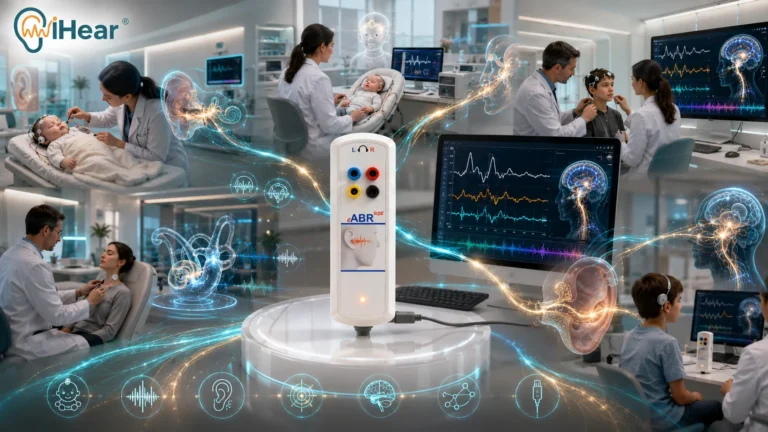
The eABR USB is a 2-channel auditory brainstem response (ABR) system from the German manufacturer BioMed Jena. About the size of a TV remote control (55 × 155 × 25 mm, just 140 g), it is still a full routine-use device for auditory evoked potentials. Unlike conventional audiometry, it does not depend on the patient's conscious response. It records the electrical response of the auditory nerve and brainstem to sound, which makes it an objective hearing test.
The eABR USB covers two distinct tests in one device:
- Auditory brainstem response (ABR/BERA) testing: assesses hearing in patients who cannot give a reliable behavioral response, above all newborns and infants.
- VEMP (vestibular evoked myogenic potentials) testing: assesses vestibular function in patients with dizziness and vertigo. It is available as an optional module (cVEMP and oVEMP).
iHear, the authorized distributor of BioMed Jena devices in the UAE, provides local technical support, training, and servicing from its branches in Al Ain and Abu Dhabi.
| Specification | Details |
|---|---|
| Model | eABR USB (also written eABRUSB) |
| Manufacturer | BioMed Jena GmbH, Germany (device developed in 2016) |
| Device type | Portable auditory brainstem response (ABR/BERA) system, with optional VEMP testing for vestibular assessment |
| Test method | Fully objective: no active response needed from the patient (works even while an infant sleeps) |
| Size and weight | Remote-control sized: 55 × 155 × 25 mm, 140 g without accessories |
| Channels | 2 channels (24-bit, 48 kHz) |
| Main uses | (1) Objective hearing testing (ABR/BERA) for babies, infants and children (2) VEMP testing to assess vestibular disorders (dizziness and balance) |
| Standards | EN 60645-7:2010 / 93/42/EEC (Medical Device Directive) |
| Authorized distributor in the UAE | iHear, Al Ain and Abu Dhabi, UAE |
Quick summary: The eABR USB is a portable German auditory brainstem response (ABR/BERA) system, about the size of a remote control. ABR is the standard objective hearing test for newborns, infants and children who cannot respond to sounds on their own. An optional module adds cVEMP and oVEMP testing to help diagnose dizziness and vertigo. Complies with EN 60645-7:2010. Available in the UAE through iHear, the authorized distributor of BioMed Jena.
What Is the eABR USB, and How Does an ABR Test Differ from a Standard Hearing Test?
The eABR USB is an auditory brainstem response (ABR) system. ABR is also known as BERA (brainstem evoked response audiometry), the name many clinics use, and parents often just call it the “brainstem test” for babies. The device uses small electrodes placed on the head to record the electrical activity that the hearing nerve and brainstem produce in response to sound, with no active response needed from the patient. This sets it apart from the eAUDIO USB, where the patient has to press a button when they hear a tone, and even from the eTYMP USB, which only checks how the middle ear works mechanically. The eABR USB tests the actual neural pathway, from the inner ear all the way to the brainstem.
With an optional module, the same device also measures VEMP (vestibular evoked myogenic potentials). In this test, a loud sound triggers a response in the neck muscle (cVEMP) or in the muscles around the eyes (oVEMP). It serves a completely different purpose: assessing the saccule and utricle, the two otolith organs of the inner ear that control balance, not hearing.
What Is a BERA Test (Auditory Brainstem Response, ABR)?
BERA vs ABR: Same Test, Different Names
+
Before going into detail, a quick clarification: BERA and ABR are, in practice, two names for the same test. "ABR" (Auditory Brainstem Response) is the technical term for the electrical signal itself, while "BERA" (Brainstem Evoked Response Audiometry) is the name that became common in everyday clinical use, especially in the Gulf, Egypt and South Asia, for using that same signal to estimate a person's hearing threshold.
You will see the two terms used interchangeably in many medical sources. Even the manufacturer of the eABR USB calls the hearing threshold protocol in its software "Threshold-BERA". You may also come across auditory evoked potentials (AEP), a broader term that covers ABR and other types of auditory evoked responses.
How Does an ABR (BERA) Test Work?
+
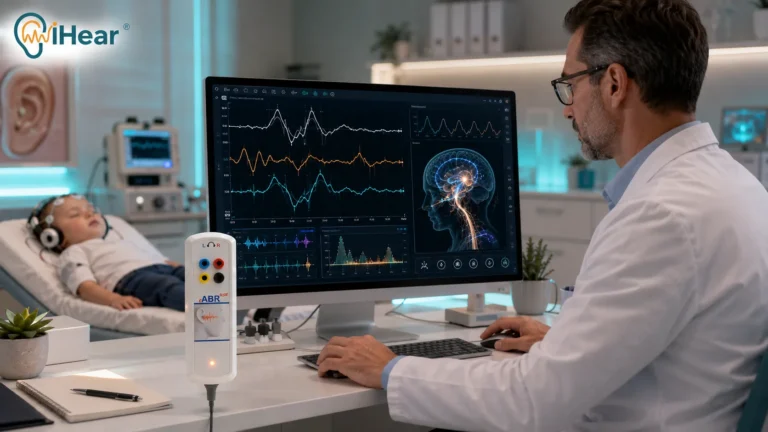
The auditory brainstem response is a set of very small electrical signals that the hearing nerve and brainstem send automatically when they hear a sound (a click or a short tone). Small adhesive electrodes placed on the forehead and behind the ears record these signals. The patient does not need to take part at all, so the test can usually be done during a baby's natural sleep, without sedation.
The result appears as a series of waves (I to V) within the first 10 milliseconds after the sound. The clinician checks the timing of these waves and compares them between the two ears to assess the whole hearing pathway, from the inner ear to the brainstem.
When Is an ABR Test Needed?
+
An ABR test is used mainly when a standard hearing test cannot give reliable results:
- Newborns and infants who cannot raise a hand or signal when they hear a sound
- Children from about 3 months to around 3 years old, the age range in which reliable behavioral audiometry is difficult
- Asymmetric hearing loss between the two ears, or a suspected problem with the hearing nerve itself rather than only the inner ear, including initial screening for acoustic neuroma (vestibular schwannoma) before an MRI
- Patients who cannot respond voluntarily, such as those with severe intellectual disability or in a coma
Accuracy note: ABR is also used in some advanced centers worldwide for continuous auditory nerve monitoring during acoustic neuroma removal surgery (intraoperative neuromonitoring). However, this is a highly specialized application that usually requires dedicated intraoperative monitoring platforms, and it is not an officially documented use of the eABR USB according to its published specifications. Mention it as background information if you wish, but do not market the device for this purpose without direct technical confirmation from BioMed Jena.
eABR USB and Mandatory Newborn Hearing Screening in the UAE
Newborn Hearing Screening Is Not Optional in the UAE
The UAE Cabinet has approved a newborn hearing screening program, enacted into official law as part of the comprehensive newborn medical screening system, alongside blood and heart screening tests. In practice, Emirates Health Services (EHS) publishes actual monthly compliance data. For example, compliance with newborn hearing screening in 2025 ranged between 96.3% and 99.1% per month, reflecting a serious, ongoing screening system rather than a temporary initiative.
Why This Matters If You're Considering the eABR USB
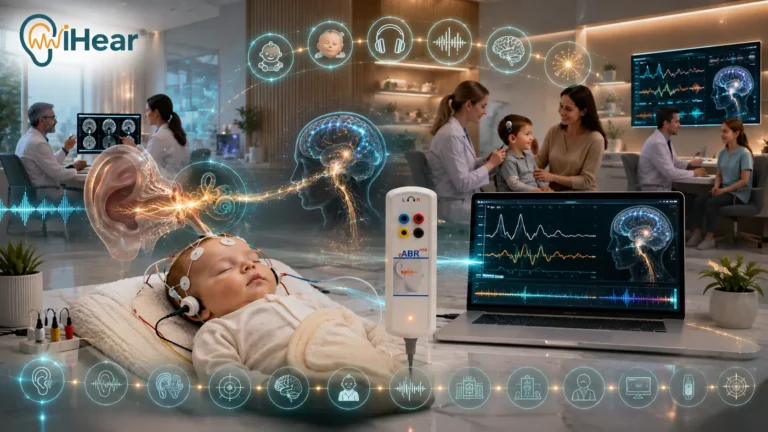
Newborn hearing screening is typically carried out in two internationally standard stages: an initial otoacoustic emissions (OAE) screening for all newborns, followed by a confirmatory auditory brainstem response (ABR/AABR) test for babies who do not pass the first stage or who have additional risk factors (low birth weight, premature birth, family history of hearing loss, infection during pregnancy). Any healthcare facility, whether a private hospital, pediatric clinic, or specialized screening center, that wants to offer both stages of this service needs both an OAE device and an ABR device. This is exactly what the BioMed Jena eOAE and eABR USB pair provides, within the same eDM system.
Signs That Call for an ABR Test Referral, Even After Passing the Initial Screening
- Noticeable lack of response to sounds compared with other children the same age.
- Clear delay in speech or language development.
- Family history of hereditary sensorineural hearing loss.
- Maternal infection during pregnancy (rubella, herpes, toxoplasmosis) or birth risk factors (low birth weight, premature birth, NICU stay).
eABR USB and VEMP Testing for Dizziness and Vertigo Clinics
Company Roots: BioMed Jena Started Out as a Vertigo Diagnostics Company
A detail worth noting: according to the company's official history, BioMed Jena did not begin with hearing test equipment. In 1998, only its second year after founding, it launched a Vertigo Diagnostic Line as an OEM developer and manufacturer, before later introducing its own brand with devices such as the eVNG. In other words, the company's expertise in balance and dizziness diagnostics is its founding foundation, not a later add-on to an audiology product line.
What Is a VEMP Test, and Why Do Dizziness Specialists Order It?
Vestibular evoked myogenic potentials (VEMP) is a test that evaluates the function of the saccule and utricle in the inner ear. These are part of the vestibular system, which is responsible for balance. The test works by recording an automatic muscle response to a loud sound or vibration. It differs from other vertigo tests, such as caloric testing or videonystagmography (VNG), because it specifically examines a different neural pathway (the inferior vestibular nerve), which makes it a complement to, not a replacement for, other balance tests.
A VEMP test is commonly requested as part of the evaluation of:
- Meniere's disease and monitoring its progression
- Vestibular neuritis and distinguishing it from other causes of vertigo
- Superior semicircular canal dehiscence (SCDS), where VEMP is a key diagnostic tool
- Comprehensive assessment before certain inner ear surgeries
Why the eABR USB Also Serves a Completely Different Audience
Dizziness and vertigo clinics (vertigo and balance clinics) are a buyer segment entirely different from pediatric audiology clinics. Here, the purchasing decision rests with ENT specialists focused on balance disorders, or with neurology clinics. Featuring VEMP clearly and separately on this page, rather than as a buried extra line, opens a whole second market for the eABR USB, separate from the hearing test market.
Why Choose the eABR USB for ABR and VEMP Testing?
Multiple, Flexible Test Stimuli
+
The device supports Click, adjustable Tone-Pip, and CW-Chirp stimuli, with control over click polarity (positive, negative, alternating). This flexibility allows the examiner to choose the most suitable stimulus for each diagnostic case.
Automated Assistance Functions That Reduce Human Error
+
Advanced functions that help ensure accurate and reliable testing:
- Automatic monitoring of electrode impedance before the test begins
- Automatic Gain Control (AGC)
- Automatic artefact rejection to clean the recording of patient movement
- Automatic stop function once sufficient recording quality is reached
High Recording Accuracy, Even in a Standard Clinic Environment
+
A 2-channel analog-to-digital converter (ADC) with 24-bit resolution and a 48 kHz sampling rate, plus a common-mode rejection ratio (CMRR) above 130 dB at 50/60 Hz. In simple terms, it filters the true brain signal from surrounding electrical mains interference very effectively, without needing a fully electrically shielded room.
Fully Customizable Test Protocols
+
Examiners can build their own freely defined test protocols (ready-made example: Threshold-BERA for estimating hearing threshold), with easy curve handling and automatic coupler detection.
Truly Portable, Not Just "Transportable"
+
Weighing just 140 g without accessories, with power consumption under 5 W, it runs entirely from a USB 2.0 port (bus-powered) with no external power adapter. You can easily carry it between exam rooms or even between clinic branches, which is rarely possible with larger evoked potential systems.
Automatic PDF Reports and Free Lifetime Software Updates
+
Automatic PDF report export after every test, plus free lifetime online software updates with no annual subscription fees for the software itself.
Complete Technical Specifications of the eABR USB BERA / ABR System
A. Supported Test Types
| Test Type | Details |
|---|---|
| Auditory Brainstem Response (BERA/ABR) | Core test: objective hearing threshold estimation, the main area of use |
| Auditory Steady-State Response (ASSR) | Supported within the auditory evoked potentials category |
| Cervical Vestibular Evoked Myogenic Potentials (c-VEMP) | Optional module: assesses saccule function and the inferior vestibular nerve |
| Ocular Vestibular Evoked Myogenic Potentials (oVEMP) | Optional module: assesses utricle function and the superior vestibular nerve |
B. General Specifications
| Specification | Value |
|---|---|
| Air Conduction Headphones (AC-Phones) | Radioear DD45 shielded / Radioear IP 30 Bera |
| Analog-to-Digital Converter (ADC) | 2 channels, 24-bit resolution, 48 kHz sampling rate |
| Common-Mode Rejection (CMR) | Greater than 130 dB at 50/60 Hz |
| Maximum Number of Sweeps | Up to 10,000 sweeps |
| Interface & Power Supply | USB 2.0, powered directly from the port with no external adapter (bus-powered) |
| Compatible Operating Systems | Windows 10 and Windows 11 |
| Dimensions | 55 × 155 × 25 mm (about the size of a remote control) |
| Weight | 140 g (without accessories) |
| Power Consumption | Less than 5 W |
| Operating Environment | 15 °C to 35 °C, humidity below 75% |
| Certified International Standards | EN 60645-7:2010 / 93/42/EEC |
| Country of Manufacture | Germany (Made in Germany) |
C. Acoustic Test Stimuli
| Specification | Value |
|---|---|
| Supported Stimulus Types | Click, adjustable Tone-Pip, Continuous Wave Chirp (CW-Chirp) |
| Click Polarity | Positive / Negative / Alternating |
| Masking | Masking noise |
D. Automated Assistance Functions
| Function | What It Does for the Examiner |
|---|---|
| Automatic Electrode Impedance Control | Instant alert when an electrode is poorly attached, before the test starts |
| Automatic Gain Control (AGC) | Automatically adjusts input sensitivity according to signal quality |
| Automatic Artefact Rejection | Automatically excludes recordings contaminated by patient movement |
| Automatic Stop Function | Ends the test as soon as sufficient recording quality is reached, with no manual intervention |
| Automated Coupler Detection | Automatically recognizes the type of transducer/coupler in use |
E. Software & Reporting Features
| Feature | Details |
|---|---|
| Digital Conversion Resolution | 24-bit conversion for high-quality recordings |
| Freely Definable Protocols | Build custom protocols, with a ready-made example: Threshold-BERA for hearing threshold estimation |
| Curve Handling | Easy-to-use interface for processing and reviewing response curves |
| Report Export | Automatic PDF report export after every test |
| Software Updates | Free lifetime online updates, with no annual subscription fees |
| Diagnostic System Integration | Full integration with eDM (Diagnostic Manager) and a unified patient database shared with other BioMed Jena devices |
eABR USB vs. Leading Global Evoked Potential Systems
| Criteria | eABR USB (BioMed Jena) | Interacoustics Eclipse | GSI Audera Pro | Natus Celesta |
|---|---|---|---|---|
| Country of Origin | Germany | Denmark | United States | United States |
| ABR/BERA Testing | Yes | Yes | Yes | Yes |
| ASSR Testing | Yes (listed within the evoked potentials category) | Yes (full module) | Yes (full module) | Not explicitly listed as a standard module |
| VEMP Testing (c-/o-) | Yes (optional) | Yes | Not announced as a standard module | Yes |
| ECochG / Cortical Responses (LLR) | Not available | Yes (add-on modules) | Yes (add-on modules) | Cortical responses available |
| Built-in OAE Testing | No (separate eOAE device from the same manufacturer) | Yes (built-in module) | Yes (built-in module) | Not directly integrated |
| Device Type | Truly portable, remote-control-sized (140 g) | Modular PC-connected platform | Comprehensive desktop clinical system | PC-connected system within the Maestro ecosystem |
| Advanced Stimuli (Chirp) | CW-Chirp | Full CE-Chirp family | CE-Chirp and CE-Chirp Octave Band | Not detailed in available sources |
| Integration with a Unified Diagnostic System | Yes: one database shared with eAUDIO, eTYMP and eOAE via eDM | Integrates with OtoAccess/NOAH | Proprietary GSI software | Natus Maestro ecosystem |
| Price Positioning (estimated, based on product type) | Lower initial investment: a focused device without built-in OAE/ECochG modules | Higher investment: comprehensive modular platform | Higher investment: comprehensive clinical system | Higher investment: part of an integrated ecosystem |
An Honest Summary of the Comparison
If your clinic or hospital needs a single, all-in-one platform that combines ABR, ASSR, OAE, ECochG and cortical responses in one device for a highly advanced diagnostic center, the three larger platforms (Eclipse, Audera Pro, Celesta) offer greater technical depth, but at a much higher investment.
ABR Testing in Adults: Objective Neurological and Retrocochlear Assessment
Analyzing Response Waves I, III and V: The Basis of the Neurological Test
The test works by analyzing the latency of the five standard response waves (clinical focus is on waves I, III and V) and comparing the timing difference between the two ears, known as the Interaural Latency Difference.
An abnormally delayed wave V, or a large difference between the two ears, is among the signs that lead doctors to suspect a problem along the auditory nerve pathway.
Conditions BERA/ABR Helps Evaluate in Adults
BERA / ABR- Retrocochlear hearing loss and tumors of the auditory nerve or brainstem (such as acoustic neuroma)
- Multiple sclerosis (MS) as a supporting tool for assessing involvement of the auditory neural pathway
- Head injuries and stroke to functionally assess brainstem integrity
- Certain infections affecting the auditory neural pathway
- Unexplained tinnitus, vertigo or difficulty understanding speech, even when conventional hearing tests such as the eAUDIO USB show normal results. This is a diagnostic gap that objective neurological testing is specifically suited to fill
Additional Specialized Use: Intraoperative Neuromonitoring
ABR is also used for intraoperative neuromonitoring during surgeries near the auditory nerve or brainstem, to immediately alert the surgeon to any change in the response that may signal a risk to the nerve during the operation.
Who Should Use the eABR USB? Ideal Clinics and Specialties for ABR/BERA Testing
Where to Buy the eABR USB in the UAE: Why Choose iHear
📞 Contact the iHear team in Al Ain or Abu Dhabi to request an audiometer quote for your clinic on WhatsApp
Start a WhatsApp ChatOther BioMed Jena Devices Your Clinic May Need
| Device | Use | How It Relates to the eABR USB |
|---|---|---|
| eOAE | Otoacoustic emissions (OAE) testing, the first step in newborn hearing screening | Used together in the complete newborn hearing screening pathway |
| eAUDIO USB | 2-channel diagnostic audiometer | For full behavioral assessment once the child is old enough to cooperate |
| eTYMP USB | Middle ear analyzer (tympanometry + ESRT for cochlear implants) | Completes cochlear implant assessment, neurally (eABR) and mechanically (eTYMP) |
eABR USB FAQs: ABR / BERA Testing and VEMP Questions Answered
For more information
Feel free to contact us anytime. Our team is always ready to help you.