What Is the eVEMP USB, and What Does VEMP Testing Measure?

The eVEMP USB is BioMed Jena’s system for vestibular evoked myogenic potentials (VEMP) testing. It is offered as part of the eABR USB hardware, so no separate extra hardware is needed. VEMP testing assesses the otolith organs, the saccule and the utricle, which are the parts of the vestibular system that sense gravity and linear acceleration. These organs are not assessed by tests of the semicircular canals, such as VNG and vHIT, which look at angular acceleration.

iHear is the exclusive authorized distributor of BioMed Jena in the UAE. It offers the eVEMP USB to hospitals and ENT centers that want to extend their vestibular assessment to the otolith organs, and not only the semicircular canals.

What Is the Difference Between cVEMP and oVEMP?
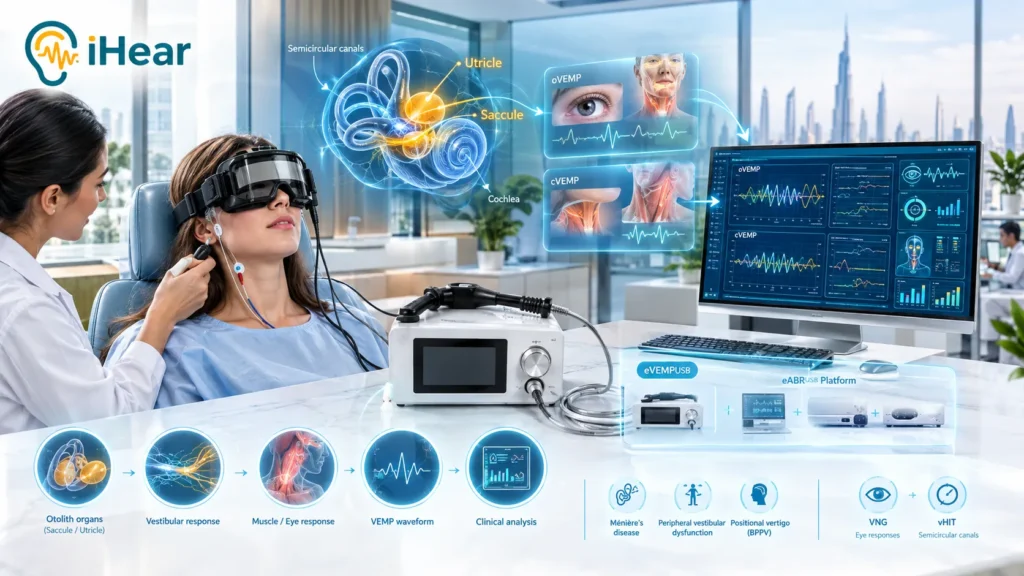
The eVEMP USB tests two different sensory receptors, with two separate tests, to assess how well the vestibular system is working:
cVEMP (cervical VEMP)
Assesses the function of the saccule, which is sensitive to vertical movement (like lifting), by recording an electrical response from a neck muscle (the sternocleidomastoid) after sound stimulation.
oVEMP (ocular VEMP)
Assesses the function of the utricle, which is sensitive to horizontal movement, by recording a response from the muscles around the eyes.
How the test is done: the patient sits or lies down, adhesive electrodes are placed at the recording locations, and the electromyography (EMG) signal is recorded and averaged.
جهاز eVEMPUSB — قياس استجابات العضو الأذني الحصوي المستثارة دهليزيًا لتشخيص داء منيير

Why Test the Otolith Organs? What cVEMP and oVEMP Add to a Vestibular Assessment

Most of the common vestibular tests (VNG and vHIT) assess the semicircular canals, which sense rotational head movement. But the vestibular system also has two other sensory organs: the saccule, which is sensitive to vertical movement (like lifting), and the utricle, which is sensitive to horizontal movement. These two organs are not assessed by VNG or vHIT. VEMP testing is the test used for them, with a device such as the eVEMP USB.

A clinic that wants to assess the otolith organs as well as the semicircular canals can add VEMP testing alongside its VNG and vHIT systems. The clinician decides which tests are needed for each patient.

cVEMP (Cervical VEMP)
Assesses the function of the saccule, which is sensitive to vertical movement, such as being lifted. It is typically recorded with adhesive electrodes on the neck muscle (the sternocleidomastoid).
oVEMP (Ocular VEMP)
Assesses the function of the utricle, which is sensitive to horizontal movement. It is typically recorded with electrodes placed below the eye.

The cVEMP and oVEMP assess two different organs, the saccule and the utricle, so using only one of them gives information about only one of the two. The clinician decides which tests are needed for each patient.

Multi-Frequency Analysis (MFA) in VEMP Testing and Ménière’s Disease

Multi-Frequency Analysis (MFA) is one of the features BioMed Jena highlights for the eVEMP USB. The stimulus is presented at several frequencies (500, 750, and 1000 Hz) instead of one fixed frequency. In healthy ears the response is typically largest at around 500 Hz, and in Ménière’s disease it has been reported to shift toward a higher frequency (1000 Hz).

In one peer-reviewed study (J Am Acad Audiol, 2016;27(9):764-777), the frequency tuning of the oVEMP was compared in 36 people with unilateral Ménière’s disease and 36 with unilateral benign paroxysmal positional vertigo (BPPV). Using a criterion point of tuning at 875 Hz, the specificity for identifying Ménière’s disease was 100% and the sensitivity was 68%. In practice, a tuning shift can support the clinician’s suspicion of Ménière’s disease, but the absence of a shift does not rule it out. Other studies, such as an analysis of the amplitude ratio between 500 and 1000 Hz, have reported the same direction with different methods and accuracy figures.

For this reason, MFA results are best read together with the other clinical findings and tests (such as VNG and caloric testing), not on their own. The clinician makes the diagnosis.

eVEMP USB Key Features

The system lets the clinician assess the saccule and the utricle together, from one platform.

The stimulus can be a conventional tone burst or BioMed Jena's CW-VEMP-Chirp®. In the literature, a chirp stimulus is described as producing a more synchronized response than a tone burst in some clinical situations.

Supports analysis at 500, 750, and 1000 Hz, to show the frequency shift that has been associated with Ménière's disease.

Generates a vibration that follows the strength of the neck muscle contraction, which helps the patient keep the muscle tension steady during the cVEMP test. Keeping the muscle tension steady is a known practical challenge in the literature, because it can affect the result.

The software marks the detected signals automatically, and shows the standard range on a grey background for quick reading, with four detailed graphs (cVEMP right and left, oVEMP right and left).

The eVEMP USB uses the same hardware as the eABR USB (EMG signal recording, stimulus tone generation, and USB data transfer), so it does not need a completely separate device.

Supports DD45 (shielded) headphones or IP30 insert earphones, together with color-coded electrode cables and wet electrodes for recording the EMG signal.

Options such as the eVibration USB biofeedback handle are optional. Ask iHear to confirm what is included in your configuration.
What Is the eVEMP USB, and What Does VEMP Testing Measure

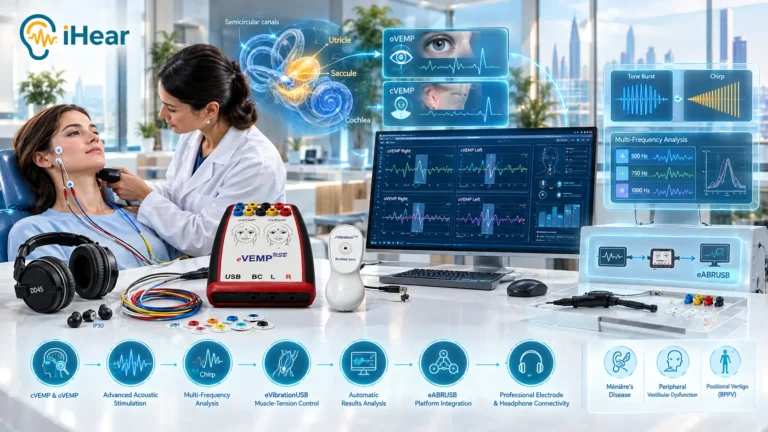
How Does the eVEMP USB Work? cVEMP and oVEMP Testing Step by Step

cVEMP (Cervical)

Measures the response of a neck muscle to assess the function of the saccule.

oVEMP (Ocular)

Measures the response of the eye muscles to assess the function of the utricle.

Two Stimulus Types

A tone burst or a chirp stimulus, delivered through DD45 headphones or IP30 insert earphones.

Electrodes and Connection

Wet adhesive electrodes with color-coded cables, for recording the EMG signal.

The Hardware Unit

The same eABR USB-VEMP unit that is used for ABR testing.

Patient Position and Workflow

The patient sits or lies down, and the responses are calculated automatically.

The test protocol, including stimulus settings, is set by the clinician.

What Does Multi-Frequency Analysis (MFA) Add to Ménière’s Disease Assessment?

In a healthy ear, the VEMP response is typically largest when the stimulus is at around 500 Hz, and it gradually decreases as the stimulus frequency rises. In an ear affected by Ménière’s disease, which is associated with endolymphatic hydrops, several published studies report a different pattern: the largest response shifts to 1000 Hz instead of 500 Hz. This “frequency tuning shift” is thought to be related to changes in the fluid dynamics of the vestibule when it is dilated by hydrops.

BioMed Jena describes multi-frequency analysis (MFA) as a unique feature of the eVEMP USB. The device presents the stimulus at several frequencies (500, 750, and 1000 Hz) in a single test, so the clinician can see whether a frequency tuning shift is present. A shift can be a supporting finding, to be read together with the patient’s symptoms and the other tests. The clinician makes the diagnosis.

A Scientific Note

The shift of the response toward 1000 Hz has been reported in several studies, including a study in the Journal of the American Academy of Audiology (2016). However, results are not identical in every study, and they can depend on the stage of the disease and on the study sample. For this reason, multi-frequency analysis (MFA) is used as a supporting finding within a wider clinical picture, not as a stand-alone test to diagnose Ménière's disease.

eVEMP USB Technical Specifications

eVEMP USB technical specifications
Specification Details
Test type Vestibular evoked myogenic potentials: cVEMP and oVEMP
Organ tested The saccule (with cVEMP) and the utricle (with oVEMP)
Hardware The eABR USB-VEMP unit: records EMG signals, generates the stimulus tones, and transfers data over USB
MFA feature Multi-frequency analysis (500 / 750 / 1000 Hz), to show the frequency tuning shift that has been associated with Ménière's disease
Stimulus type Tone burst or CW-VEMP-Chirp®
Sound delivery DD45 shielded headphones or IP30 insert earphones
Electrodes Wet adhesive electrodes with color-coded cables
Optional accessory The eVibration USB biofeedback handle, used during cVEMP testing
Results display Four graphs in total (cVEMP right and left, oVEMP right and left), with the detected signals marked automatically
Patient position Sitting or lying down

Specifications are from BioMed Jena's catalogue, which gives a functional description rather than numerical data. Ask iHear for the full technical data of the eABR USB-VEMP hardware and for the conformity documents and registration status for your facility. Download the eVEMP USB datasheet (PDF).

VEMP vs. VNG vs. vHIT: Which Part of the Vestibular System Does Each Test Assess?

What VEMP, VNG, and vHIT assess in the vestibular system
Comparison eVEMP USB eVNG USB eHIT USB
Organ tested The saccule and the utricle (the otolith organs) The semicircular canals (through nystagmus) The semicircular canals (through head impulses)
Signal measured Muscle electrical potentials (EMG) Eye movement (video) Eye movement and head movement (video and motion sensors)
Stimulus Sound (a tone burst or a chirp) Visual, caloric, and positional A fast mechanical head movement
Examples of use May be used in assessing Ménière's disease and BPPV May be used in assessing peripheral and central causes of vertigo, in general May be used in assessing a deficit of one semicircular canal
Does it replace the others? No. It adds information about the otolith organs and does not replace testing of the canals No. It does not test the otolith organs No. It does not test the otolith organs

In Practice

A clinic that wants to assess both the semicircular canals and the otolith organs can combine a canal test (the eVNG USB or the eHIT USB) with VEMP testing (the eVEMP USB). The clinician decides which tests are needed for each patient, and interprets the results together.

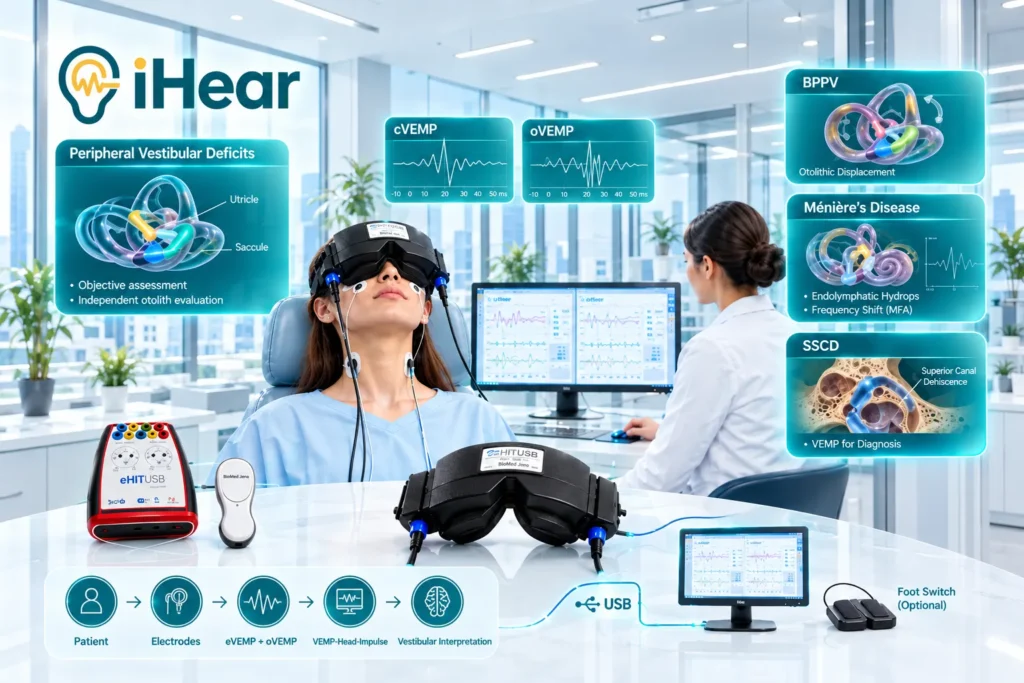
Clinical Uses of VEMP Testing

Peripheral Vestibular Deficits

May be used to assess the function of the saccule and the utricle separately from the rest of the vestibular system.

Benign Paroxysmal Positional Vertigo (BPPV)

May be part of the assessment when an otolith-related cause of the symptoms is suspected.

Ménière's Disease

Through the multi-frequency analysis (MFA) of the frequency tuning shift, as described above.

Superior Semicircular Canal Dehiscence (SSCD)

A condition in which VEMP testing, and the oVEMP in particular, is described in the clinical literature as one of the tests used in the assessment.

BioMed Jena's catalogue lists peripheral vestibular deficits, BPPV, and Ménière's disease. Other uses are described in the clinical literature. The clinician decides when VEMP testing is appropriate and interprets the results.
EVEMP USB Technical Specifications

Who Is the eVEMP USB For?

Specialized Ménière's Disease Centers

Centers that assess Ménière's disease, where multi-frequency analysis (MFA) of the frequency tuning shift can be an additional finding within the clinical picture.

Facilities That Already Own an eABR USB

A way to extend the equipment you already have, since the eVEMP USB is offered as part of the eABR USB hardware, so that it also assesses the otolith organs. Ask iHear whether your existing unit supports VEMP testing.

Advanced Centers for Superior Canal Dehiscence (SSCD)

VEMP testing, and the oVEMP in particular, is described in the clinical literature as one of the tests used in assessing this condition.

Clinics That See Older Adults or Patients With Muscle Weakness

The optional eVibration USB biofeedback handle helps the patient keep the muscle tension steady during cVEMP testing, which can be hard to maintain.

Centers Offering a Wide Vestibular Assessment

Extending the test protocol to cover both the semicircular canals (for example with the eVNG USB or the eHIT USB) and the otolith organs.

Buy the eVEMP USB VEMP Testing System in the UAE From iHear

💡 The price of the eVEMP USB depends on whether it is an expansion of an existing eABR USB or part of a complete new system, so we prepare your quote after defining your facility's exact needs. Here is what the iHear team offers:
🛡️ Officially Authorized Distributor
BioMed Jena (Germany) is the manufacturer and does not sell directly in the UAE market. iHear is the official link between the company and hospitals and dizziness and vertigo clinics across the country.
⚙️ Specialized Technical Consultation
A precise assessment of whether your facility needs to expand its existing eABR USB, or build a complete new VEMP setup that suits the way you work.
🎓 Advanced On-Site Training
Training for your medical staff on accurate electrode placement, interpreting cVEMP and oVEMP waveforms, and using the vibration biofeedback handle with confidence.
🛠️ Local Technical Support and Calibration
Technical support and regular calibration services provided locally within the UAE, so your work continues without shipping devices abroad.
🌐 eVEMP USB Within the Complete BioMed Jena Vestibular and Audiology Ecosystem
🔗
eVEMP USB + eABR USB
The shared technical foundation: if you already own an eABR USB, you can expand it with a VEMP module without buying separate hardware.
🔄
eVEMP USB + eVNG and eHIT USB
Works together within a comprehensive vestibular diagnostic protocol that covers both the semicircular canals (through VNG and vHIT) and the otolith organs (through VEMP).
📁
eVEMP USB + eDM
cVEMP and oVEMP results are archived in the unified eDM (Diagnostic Manager) platform, alongside the patient's other test results.

eVEMP USB FAQs: VEMP Testing, cVEMP and oVEMP Questions Answered
The eVEMP USB is a vestibular evoked myogenic potentials (VEMP) system from the German manufacturer BioMed Jena. It is used to assess the otolith organs of the inner ear: the saccule (through cVEMP) and the utricle (through oVEMP). It runs on the portable eABR USB hardware.
A VEMP (vestibular evoked myogenic potentials) test is an objective test of the balance organs in the inner ear. A loud sound is played through earphones, and small adhesive electrodes record the reflex muscle response it triggers, either in the neck muscle (cVEMP) or in the muscles around the eyes (oVEMP). The response reflects the function of the saccule and utricle and their nerve pathways, which other balance tests such as VNG and vHIT do not assess.
No. Although VEMP uses sound as the stimulus, it does not measure hearing. It tests the balance organs of the inner ear (the saccule and utricle), which also respond to loud sound. Hearing is assessed with other tests such as audiometry (for example the eAUDIO USB) and auditory brainstem response (ABR) testing (for example the eABR USB).
cVEMP (cervical VEMP) is recorded from a neck muscle and mainly reflects the function of the saccule and the inferior vestibular nerve. oVEMP (ocular VEMP) is recorded from the muscles around the eyes and mainly reflects the function of the utricle and the superior vestibular nerve. They give complementary information, and the eVEMP USB measures both.
Adhesive electrodes are placed on the neck muscle (for cVEMP) or below the eyes (for oVEMP), and sounds are played through earphones. For cVEMP the patient keeps the neck muscle gently tensed during recording, and for oVEMP the patient looks upward. The patient sits or lies down depending on the test. The software averages the responses and shows four traces: cVEMP right and left, and oVEMP right and left. A full test with both cVEMP and oVEMP typically takes about 30 to 60 minutes, depending on the protocol and the patient.
The VEMP test is non-invasive. It uses adhesive electrodes on the skin and no needles. The main discomfort is that the sounds are loud, because a strong stimulus is needed, and cVEMP requires holding neck muscle tension for short periods, which can be tiring. Tell your clinician if you are sensitive to loud sounds, have neck problems or have had recent ear surgery, so they can decide whether the test is suitable.
VEMP testing is used in the evaluation of peripheral vestibular disorders, Meniere's disease, vestibular neuritis and superior semicircular canal dehiscence (SSCD, also abbreviated SCDS). It is also used as part of the wider assessment of vertigo, including benign paroxysmal positional vertigo (BPPV) when otolith involvement is suspected. VEMP is a supporting test and is interpreted together with the clinical history and other tests.
Multi-frequency analysis (MFA) presents the sound stimulus at alternating frequencies (500, 750 and 1000 Hz) in a single session, instead of one fixed frequency. In healthy ears the strongest VEMP response is usually around 500 Hz, while several studies of Meniere's disease report a shift of the strongest response toward a higher frequency (about 1000 Hz), a pattern linked to endolymphatic hydrops. The eVEMP USB lets clinicians look for this shift within one session. It is a supportive indicator rather than a stand-alone diagnosis, because findings vary between studies.
No. Meniere's disease is mainly a clinical diagnosis based on symptoms, history and hearing tests. VEMP adds supporting information about the otolith organs and can help follow changes over time, but it does not replace the full clinical assessment, which may also include audiometry, VNG and caloric testing.
VEMP testing is a recognized supporting test for SSCD, and oVEMP in particular is widely used. On the affected side, VEMP responses may appear at lower sound levels or with larger amplitudes than normal. The diagnosis is confirmed with the clinical picture and high-resolution CT imaging of the temporal bone.
The eVEMP USB software marks the detected response peaks automatically and shows the normal range as a gray background to make reading easier. Results are assessed by response amplitude, latency and the asymmetry ratio between the two sides. A reduced, absent or clearly asymmetric response may point to a problem in the saccule, utricle or their nerve pathways, while an unusually large response can occur in conditions such as SSCD. Results must always be interpreted by a clinician together with other tests.
Air-conducted VEMP depends on sound reaching the inner ear, so a conductive hearing loss or middle ear problem can reduce or abolish the response even when the balance organ is normal. The eVEMP USB delivers sound through air-conduction earphones (DD45 or IP30), so clinicians usually check the middle ear first, for example with tympanometry using the eTYMP USB, and review the hearing tests. Sensorineural hearing loss alone does not necessarily prevent VEMP testing.
VNG (videonystagmography) and vHIT (video head impulse test) assess the three semicircular canals, which sense rotational head movement, by tracking eye movements. VEMP assesses the saccule and utricle, which sense gravity and linear movement, by recording muscle responses to sound. They examine different parts of the vestibular system, so VEMP complements VNG and vHIT and does not replace them. A complete vestibular assessment often combines all three.
The eVEMP USB records muscle potentials (EMG) in response to sound to test the otolith organs. The eVNG and eHIT USB record eye and head movements to test the semicircular canals. Used together within the BioMed Jena ecosystem, with results archived in the eDM (Diagnostic Manager) platform, they cover both groups of vestibular receptors.
The eVEMP USB is a VEMP module designed to run on BioMed Jena's portable eABR USB hardware, which records the EMG signals, generates the stimulus tones and sends the data to the computer over USB. If you already own an eABR USB, you can expand it with VEMP testing without buying a completely separate device. Contact iHear to confirm what your configuration needs, or to quote a complete new system.
The eVibration USB is an optional biofeedback handle that vibrates in proportion to the strength of the neck muscle contraction, helping the patient hold steady muscle tension during cVEMP. It is not mandatory, but it can improve test accuracy in practice, because the result depends directly on the level of muscle contraction.
cVEMP accuracy depends on keeping a steady, sustained neck muscle contraction throughout the recording. This can be difficult for older patients, people with neck pain or muscle weakness, and anyone who tires quickly, which can make results variable. The optional eVibration USB handle gives the patient feedback to help control the contraction.
The eVEMP USB offers two stimulus options: a conventional tone burst or the CW-VEMP-Chirp® stimulus from BioMed Jena. Some published studies of band-limited chirp stimuli report larger response amplitudes and shorter latencies than tone bursts in both cVEMP and oVEMP, which can make responses easier to identify. The clinician chooses the stimulus that suits the case.
Test types: cVEMP and oVEMP, assessing the saccule and utricle. Hardware: the portable eABR USB-VEMP unit, which records EMG signals, generates the stimulus and transfers data over USB. Stimulus: tone burst or CW-VEMP-Chirp®. Multi-frequency analysis (MFA): 500, 750 and 1000 Hz. Transducers: DD45 shielded earphones or IP30 insert earphones. Electrodes: wet adhesive electrodes with color-coded cables. Optional accessory: eVibration USB biofeedback handle. Display: four traces per test (cVEMP right and left, oVEMP right and left). Patient position: sitting or lying down, depending on the test. See the BioMed Jena vestibular catalogue for full specifications.
The eVEMP USB suits ENT departments and clinics that want a vestibular test battery covering the otolith organs and not only the semicircular canals, specialized dizziness and Meniere's disease centers, neurology clinics that include electrophysiology in the assessment of vertigo, centers evaluating suspected SSCD, and facilities that already own an eABR USB and want to add VEMP testing without a completely new device.
The price depends on whether the eVEMP USB is an expansion of an existing eABR USB or part of a complete new system, so iHear prepares a quote after defining your facility's needs. Contact the iHear team for a customized quote.
To confirm the registration status and the official documentation your facility requires, please contact the iHear team directly. They will provide the necessary documents and certificates before purchase.
In the UAE, the eVEMP USB is available through iHear, the authorized distributor of BioMed Jena devices, with offices in Abu Dhabi and Al Ain. iHear provides supply, installation, training and local technical support. Contact the team by WhatsApp or phone to request a quote.
Yes. iHear provides hands-on training for your medical staff on accurate electrode placement, interpreting cVEMP and oVEMP waveforms and using the biofeedback handle, along with local technical support and regular calibration within the UAE.
دون عنوان 200 x 200 بيكسل

For more information

Feel free to contact us anytime. Our team is always ready to help you.