
KALORIstar CT Air Caloric Irrigator With Active Cooling for Vestibular Testing
The KALORIstar CT is an air caloric irrigator from the German company BioMed Jena. It builds on the robust technology of the earlier KALORIstar Arctic, with a new design and an ultra-quiet pump system. It is used to perform the caloric test, one of the most popular methods in balance testing, by delivering warm or cool air at a precisely controlled temperature into the ear canal, instead of water, which is less convenient for the patient.
The device uses active cooling technology (ACT), which cools the air to 7 K below the ambient temperature (at an air flow of 8 l/min). BioMed Jena’s datasheet does not list a water tank to fill or maintain, which can be practical for clinics in warm climates such as the UAE, because it reduces the daily operating work for the medical staff.
iHear is the exclusive authorized distributor of BioMed Jena in the UAE. It offers the KALORIstar CT to hospitals and ENT centers that specialize in diagnosing dizziness and vertigo.
Air vs. Water Caloric Irrigation: What Are the Differences?
Caloric irrigation (warming or cooling the ear canal to stimulate the horizontal semicircular canal) is one of the most popular methods in balance testing. The traditional water method needs a water supply and drainage inside the examination room, and it can sometimes be uncomfortable for the patient. BioMed Jena states that, to achieve the same results as with water, the recommended temperatures for air irrigation are 24 °C for cold stimulation and 50 °C for warm stimulation. The KALORIstar CT works over a temperature range of 20 °C to 51 °C, which gives the examiner room to adjust the test protocol to each case, without needing water lines or drainage in the examination room.
Perforated Eardrum
01Irrigation with water can cause irritation or discomfort when there is a perforation in the eardrum (tympanic membrane). Air irrigation may be considered as an alternative in these cases, so the patient does not have to be excluded from the test. The clinician decides for each patient.
Patient Comfort
02There is no feeling of wetness or leakage in the ear canal, which can reduce discomfort during a test that may take several minutes for each ear. BioMed Jena states that using air instead of water is more convenient for the patient.
Temperature Accuracy and Stability
03The electronically controlled air is held at the set temperature with an accuracy of ±0.3 K, according to BioMed Jena's datasheet.
Cleaning and Maintenance Between Patients
04BioMed Jena's datasheet does not list a water tank, so there is no tank to clean and disinfect, which can reduce the daily maintenance work for the clinic. The datasheet also lists an automatic standby after irrigation and a maintenance reminder.
To achieve the same results as with water, BioMed Jena recommends 24 °C for cold stimulation and 50 °C for warm stimulation when using air.
Clinical Note
To achieve the same results as with water, BioMed Jena recommends 24 °C for cold stimulation and 50 °C for warm stimulation when using air. These values differ from the temperatures usually used in water irrigation protocols, so the clinician should set the protocol accordingly.
KALORIstar CT Technical Specifications
| Specification | Details |
|---|---|
| Pump system | Ultra-quiet pump system |
| Temperature range | 20 °C to 51 °C |
| Active cooling | 7 K below ambient temperature (at an air flow of 8 l/min) |
| Temperature accuracy | ±0.3 K |
| Control interface | Isolated USB |
| Automatic standby | Automatic standby after irrigation |
| Maintenance reminder | Built into the device |
| Dimensions | 240 × 130 × 260 mm (W × H × D) |
| Weight | 4 kg |
| Power consumption | Maximum 45 W |
| Operating environment | 10 to 40 °C, humidity below 80% |
| Regulation | EU MDR 2017/745 (Annex VIII) |
Specifications are from BioMed Jena's datasheet. Ask iHear for the conformity documents and the registration status for your facility.
KALORIstar CT Key Features
Active Cooling Technology (ACT)
ACTCools the air to 7 K below the ambient temperature at an air flow of 8 l/min, building on the active cooling concept of the KALORIstar Arctic.
High Temperature Accuracy
±0.3 KAn accuracy of ±0.3 K helps keep the stimulus consistent between the two ears, which is important for a reliable caloric test result.
Very Quick Regulation
Quick RegVery quick regulation of the temperature, which can shorten the waiting time between consecutive irrigations.
Ultra-Quiet Pump
Ultra QuietAn ultra-quiet pump system, for a quieter test for both the patient and the examiner.
Circular Push-Pull Connector
Easy ConnectionA circular connector with a push-pull mechanism and a high-quality engineered design, for quick connecting and disconnecting.
Intelligent Handle
Fast ServiceWhen service or maintenance is needed, only the handle has to be sent in, not the whole device, which can reduce downtime and simplify maintenance logistics.
Maintenance Reminder and Standby
Smart OperationAn automatic maintenance reminder, and an automatic standby after irrigation.
Mounting Options and Flexibility
Flexible DesignA handle holder built into the device, with an optional wall-mounting option, to suit the space and layout of the clinic.
Easy Cleaning and Disinfection
Infection ControlA practical design intended to make cleaning and disinfection between patients easy and quick.
eVNG Software Control
Digital ControlThe device can be fully remote controlled from the eVNG USB software, for one-button operation of the bithermal caloric test.
EU MDR Regulation
RegulationBioMed Jena's datasheet lists MDR Annex VIII (EU 2017/745). Ask iHear for the conformity documents and the registration status for your facility.
Some options, such as the mounting options, should be confirmed with iHear for your configuration.
What Is the Caloric Test, and When Do ENT Specialists Use It?
What Is the Caloric Test?
The caloric test is one of the most popular methods in balance testing. It assesses the function of the horizontal semicircular canal in each ear separately, by stimulating the vestibular system with a stream of cool and warm air or water and observing the resulting nystagmus.
The test is used for:
Detecting unilateral vestibular weakness, which may result from vestibular neuritis, Ménière's disease, or labyrinthitis.
Helping the clinician tell apart causes of vertigo linked to the inner ear and those linked to the central nervous system, together with other tests.
Pre-surgery assessment, which may be used to check the vestibular function of the unaffected ear.
Following the recovery of patients after treatment or related surgery.
These uses are described in the clinical literature, not in the device datasheet. The clinician decides when a caloric test is appropriate and interprets the results.
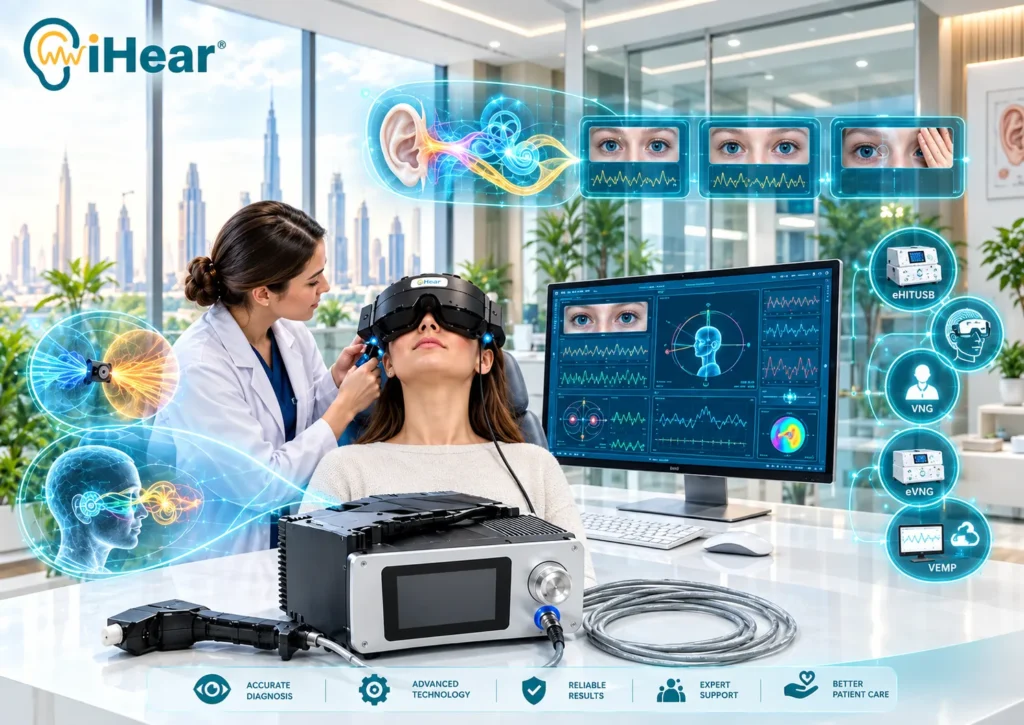
How Does the KALORIstar CT Work?
Intelligent Handle
Easier ServiceThe handle can be sent in on its own for service or maintenance, without the whole device, which can reduce downtime and cost.
Circular Push-Pull Connector
Easy ConnectionAn innovative, high-quality design that makes connecting and disconnecting quick during busy daily use in the clinic.
One-Button Operation
Digital ControlWhen used with the eVNG USB software, the examiner can control the device from the computer, with one-button operation of the bithermal caloric test.
Ultra-Quiet Air Pump
Ultra-QuietAn ultra-quiet pump system, for a quieter test for the patient, which may matter in small or closed examination rooms.
Automatic Standby
Energy SavingThe device goes into standby automatically after each irrigation, which saves energy.
Automatic Maintenance Reminder
Device CareA reminder appears on the touchscreen, to help keep track of regular maintenance.
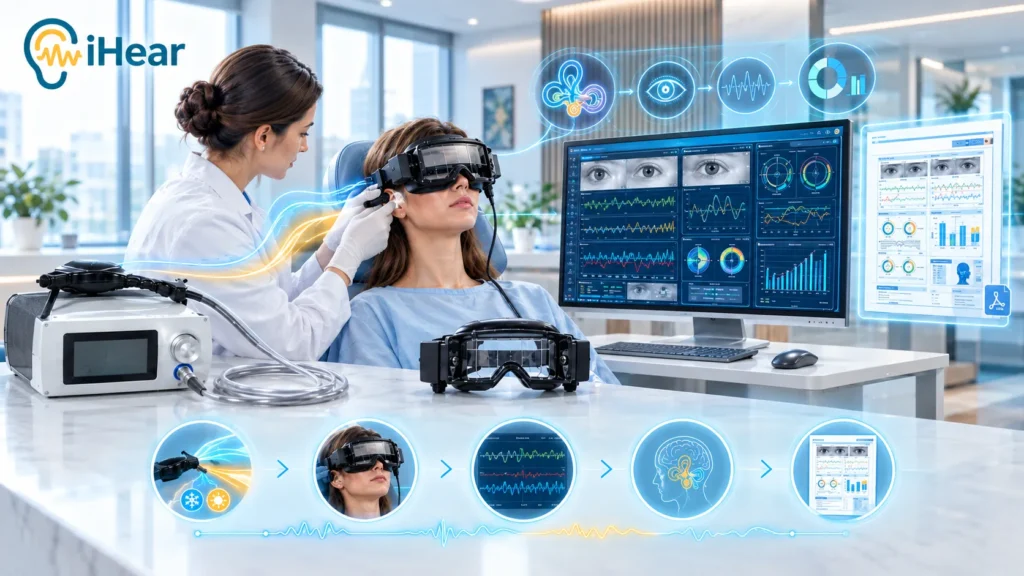
KALORIstar CT and eVNG USB: Working Together
Recording of the eye movement that goes with the thermal stimulation, and displaying it in real time on the same eVNG screen.
Automatic calculation of unilateral weakness and directional preponderance.
The option to record spontaneous nystagmus before the irrigation starts, as part of the same test.
A detailed results printout from the eVNG software, for saving and comparing later.
KALORIstar CT vs. Other Air Caloric Irrigators: What to Compare
| Device | Manufacturer | Strengths | A neutral note |
|---|---|---|---|
| KALORIstar CT | BioMed Jena (through iHear) | Active cooling (ACT), ±0.3 K temperature accuracy, an intelligent handle that can be sent in on its own for service, one-button control from the eVNG USB software, and the EU MDR regulation listed in the datasheet | It does not include an integrated otoscope for viewing the eardrum during the test |
| Air caloric irrigators with an integrated otoscope | Offered by some manufacturers | An integrated otoscope can let the examiner see the eardrum directly while directing the stimulus | Specifications such as temperature accuracy and range vary by model; ask the manufacturer |
| Air caloric irrigators without an integrated otoscope | Offered by some manufacturers | Temperature range and integration with the manufacturer's own VNG or ENG system differ by model | An integrated otoscope may not be included; ask the manufacturer |
KALORIstar CT values are from BioMed Jena's datasheet. Specifications of other devices differ by manufacturer and model and change over time, so check each manufacturer's current information. The right device depends on your protocols and budget; contact iHear to discuss it.
Who Is the KALORIstar CT Air Caloric Irrigator For?
Ear, Nose, and Throat (ENT) Clinics
01ENT clinics and audiology and balance centers, as part of a VNG test battery (spontaneous nystagmus, positioning tests, and caloric testing), for example with the eVNG USB.
Advanced Hospitals
02Hospitals that prefer to avoid water lines inside the examination room, since the device uses air instead of water.
Clinical Research Centers
03Centers that value a temperature accuracy of ±0.3 K when they need to keep the stimulus consistent between sessions.
Buy the KALORIstar CT Air Caloric Irrigator in the UAE From iHear
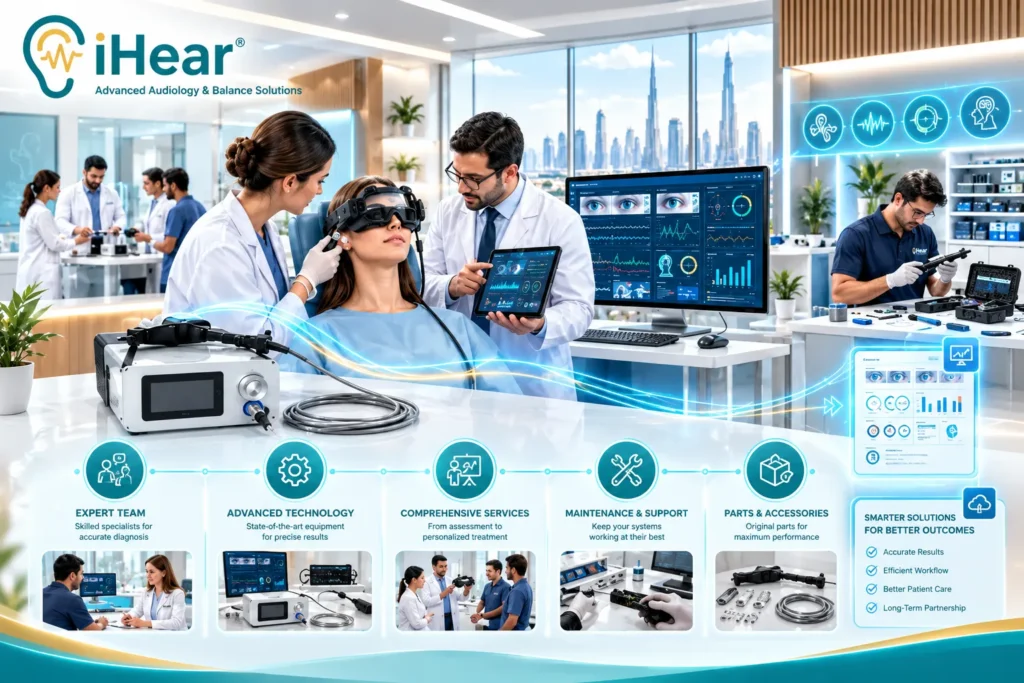
The price of the KALORIstar CT depends on the configuration you need (on its own, or as part of a setup with the eVNG USB and the Combi Mask), so a quote is prepared after your clinic's needs are defined. Here is what iHear's team offers:
KALORIstar CT FAQ: Common Questions About Air Caloric Testing and the Air Caloric Irrigator

For more information
Feel free to contact us anytime. Our team is always ready to help you.