PhysioSensing Otoneuro System: Balance Assessment and Vestibular Rehabilitation With VR
The PhysioSensing Otoneuro System is an all-in-one vestibular rehabilitation and balance assessment system that combines force plate posturography, an inertial sensor, and immersive virtual reality (VR) in one software-driven workflow. It lets clinicians assess the vestibulo-ocular reflex (VOR), visual-vestibular integration, cervical proprioception, and postural control, then deliver targeted, engaging therapy with automated reports to track patient progress, all without switching between separate systems.
The system is a CE-marked Class I medical device under the EU Medical Device Regulation (MDR 2017/745), and ISO 13485, the quality management standard for medical device manufacturers, is applied. It carries a Unique Device Identification (UDI-DI) number and a 2-year warranty.
iHear supplies the Otoneuro System in the UAE for ENT clinics, otoneurologists and neurotologists, audiologists, vestibular physiotherapists, rehabilitation centers, and universities and research groups.
| Component | Key Specifications |
|---|---|
| Force plate | 55 × 55 × 3 cm, 8.5 kg, maximum load 250 kg, 100 Hz sampling rate, 24-bit analog-to-digital conversion |
| Inertial sensor | 3-axis accelerometer, magnetometer, and gyroscope; about 100 Hz sampling rate (around 100 acquisitions per second); USB connection |
| Virtual reality (VR) headset | Meta Quest 3S; 1832 × 1920 resolution per eye; 96° horizontal / 90° vertical field of view; 120 Hz refresh rate; battery life of about 2.5 hours |
| Screen (Complete configuration) | 65-inch 4K Ultra HD (3840 × 2160) display, 144 Hz refresh rate |
| Minimum PC requirements | Intel i5 processor (2.5 GHz, 6 performance cores; avoid "U" and "G7" versions), 16 GB RAM, 8 GB graphics card, Windows 10 or 11 (64-bit) |
| Regulatory status | CE-marked Class I medical device under the EU Medical Device Regulation (MDR 2017/745); ISO 13485 applied |
| Warranty | 2 years |
Otoneuro System: An All-in-One Platform for Balance Assessment and Vestibular Rehabilitation With VR
The integrated solution for the diagnosis and treatment of balance disorders is designed for robust clinical decision-making.
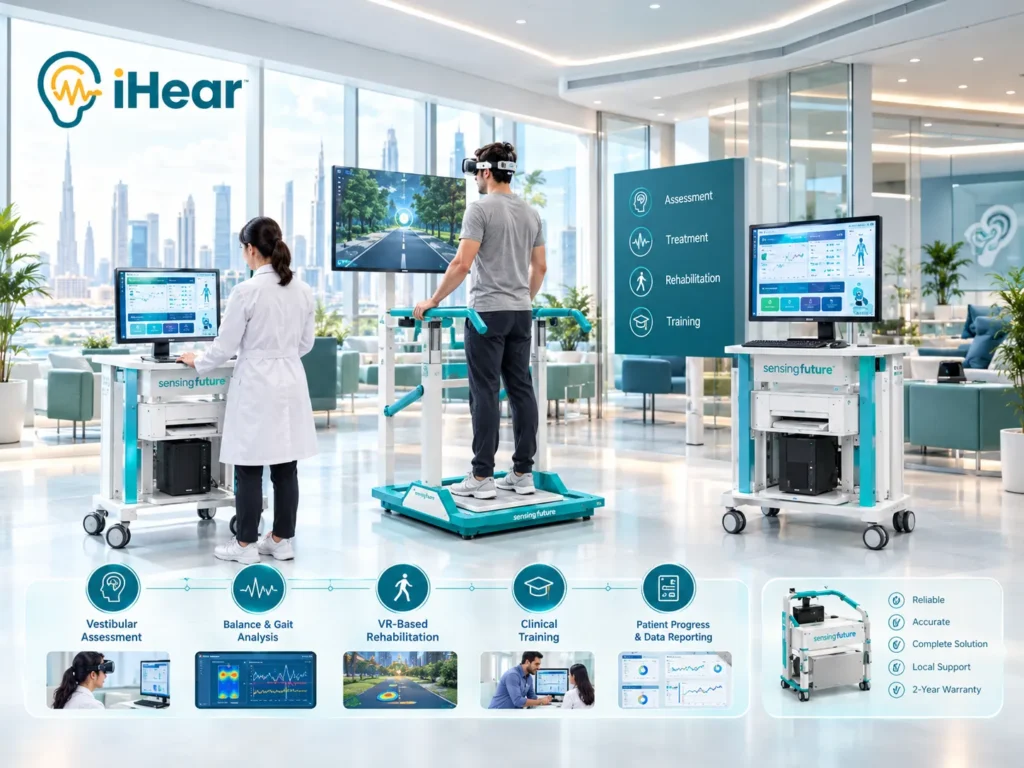
An advanced system that combines balance analysis, virtual reality, and sensors to provide an accurate and effective experience in evaluating and treating dizziness and balance problems. Physiosensing Otoneuro combines posture measurement using a force plate, inertial sensor, and immersive virtual reality into a single software-powered workflow. Clinicians assess the vestibulo-visual reflex, visual-vestibular integration, proprioception in the neck, and postural control, then provide targeted, engaging treatment with automated reports to track progress.
The PhysioSensing Otoneuro System represents a new generation of technology to evaluate and rehabilitate the vestibular system, enabling doctors to view balance in a whole new way.
Thanks to the combination of high-precision inertial sensors, a force board, virtual reality technology and intelligent software, the system turns complex postural responses into clear, objective and actionable clinical insights.
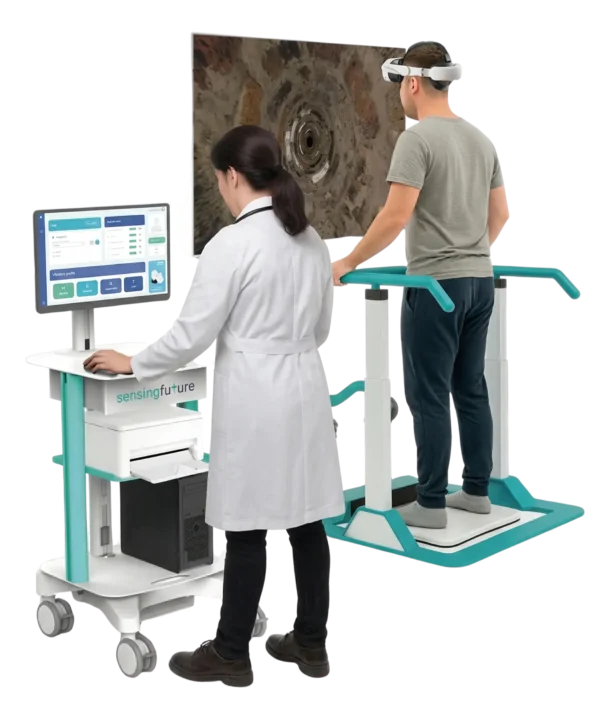

Designed specifically for auditory neurologists, physical therapists, and balance rehabilitation specialists, the Otoneuro System enables accurate assessment of postural control, limits of stability, and dynamic balance in realistic clinical conditions. Its standardized protocols support accurate diagnosis, development of personalized treatment plans, and confident monitoring of patient progress over time.
The system is quick and easy to set up and use, and integrates seamlessly into daily clinical practice, while providing visually attractive reports that enhance clinical decision-making and patient motivation.
By bridging the gap between technology and functional rehabilitation, the PhysioSensing Otoneuro System redefines how balance disorders are assessed, treated and understood.
In this system, we take into account everyone who suffers from balance disorders in the world.
What Is Vestibular Rehabilitation, and How Is VR Used in It?
Vestibular rehabilitation is a specialized, exercise-based form of physical therapy designed to help reduce dizziness, vertigo, and balance and posture problems caused by a disorder of the vestibular system in the inner ear. Through targeted exercises, it helps the brain adapt to and compensate for the problem. If you have these symptoms, see a doctor first for an assessment.
Virtual reality (VR) is increasingly used in rehabilitation. The UAE Ministry of Health and Prevention (MOHAP) has announced plans to introduce VR rehabilitation in physiotherapy, including for patients with balance disorders, and has described VR as a safe, effective alternative to conventional balance therapy. The Otoneuro System offers one VR-enabled approach, combining objective assessment and interactive therapy, with or without VR, in a single platform.
How Does the Otoneuro System Work? Assessment and Rehabilitation in One Platform
A force plate inside an adjustable-height frame (65 to 110 cm) with automatic safety bars, an inertial sensor worn on a head strap, a Meta Quest 3S VR headset, and a 65-inch screen on a display cart.
A mobile cart with a desktop PC, a 27-inch screen on a tilt-, rotate-, and height-adjustable mount, and a printer, where the clinician runs the software and reviews results and reports.
Otoneuro System Rehabilitation Modules: Vestibular Therapy With or Without VR
| Test | What It Assesses | How |
|---|---|---|
| DVA and GST(Dynamic Visual Acuity and Gaze Stabilization Test) | Functional vestibulo-ocular reflex (VOR) assessment | An inertial sensor on the head tracks head movement. DVA determines the loss of visual acuity at a fixed head speed; GST determines the maximum head movement before visual acuity drops. The workflow also includes a perception time test (PTT) and a static visual acuity baseline. |
| Optokinetic test(with or without VR) | Visual-vestibular integration and visual dependence in postural control | Posturography on the force plate with optokinetic bar patterns moving in different directions, creating a visual conflict |
| Cervical Joint Position Error test(JPE) | Cervical proprioception (neck position sense), relevant to cervicogenic dizziness | With the inertial sensor, the patient sits with the trunk stabilized and, with eyes closed, returns the head to the neutral position after moving it |
| Balance assessment protocols | Balance in multiple sensory conditions and motor tasks, including fall risk | On the force plate: body sway, limits of stability, mCTSIB + Fukuda, Romberg test, Balance Error Scoring System (BESS), fall risk, rhythmic weight shift, and unilateral stance |
- VOR and oculomotor exercises: saccades, smooth pursuit, vergence, fixation, and VOR exercises, with or without VR.
- Balance exercises on the force plate: five groups of exercises targeting postural alignment, weight transfer, directional control, and limits of stability.
- Cervical proprioception exercises: using the inertial sensor, with figure-and-path, random-point, and visual-stimulus tasks to improve head–neck coordination.
- Habituation exercises: gradual, controlled exposure to visual and movement stimuli that provoke dizziness, adjusted to the patient's tolerance and designed to reduce symptoms over time. They include optokinetic stimulation (bars and tunnel), and, in VR only, VOR suppression and 360° HD videos of busy real-world environments.
- Balance and motor-cognitive games: played on the force plate, such as Pong & Ball Balance, BART, Slime Pong & Slime Run, Break Your Balance, Space Sway, and a Memory Game, designed to make sessions more engaging.
- Coming soon: VR Head Flight (steering an aircraft with head movements to train gaze stability and vestibular adaptation) and HD Busy Environments (high-definition videos of complex visual scenes for habituation).
Clinical Applications of the Otoneuro System: Four Key Areas of Assessment and Training
The system assesses the vestibulo-ocular reflex (VOR) with two functional tests, using an inertial sensor worn on the head:
- DVA (Dynamic Visual Acuity): determines the loss of visual acuity at a fixed head speed.
- GST (Gaze Stabilization Test): determines the maximum head movement before visual acuity begins to drop.
The workflow also includes a perception time test (PTT) and a static visual acuity baseline. These tests help identify asymmetries, and clinicians can then use adaptation exercises to improve gaze stability and reduce oscillopsia, the sensation of a blurred or bouncing visual field during head movement. Interpretation and diagnosis remain with the treating clinician.
Using optokinetic stimuli within posturography, with or without VR, the system helps reveal sensory conflict and visual dependence, which can contribute to discomfort in visually busy environments.
After assessment, clinicians can use gradual, safe exposure (habituation) in VR scenarios tailored to motion-provoked symptoms.
With an inertial sensor, the system quantifies cervical joint position error (JPE) to profile deficits in neck proprioception, the sense of neck position.
Clinicians can then tailor head–neck repositioning tasks with real-time feedback. This is relevant when neck problems may contribute to dizziness (cervicogenic dizziness). Dizziness has many possible causes, so a medical assessment comes first.
On the force plate, the system objectively assesses static and dynamic balance using established protocols:
- Body sway
- Romberg test
- mCTSIB with Fukuda
- Limits of stability
- Rhythmic weight shift
- Unilateral stance
- Balance Error Scoring System (BESS)
It also assesses fall risk, which is particularly relevant for older adults. The results establish a baseline, and training exercises then target postural alignment, weight transfer, directional control, limits of stability, and sensory integration, with or without VR.
What’s Included in the Otoneuro System: Technical Setup and Configurations
| Component | Key Specifications |
|---|---|
| Force plate | 55 × 55 × 3 cm, 8.5 kg, maximum load 250 kg, 100 Hz sampling rate |
| Inertial sensor | Adjustable head strap (53–63 cm), 3-axis accelerometer, magnetometer, and gyroscope, 200 g (plus 90 g cable) |
| Virtual reality (VR) headset | Meta Quest 3S, 1832 × 1920 resolution per eye, 96° horizontal / 90° vertical field of view, battery life of about 2.5 hours |
| Screen (Complete configuration) | 65-inch, 4K Ultra HD, 144 Hz refresh rate |
| Minimum PC requirements | Intel i5 processor (2.5 GHz, 6 performance cores), 16 GB RAM, 8 GB graphics card, Windows 10 or 11 |
Otoneuro System Clinical Workflow: From Patient Intake to Progress Report
Why Choose the Otoneuro System for Your Clinic?
Once the cause of a patient's dizziness or vertigo has been diagnosed, through tests such as videonystagmography (VNG), the video head impulse test (vHIT), or vestibular evoked myogenic potentials (VEMP), the next step is rehabilitation. Traditional exercise programs, such as the Cawthorne-Cooksey exercises, are well established, but on their own they often provide little objective measurement of progress and rely heavily on the patient's own motivation. The Otoneuro System is designed to address this gap by combining objective measurements (force plate and inertial sensor), engaging therapy with or without immersive VR that is designed to support patient adherence, and automated reports that show progress to both the patient and the clinical team. It complements diagnostic testing and does not replace it.
Why Choose the Otoneuro System for Balance Assessment and Vestibular Rehabilitation, With or Without VR?
Otoneuro System vs. Other VR Balance and Vestibular Rehabilitation Systems
| Criterion | Otoneuro System (PhysioSensing) | Bertec Balance Advantage | Virtualis (Interacoustics group) |
|---|---|---|---|
| Force plate | Static force plate (55 × 55 cm) | Static or dynamic dual-balance plate, depending on the package; the dynamic base moves in translation and rotation | Static (StaticVR) or dynamic 360° (MotionVR) rehabilitation platforms |
| Virtual reality | Meta Quest 3S headset included in the Base and Complete configurations | Immersive VR on a screen (CDP/IVR, Prime IVR) or a wireless head-mounted display | VR headset with BalanceVR and PhysioVR modules, used with static or dynamic platforms |
| Assessment and training | VOR (DVA, GST), optokinetic testing, cervical joint position error (JPE), balance protocols, and rehabilitation modules | Computerized dynamic posturography protocols, head-shake and visual acuity tests, and balance and mobility training modules | Assessment and rehabilitation modules (including DVA rehab and cervical range of motion), plus posturography functions with MotionVR |
| Configurations | Two: Base and Complete | Several packages (for example static plate, dynamic plate, portable, and immersive VR) | Four solutions that can be combined: PhysioVR, BalanceVR, StaticVR, and MotionVR |
| Manufacturer | PhysioSensing (Portugal); CE-marked Class I medical device under the EU MDR | Bertec Corporation (USA) | Virtualis (Montpellier, France), part of Interacoustics |
Information on Bertec and Virtualis comes from the manufacturers' public websites and may change; check each manufacturer for current specifications. Sources: Bertec CDP/IVR, Interacoustics MotionVR, Virtualis BalanceVR. The right system depends on your clinical needs, space, and budget.
Who Is the Otoneuro System For?
| Professional Group | How They Can Use It |
|---|---|
| Otoneurologists and neurotologists | Objective, multi-dimensional measurements to support the clinical assessment of dizziness before a rehabilitation plan is set |
| ENT / otolaryngology clinics | Add vestibular assessment and rehabilitation to the clinic in one integrated system |
| Audiologists | Relate vestibular findings to the patient's wider hearing and balance picture |
| Vestibular physiotherapists and rehabilitation specialists | Deliver targeted, measurable rehabilitation programs and track progress with objective data |
| Rehabilitation medicine and neurology services | Track patient progress over time with objective measures |
| Private clinics and balance centers | Offer assessment and rehabilitation in one integrated platform |
| Universities and research groups | A measurable research environment with data export for studies |
Otoneuro System Price and Supply in the UAE: Request a Quote From iHear
Otoneuro System FAQ: Common Questions About VR Vestibular Rehabilitation and Balance Assessment
For more information
Feel free to contact us anytime. Our team is always ready to help you.