eOAE Portable Otoacoustic Emissions (OAE) Device for Newborn Hearing Screening
The eOAE is a portable otoacoustic emissions (OAE) device from BioMed Jena (Germany). It measures both transient-evoked otoacoustic emissions (TEOAE) and distortion-product otoacoustic emissions (DPOAE), and it includes a dedicated newborn hearing screening mode based on TEOAE. It weighs 320 g and has a 5-inch touchscreen. OAE testing is one of the standard methods used in newborn hearing screening programs.
iHear is the authorized distributor of BioMed Jena devices in the UAE. Headquartered in Al Ain, iHear offers the eOAE with technical support, training, and maintenance.
The eOAE is a portable German otoacoustic emissions device for TEOAE and DPOAE testing, with a dedicated newborn hearing screening mode. It has a 5-inch touchscreen, a replaceable battery, and a listed standard of DIN EN 60645-6:2010. It is available in the UAE through iHear.
| Field | Details |
|---|---|
| Device name | eOAE |
| Manufacturer | BioMed Jena GmbH, Germany |
| Main use | Otoacoustic emissions testing, including newborn hearing screening with a dedicated screening mode (TEOAE method) |
| Test principle | Measurement of transient-evoked (TEOAE) and distortion-product (DPOAE) otoacoustic emissions: a very quiet sound sent back from the inner ear in response to an acoustic signal |
| Test settings | 4 configurable profiles each for TEOAE and DPOAE; custom stopping criteria for TEOAE |
| Device type | Portable; 5-inch TFT capacitive touchscreen; replaceable Li-ion battery (3.8 V, 3880 mAh); charging by docking station |
| Weight / dimensions | 320 g / 141 × 97 × 27 mm |
| Standard listed in the datasheet | DIN EN 60645-6:2010 (instruments for the measurement of otoacoustic emissions) |
| Distributor in the UAE | iHear, Al Ain, UAE |
What Is Otoacoustic Emissions (OAE) Testing, and How Does It Work?
Otoacoustic emissions (OAEs) are very faint sounds that a healthy inner ear (cochlea) sends back in response to sound. In an OAE test, a small probe placed in the ear canal plays soft sounds, and a sensitive microphone in the probe picks up the emission. The test does not require the person to respond, so it can be used with newborns and young children. It is often done while the baby is asleep or quiet, and it usually takes only a few minutes.
Two Types of Otoacoustic Emissions: TEOAE and DPOAE
TEOAE (transient-evoked otoacoustic emissions): the ear's response to brief clicks is measured. TEOAE is widely used in newborn hearing screening because the test is quick and simple, and it is the method of the eOAE's newborn screening mode. The eOAE's TEOAE range is 1–4 kHz.
DPOAE (distortion-product otoacoustic emissions): the ear's response to two pure tones of different frequencies played at the same time is measured. DPOAE gives frequency-specific information, which is useful for more detailed assessment and follow-up. The eOAE's DPOAE range is 0.5–8 kHz.
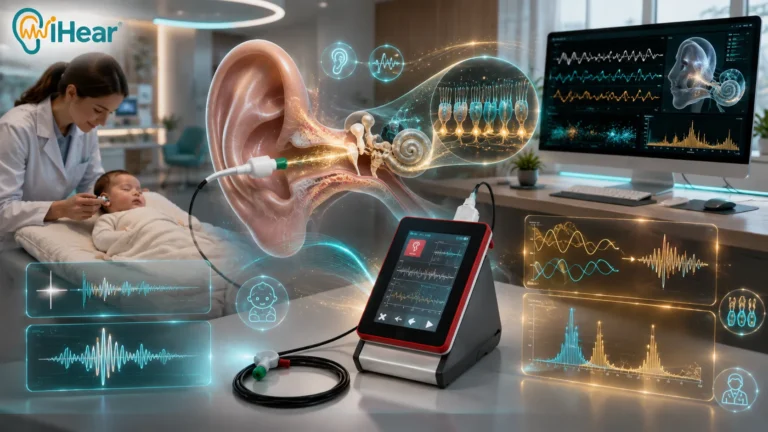
The eOAE supports both TEOAE and DPOAE in one device, so a clinic or hospital can use TEOAE for newborn screening and DPOAE for more detailed, frequency-specific assessment, depending on clinical need.
Newborn Hearing Screening in the UAE and the Role of the eOAE
Hearing screening is part of the UAE’s national newborn screening program. MoHAP’s National Newborn Screening Guidelines (July 2024) cover hearing screening in government and private hospitals, and Abu Dhabi’s Department of Health (DOH) lists it as a mandatory element of newborn screening, alongside the heel-prick test and pulse oximetry screening for heart defects. It is meant to be completed before the baby leaves the hospital.
OAE testing is non-invasive. A small probe in the baby’s ear canal plays soft sounds and records the faint echo that a healthy cochlea sends back, usually within a few minutes and often while the baby sleeps.
Finding hearing loss early, before a baby is six months old, gives the child a better chance of developing speech, language, and social skills. That is why maternity facilities that offer newborn hearing screening need suitable equipment, such as an OAE device.
Newborn hearing screening is a preventive check done in the first days of life. Finding hearing loss early, before a baby is six months old, gives the child a better chance of developing speech, language, and cognitive skills, because support can start sooner.
In the UAE, newborn screening is carried out in government and private health facilities. According to MoHAP reports cited by the Abu Dhabi Public Health Centre, uptake of newborn screening in Abu Dhabi reached 98% in 2021. The program covers a physical examination, hearing screening, critical congenital heart disease screening, and the heel-prick test. Facilities that offer newborn hearing screening need suitable equipment, such as an OAE device like the eOAE.
A small probe placed in the baby's ear canal plays a brief click (TEOAE) or two tones at once (DPOAE). A healthy cochlea responds with a very faint echo, which a sensitive microphone picks up. The eOAE analyzes the response and shows it on its touchscreen as a clear chart. The test does not need sedation, and a quiet or sleeping baby makes it easier to record a clean result.
The eOAE measures two types of emissions:
- TEOAE (transient-evoked): widely used in newborn hearing screening because the test is quick and simple, and it is the method of the eOAE's newborn screening mode.
- DPOAE (distortion-product): covers a wider frequency range (0.5–8 kHz) when further assessment is needed.
No. Newborn hearing screening programs use OAE, automated auditory brainstem response (AABR), or both. Babies who do not pass the screening, or who have risk factors, are referred for further testing, which includes ABR. OAE tests the function of the cochlea, so a normal OAE result does not rule out hearing loss further along the hearing pathway, such as auditory neuropathy. For this reason, some programs use AABR for babies who have been in intensive care.
A facility starting a newborn hearing screening service can begin with an OAE device such as the eOAE. BioMed Jena's eABR USB covers ABR testing, and iHear supplies both. The choice of protocol follows the facility's program and the clinician's judgment.
The eOAE includes a dedicated screening mode for newborn examinations, based on the TEOAE method, with a clear chart illustration of the result. Decisions about referral and follow-up remain with the clinician and follow the facility's screening protocol.
eOAE Key Features for Newborn Hearing Screening
Newborn screening mode: a dedicated mode for newborn examinations using the TEOAE method, with a clear chart illustration of the result.
TEOAE and DPOAE: both emission types are measured in one device, with 4 configurable profiles for each and custom stopping criteria for TEOAE.
Portable touchscreen device: a 5-inch capacitive touchscreen, 320 g, with patient registration and data management on the device itself.
Replaceable battery and docking station: a replaceable Li-ion battery (3880 mAh), with charging and data synchronization when the device is placed in the docking station.
eDM and GDT integration: full integration with the eDM Diagnostic Manager, plus a GDT interface to connect results to a clinic or hospital system.
Automatic reports: the eOAE PC software generates reports automatically and can store results as PDF files.
Optional thermal printer: printing of results with an optional thermal printer connected through the docking station.
Easy cleaning: the probe parts are easy to clean, and the touchscreen is easy to sanitize between patients. Optional masking headphones (IP30 or DD45) are available.
Made in Germany: the datasheet lists the standard DIN EN 60645-6:2010 and the CE 0124 mark (Class IIa according to MDD).
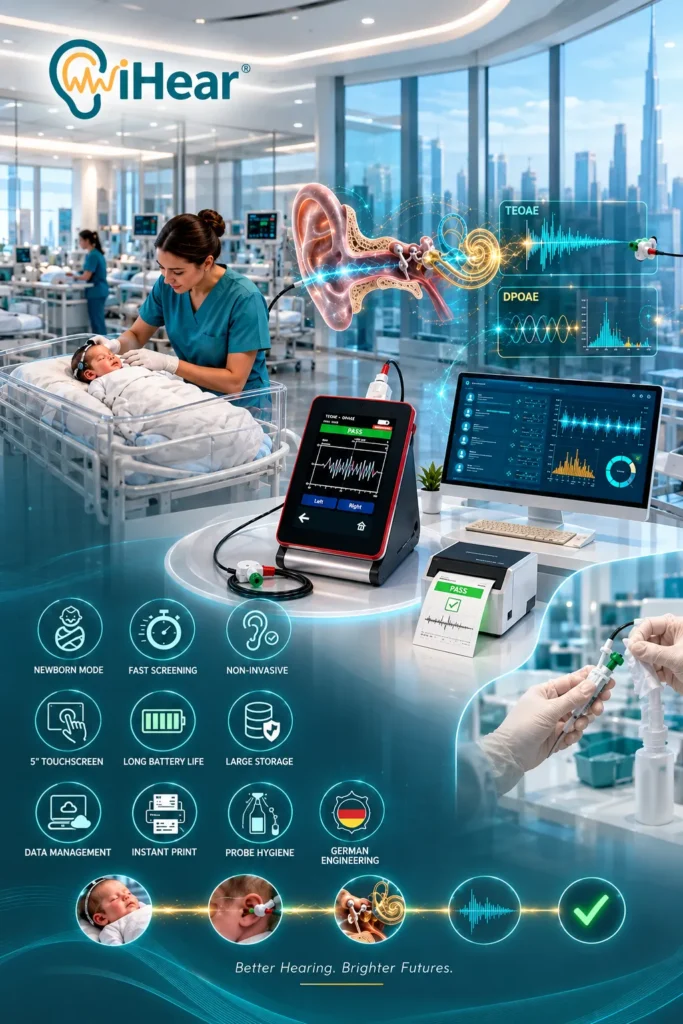
Who Is the eOAE Newborn Hearing Screening Device For?
Facilities that take part in the UAE's national newborn screening program (MoHAP guidelines and, in Abu Dhabi, Department of Health standards), where hearing screening is part of newborn care.
Neonatal intensive care units (NICU) that want a portable device for use at the bedside. Many programs add or use AABR for babies who have been in intensive care, so confirm your unit's protocol.
Pediatric clinics and audiologists who want to offer early hearing screening as part of their services.
Medical examination centers (public and private) that run infant and child hearing screening. OAE is one tool among others, and older children are often tested with pure-tone audiometry.
Audiology centers that want OAE testing alongside other tests. The eOAE adds otoacoustic emissions testing, and it can sit in the same eDM patient database as BioMed Jena's audiometer (eAUDIO USB), middle-ear analyzer (eTYMP USB), and ABR device (eABR USB).
How Does the eOAE Work in Newborn Hearing Screening?
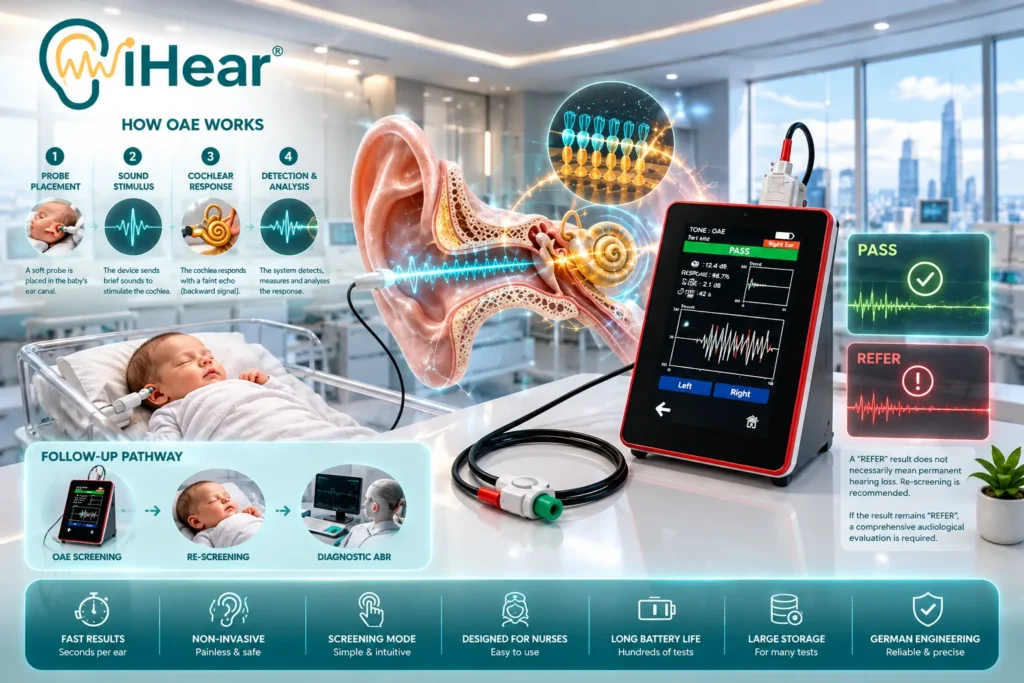
A small, lightweight probe is placed in the baby's ear canal. (OAE testing is non-invasive.)
The device plays soft sounds (clicks for TEOAE, tones for DPOAE) and records the faint echo that a healthy cochlea sends back.
The device displays the result as a clear chart on its touchscreen.
A "refer" screening result does not necessarily mean permanent hearing loss (fluid in the middle ear, for example, can cause one). The usual approach is to retest, and if the result is repeated, the baby is referred for further testing such as ABR, which BioMed Jena's eABR USB measures. The clinician decides on follow-up.
The eOAE's newborn screening mode uses the TEOAE method and shows the result as a clear chart. Newborn hearing screening should be performed by trained healthcare personnel, following your facility's protocol.
eOAE Technical Specifications
eOAE Device Specifications
| Specification | Value |
|---|---|
| Measurement type | TEOAE and DPOAE |
| Screen | 5-inch TFT with capacitive touch |
| Weight | 320 g |
| Dimensions | 141 × 97 × 27 mm (L × W × H) |
| Battery | Replaceable Li-ion battery, 3.8 V, 3880 mAh |
| Protection class | Class II (EN 60601-1) |
| Degree of protection | Type BF |
| Protection type | IPX0 (no protection against liquid ingress) |
| Charging | Docking station with spring contacts |
| Keyboard | Qwerty keyboard on the device |
| Masking headphones | IP30 or DD45 (optional) |
| Standard listed in the datasheet | DIN EN 60645-6:2010 |
Regulatory Information
| Item | Value |
|---|---|
| Medical device classification | Class IIa according to the Medical Device Directive (MDD) |
| CE marking | CE 0124 |
Power Supply Specifications
| Specification | Value |
|---|---|
| Model | ACM18US05 |
| Input | 90–264 VAC, 47–63 Hz |
| Power consumption | 48 W maximum |
| Output | 5 VDC, up to 2.5 A |
Probe Specifications
| Specification | Value |
|---|---|
| Measurement type | TEOAE and DPOAE |
| TEOAE stimulus | Nonlinear clicks, 100 µs width, 20 µs rise and fall time |
| DPOAE stimulus | Two primary sinusoidal tones (phase-aligned), frequency ratio f1:f2 = 1:1.2 |
| TEOAE frequency range | 1–4 kHz |
| DPOAE frequency range | 0.5–8 kHz |
| TEOAE stimulus level | 40–90 dB peSPL |
| DPOAE stimulus level | 40–70 dB SPL |
| Cable length | 1.5 m |
PC Requirements for the eOAE Software
| Requirement | Specification |
|---|---|
| Operating system | Windows 10 |
| Processor | Intel i3, 2 GHz |
| RAM | 4 GB |
| Screen resolution | 1920 × 1080 |
Optional Thermal Printer
| Specification | Value |
|---|---|
| Type | Thermal printer |
| Speed | 50–80 mm/s |
| Paper | Thermal paper, 57.5 mm wide, roll diameter up to 39 mm |
| Resolution | 8 dots/mm, 384 dots/line |
| Connection | Through the docking station |
Ports
- Port for power supply
- USB Type-C port
- Port for the probe
- Spring contacts for the docking station
- Port for the optional printer
Environmental Conditions
| Condition | Temperature | Humidity | Notes |
|---|---|---|---|
| Transport | −10 to 50 °C | 5%–90%, no condensation | At 700–1060 hPa air pressure |
| Operation | +10 to 40 °C | 5%–80%, no condensation | At 700–1060 hPa air pressure |
Newborn Screening Mode and Software Features
- Dedicated newborn screening mode using the TEOAE method, with a clear chart illustration.
- 4 configurable profiles each for TEOAE and DPOAE.
- Custom stopping criteria for TEOAE.
- Results shown as a time graph or frequency diagram (TEOAE) and as a DP-gram and chart (DPOAE).
- Full integration with the eDM Diagnostic Manager, plus a GDT interface for connecting results to a clinic or hospital system.
- Patient registration on the device or on the PC, with data synchronization when the device is placed in the docking station.
- Automatic report generation, with results stored as PDF files.
- Easy cleaning of the probe parts and good sanitizability of the touchscreen.
eOAE vs. Other Portable Newborn Hearing Screening Devices
eOAE (BioMed Jena)
- Supported testsTEOAE and DPOAE together
- ScreenBuilt-in 5-inch touchscreen
- Data entryBuilt-in QWERTZ keyboard
- Storage capacityUp to 10,000 tests
- ABR moduleThrough a separate eABR USB device
- Diagnostic integrationYes: unified eDM system
MAICO EroScan
- Supported testsTEOAE and/or DPOAE
- ScreenOLED screen (no touch)
- Data entryLimited on the device itself
- Storage capacityNot explicitly stated in the sources
- ABR moduleNo
- Diagnostic integrationMAICO's own software / NOAH
Otodynamics Otoport
- Supported testsTEOAE and/or DPOAE (depending on the model)
- ScreenSmall screen (simple interface)
- Data entryLimited, depends on PC software
- Storage capacityUp to 500 (Lite) or 5,000 (Screener)
- ABR moduleYes: optional sleeve (ABR Sleeve)
- Diagnostic integrationOtolink's own software
GSI Novus
- Supported testsComprehensive screening (OAE and sometimes ABR)
- ScreenModern portable design
- Data entryDepends on a companion app
- Storage capacityNot explicitly stated
- ABR moduleYes: combines OAE and ABR together
- Diagnostic integrationGSI's own software
An Honest Summary of the Comparison
If your top priority is combining OAE and ABR screening in one portable device, some Otodynamics and GSI Novus models offer that combination directly. If your priority is a large touchscreen that is easy for the nursing team, direct data entry on the device without a computer, and full integration with a broader diagnostic system (tympanometry, audiometry, and evoked responses) from the same company through a single database, then the eOAE with the rest of the BioMed Jena family offers strong value for an integrated diagnostic center, not just a standalone device.
eOAE and the BioMed Jena Device Family: Why Integration Matters
eOAE + eTYMP USB
Combination 1To check middle-ear function (tympanometry) before interpreting OAE results, since middle-ear problems can affect OAE.
eOAE + eABR USB
Combination 2For further testing of newborns who do not pass the initial OAE screening, and when auditory neuropathy is a concern.
eOAE + eAUDIO USB
Combination 3To build a fuller hearing picture that combines objective assessment (OAE) with behavioral assessment (pure-tone audiometry) for older patients.
eDM (Diagnostic Manager)
The central softwareBioMed Jena's data management software. The eOAE datasheet lists full integration with eDM, automatic PDF reports, and a GDT interface for connecting results to hospital systems. BioMed Jena describes eDM as one software for all of its devices, with a single patient database.
Buy the eOAE Newborn Hearing Screening Device in the UAE From iHear
📞 Contact the iHear team in Al Ain or Abu Dhabi to request an audiometer quote for your clinic on WhatsApp
Start a WhatsApp ChatOther BioMed Jena Devices for Your Clinic
| Device | Use | Relationship to the eOAE |
|---|---|---|
| eABR USB | Auditory brainstem response (ABR / BERA) measurement | Often used for further testing of babies who do not pass the OAE screening, and for babies with risk factors; the clinician decides |
| eAUDIO USB | 2-channel diagnostic audiometer (pure-tone and speech audiometry) | For behavioral hearing testing once a child is old enough to cooperate |
| eTYMP USB | Middle-ear analyzer (tympanometry) | A complementary test when a middle-ear problem is suspected, since middle-ear problems can affect OAE results |
eOAE FAQ: Common Questions About Newborn Hearing Screening and OAE Testing
For more information
Feel free to contact us anytime. Our team is always ready to help you.