

Short answer: The best hearing aids for seniors are the ones that match the degree of hearing loss found in a hearing test, and combine clear speech, ease of use, comfort, and a simple battery or charger, with proper fitting and follow-up. Choose by how easily the wearer can handle the device, not by how many features it has, and try it before you buy.
Every family seems to have the same story. Dad turns the TV up until the neighbours complain. Mum asks “what did you say?” for the third time. Grandpa smiles politely in the majlis because he missed half the conversation. At some point, one of the children decides to look for a solution and types “hearing aids for seniors” into Google, and finds hundreds of results. Some are real medical devices, some are cheap amplifiers, and every one of them promises to be “the best.”
If that’s where you are, this guide is for you. We wrote it in plain language to answer the questions families actually ask: Which hearing aid suits my parent? Is the most expensive one the best? What if they can’t handle it? How do I even convince them to try? And when should a doctor look at the ears before any device is bought?
The World Health Organization estimates that more than a quarter of people over 60 live with a disabling hearing loss, so you’re far from alone, and neither is your parent. The good news is that hearing aids for older adults have improved enormously. They’re smaller, simpler, and smarter than many people imagine.
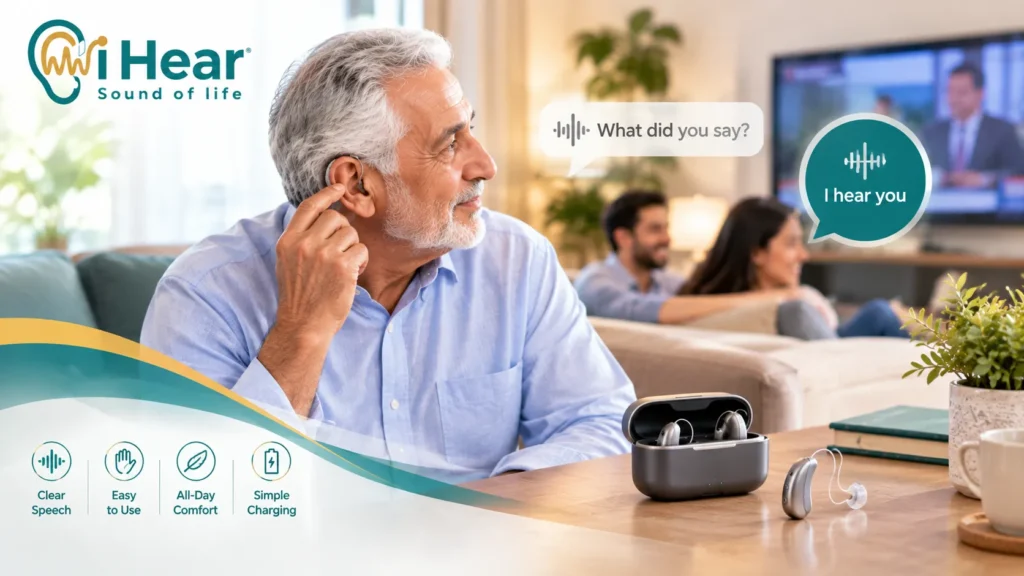
Why Is Choosing Hearing Aids for Seniors Different?
Age-related hearing loss, which doctors call presbycusis, usually develops slowly over years and affects both ears. It often starts with high-pitched sounds, so a person can hear that someone is talking but can’t quite make out the words, because sharp consonants such as s, sh, f, and th disappear first. That’s why so many people say, “I can hear you, I just can’t understand you.” It gets worse with women’s and children’s voices and with background noise, as in restaurants and crowded family gatherings.
But the biggest differences between seniors and younger buyers aren’t only in the hearing itself. They’re in everything around it:
- Hands: Fingers may be stiff or tremble, which turns a tiny battery or a small button into a real obstacle.
- Eyesight: If vision is poor, small devices are hard to read, to orient, and to insert correctly.
- Learning: New devices and phone apps can be tiring for someone who isn’t used to them. The simpler the device, the more likely it is to succeed.
- Patience: The brain needs time to adapt to sounds that come back after a long absence, and that takes family support.
- General health: Other conditions or medicines can affect comfort and how a device is used.
That’s why there’s no single “best” hearing aid for every senior. There’s the one that suits this particular person, and it’s found after a test, by looking at their lifestyle and abilities. That’s what the rest of this guide helps you do.
Is a Medical Hearing Aid the Same as a Cheap Sound Amplifier?
No, and this point matters more than you might think. When you search for “medical hearing aids for older adults” you’ll find a strange mix online: real hearing aids that are fitted by a professional, next to “sound amplifiers” sold at very low prices in online shops and classified ads, and sometimes second-hand. The names sound alike. The difference is big.
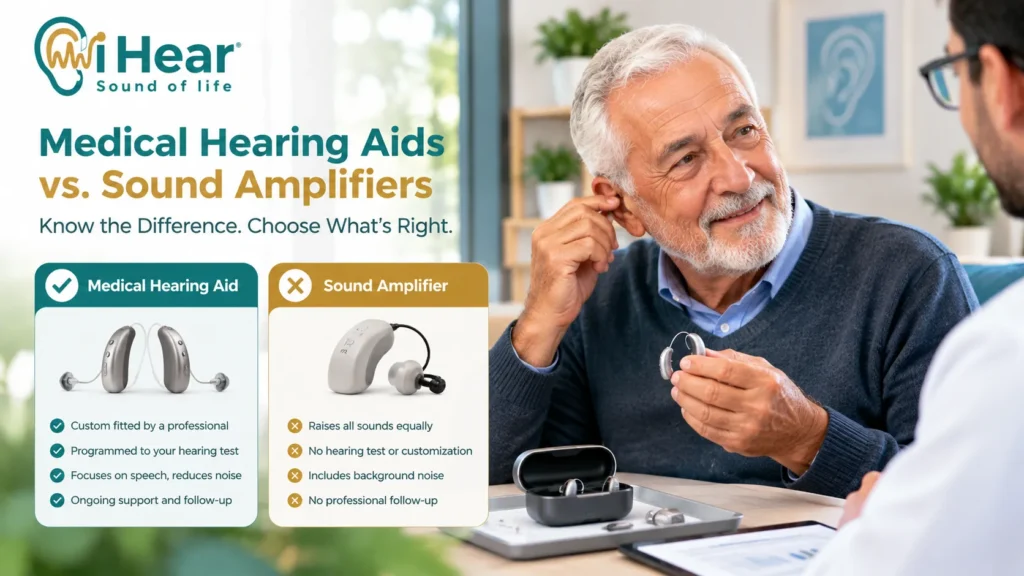
A medical hearing aid is an electronic device programmed to the results of your own hearing test. It boosts the pitches you’ve lost more than the ones you still hear well, and it tries to separate speech from noise. It’s fitted by a professional, who then follows up with you.
A sound amplifier raises all sounds by about the same amount, background noise included, and it knows nothing about your hearing.
The problem isn’t only quality. An amplifier can make sound louder than it should be without proper adjustment, it can create the impression that the problem has been solved when it hasn’t, and it can delay the check-up that might have found something treatable. A second-hand device is a device set up for someone else’s ear, with no guarantee of cleanliness or condition.
We’re not saying amplifiers are useless in every situation. But for a parent, the sensible path is a hearing test first, and then a device chosen on that basis.
What Makes a Hearing Aid Right for a Senior? 8 Criteria That Decide It
If you asked us to sum up this guide in a page, these are the eight criteria we go through with every family.
1) Start With a Hearing Test, Not the Device
You can’t choose the right device if you don’t know the type and degree of hearing loss. A hearing test with a qualified audiologist shows whether the problem is in the outer and middle ear or the inner ear, and how severe it is at each pitch. Everything else is built on that: the style, the power, and the features.
iHear offers a free hearing test, and you can book through WhatsApp. Whoever does the test, ask for a copy of the results so you can compare offers later.
2) Ease of Use Before Features
This is where many families go wrong. They buy the newest device with the longest feature list, and then the wearer can’t manage it and stops using it. Ask yourself: Can my parent switch it on and off alone? Can they feel the buttons? Can they change the volume? The best choice is often a device that works automatically most of the time and has a few clear controls for the person who wants them.
3) Rechargeable or Replaceable Batteries?
Each option suits different people:
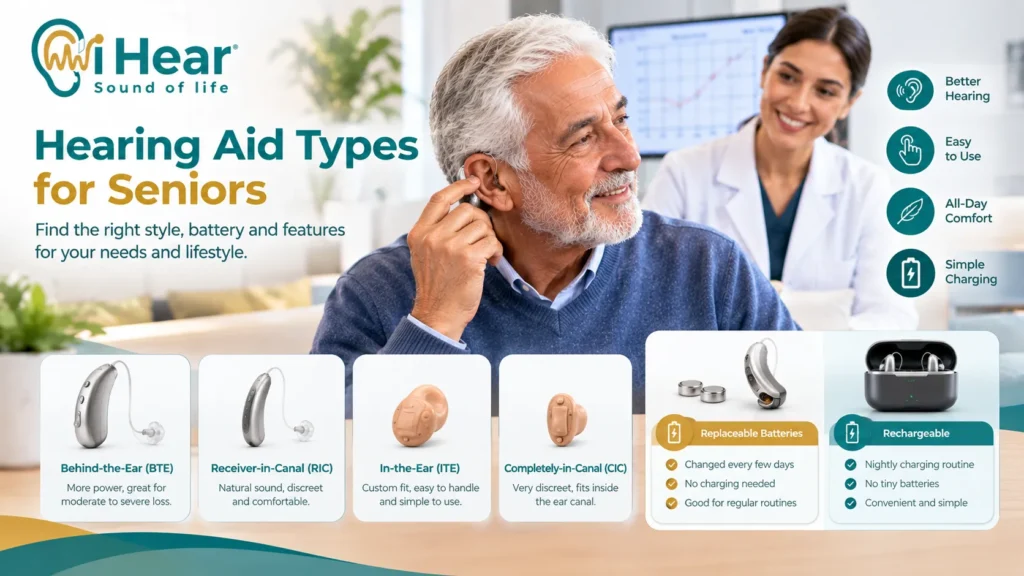
- Small replaceable batteries: These are changed every few days. They suit people who handle small things easily and don’t like the idea of daily charging, but they can be tiring for tired fingers or weak eyesight.
- Rechargeable: The wearer puts the hearing aids in a charger every night. It suits people who have a regular routine and want to avoid tiny batteries, but it requires the habit of charging, and keeping a charger nearby.
Our advice: decide based on your parent’s habits. Someone who takes their medicine every night will remember the charger. Someone who forgets often may do better with a battery that a family member reminds them about.
4) Behind-the-Ear or In-the-Ear?
Many people lean toward the smallest because looks matter to them, which is understandable. But for seniors the trade-off is different:
- Behind-the-ear (BTE) or receiver-in-canal (RIC): Slightly larger, easier to hold, insert, and remove, and available for different degrees of hearing loss, including severe. They’re often the best choice for someone with limited finger control.
- In-the-ear (ITE, ITC, CIC): Small and almost invisible, but they come with smaller buttons and batteries, they can be affected by wax and moisture, and they’re harder to insert and remove. They mostly suit mild to moderate loss.
Don’t dismiss visible styles. Many older adults care more about hearing well than hiding the device, and some even see a visible device as a gentle signal to others that they need clear speech.
5) Speech Clarity in Noise
This is the real test of any hearing aid for an older adult. Most complaints don’t come from the quiet living room. They come from the restaurant, the family gathering, and the car. So focus on how well the device brings speech forward and reduces background noise, abilities that generally improve as the technology level rises. Ask for the device to be tried in a place with overlapping voices, not only in the clinic room, and remember that no hearing aid removes noise completely. It helps you pick out speech from within it.
6) Phone and TV Connectivity: Feature or Complication?
Wireless connectivity means calls and TV sound can stream straight into the hearing aids. In many homes it ends the classic argument over TV volume: your father hears what he wants and nobody else is disturbed. But it can be a burden for someone who doesn’t use a smartphone at all. So ask honestly: will they actually use this, or are we paying for something they’ll never touch? If the answer is no, a simpler device without complicated connectivity may be the more successful choice.
7) Comfort and Durability in the UAE Climate
Heat, humidity, dust, and sweat are hard on small electronics, and seniors often wear their hearing aids most of the day. Ask how well the device resists moisture and dust, and how to clean and dry it. And test it for hours, not minutes. A hearing aid that presses on the ear or itches will end up in the drawer, whatever its specifications say.
8) Follow-Up and Remote Adjustment
The first weeks decide whether a hearing aid succeeds, and during them the device needs fine-tuning. If getting to the clinic is hard for your parent, ask about remote adjustment through the phone app, which can save many visits. iHear offers this service, so ask whether it’s available for the model you choose. Even more important than the service itself is knowing who you’ll contact when a problem comes up, and how quickly they respond.
Hearing Devices for Seniors: Which Type Fits Which Situation?
Before we get to specific models, here’s a table showing how the options change with the senior’s situation. It’s general guidance, and the final decision belongs to your audiologist after the test:
Senior’s situation | What often suits them | Notes |
|---|---|---|
Mild to moderate loss, quiet lifestyle | A simple device, behind-the-ear or receiver-in-canal | Few buttons, automatic operation |
Moderate loss, very active social life | A higher technology level for noise handling | Helps in restaurants and gatherings |
Moderate to severe loss | A behind-the-ear device with enough power | Power matters more than size |
Severe to profound loss | A high-power behind-the-ear device | Designed for these degrees |
Weak hands or poor eyesight | A larger style, clear buttons, a simple charger | Avoid very small devices |
Enjoys technology and the phone | Wireless connectivity and an app | Adds enjoyment, not essential |
Wants no complications | An automatic device without an app | Simplicity first |
Beltone Hearing Aids at iHear: Which One Might Suit Your Parent?
iHear supplies Beltone hearing aids in the UAE as an authorized distributor. Here’s a look at some of the models from a senior’s point of view, with one important note: this isn’t a final recommendation. The right model is chosen after the hearing test and depends on your parent’s situation.
Commence: A Practical Choice for First-Time Users
On our page, Commence is described as a practical choice for people using hearing aids for the first time. The manufacturer places it in its simpler, essential level, which can make it a sensible candidate for someone with a fairly calm daily life who wants an easy device. Some versions come in different styles, depending on the model. Someone who needs advanced noise handling may find the higher levels a better fit.
Envision: For Automatic Adaptation to the Surroundings
The manufacturer presents Envision as one of its newest hearing aids, with AI-assisted sound processing aimed at bringing speech forward and reducing noise, along with wireless connectivity. On our page we explain that it adapts automatically to the environment around you. That helps a senior who doesn’t want to change settings by hand and moves between home, restaurants, and gatherings. Some versions are rechargeable, so ask which one is available.
Boost Max S: For Severe Hearing Loss
Our page presents Boost Max S as suitable for severe hearing loss, and the manufacturer describes it as a rechargeable, high-power behind-the-ear device for severe to profound loss. If your parent’s test results fall in that range, this is the type of device that is usually discussed.
Other Models
You’ll find the details of Serene, Boost SP, and Illuminate on each model’s page, and your audiologist can tell you whether one of them suits your parent better.
One Hearing Aid or Two for an Older Adult?
If both ears are affected, which is the most common situation with age, audiologists usually recommend two hearing aids, because using both ears helps the brain work out where a sound comes from and follow speech in noise. Buying two may feel expensive, but settling for one when two are needed can leave the person disappointed, and they may judge hearing aids as a whole to have failed. Ask your audiologist plainly: what difference should we expect between the two options in my parent’s case?
How Do You Convince a Parent to Get Tested and Wear Hearing Aids?
This is the hardest part of the whole story, and it isn’t about money. It’s about dignity. Many older people see a hearing aid as an admission of weakness or a sign of ageing, and they’d rather blame everyone else for “mumbling” than accept that their hearing has changed. Here is what helps:
- Start with the test, not the device. Say, “Let’s check your hearing the way we check blood pressure and sugar.” It sounds much lighter than “you’ll need a hearing aid.”
- Describe what you noticed, not what’s “wrong.” Instead of “you can’t hear,” try “at the restaurant you missed what your son said, and it upset me.”
- Go with them to the appointment. Your presence reassures them, and it helps you understand and remember the advice.
- Let it be their decision. Let them help choose the style and colour and try it themselves. People accept a device more readily when they feel they chose it.
- Ask for a trial period. “Let’s try it and see” is much easier than “we’re buying it.” iHear lets you try a hearing aid before you buy, so ask about the terms.
- Tell them what they’ll gain. A grandchild who can talk to them without raising their voice, family gatherings that are enjoyable again, phone calls that are clear.
It’s also worth knowing that the World Health Organization links untreated hearing loss to social isolation, and some studies link it to a decline in thinking abilities. That doesn’t mean a hearing aid alone prevents it, but it’s a good reason not to put the decision off.
How Do Seniors Adjust in the First Weeks?
Your father may put the hearing aids in, then take them out after two days saying, “the sounds are annoying.” Don’t assume the device has failed. What’s happening is that his brain has spent years without many everyday sounds, so when they return all at once they seem loud and strange: his own footsteps, dishes clinking, rustling paper, even his own voice.
Here is a typical adjustment path. It’s approximate and varies from person to person:
- The first days: A few hours at home, in quiet places, with breaks.
- The first to second week: Gradually longer wear, trying the hearing aids with the TV and short conversations.
- After that: Busier places and phone calls, writing down notes, and visiting the audiologist for fine-tuning.
And avoid three common family mistakes: forcing them to wear the hearing aids all day from day one, repeating “did you hear that?” as if they were being tested, and brushing off their complaints about discomfort. Tell the audiologist everything that bothers them so the settings can be adjusted. That is the real fix.
Daily Care for Hearing Aids: A Simple Routine for Families
The best hearing aid in the world fails when it’s neglected, and seniors sometimes need someone to remind or help them. It takes about ten minutes a day:
- Every morning: Check that the hearing aids are clean and that the battery is charged or fresh before they’re worn.
- Every evening: Wipe them with a soft dry cloth, remove any wax with the tool supplied, then put them in their case or charger.
- Drying: Moisture and sweat are among the most common causes of faults in the UAE, so dry them daily and ask which drying case suits your device.
- Heat: Never leave hearing aids in a car parked in the sun, or near a heat source.
- Water: Take them off before showering or swimming, and if they get wet, dry them rather than switching them on straight away.
- Spares: Keep spare batteries or a charger in the bag if your parent goes out a lot.
- Visits: Keep the follow-up appointment, and keep the serial number, the purchase invoice, and the warranty paperwork.
How Much Do Hearing Aids for Seniors Cost?
The question we hear most after “which hearing aid should I choose?” is “how much is it?” We deliberately won’t quote a number here. Prices vary with the model, the technology level, and what the offer includes, and any general figure can mislead you when you compare two offers that are different in substance.
What Makes Prices Different?
- The technology level and how well the device handles noise.
- The style, the size, and the amplification power.
- Connectivity and charging features.
- The number of devices: one or two.
- The services included: testing, fitting, follow-up, and warranty.
Why Not Compare With Cheap Online Prices?
You’ll find sound amplifiers at very low prices marketed as “hearing aids for seniors.” But they aren’t programmed to your parent’s hearing, nobody follows them up, and they can do more harm than good if they’re too loud or if they delay a check-up. Compare real hearing aid offers only, and ask for a written offer showing:
- Exactly which model and technology level.
- Whether the price is for one hearing aid or two.
- Whether it includes the test, the fitting, and follow-up visits, and how many.
- The length of the warranty and what it covers: repair, replacement, loss, damage.
- Whether there’s a trial period, and what the return terms are.
- Who handles repairs, and where.
Does Insurance Cover Hearing Aids?
Coverage varies from policy to policy. Some plans cover part of the test or the device, and others exclude them. Check your parent’s policy or call the insurer before buying, ask what paperwork is needed, then ask the provider what they need from you to submit a claim.
If you’d like a written offer based on your parent’s situation, you can contact us or message us on WhatsApp.
When Should a Senior See an ENT Doctor Before Getting Hearing Aids?
Some situations call for a doctor before any device, because the cause may be treatable. See an ear, nose, and throat (ENT) specialist first if you notice:
- Sudden hearing loss, especially in one ear. This needs urgent medical attention, because every day of delay can reduce the chance of recovery.
- Hearing that is clearly worse in one ear than the other.
- Ear pain, discharge, or repeated infections.
- Dizziness or problems with balance.
- Ringing in only one ear, or ringing that pulses with the heartbeat.
- A blocked ear that might be wax or something stuck inside.
And if hearing loss comes with a noticeable change in memory, attention, or mood, mention that to the doctor as well so the whole picture can be assessed, since the two can overlap in older adults.
Common Mistakes When Buying Hearing Aids for Seniors
- Buying without a hearing test. You’re buying a device for a problem nobody has measured.
- Choosing the smallest one only. It may not suit your parent’s hands or degree of loss.
- Always choosing the most expensive. Features that won’t be used don’t help the wearer.
- Comparing prices alone. Compare what the offer includes: testing, fitting, follow-up, and warranty.
- Buying a sound amplifier as if it were a medical hearing aid. The difference is large, as we explained.
- Judging on day one. The brain needs weeks to adapt.
- Skipping follow-up. Adjustment visits are part of the treatment, not a luxury.
- Leaving it all to the senior. They need your help with cleaning, charging, and follow-up in the first weeks.
Checklist Before Buying Hearing Aids for Your Parent
- A qualified audiologist has tested their hearing and we have a copy of the results.
- An ENT doctor has ruled out treatable causes if there were any warning signs.
- We know the type and degree of the hearing loss.
- My parent tried the style themselves: putting it in, taking it out, pressing the buttons.
- We agreed on batteries or charging according to their habits.
- We asked whether one or two hearing aids are right.
- We have a written offer showing the device, what’s included, and the warranty.
- We know the trial period and the return terms.
- We know how many follow-up visits are included and whether remote adjustment is available.
- The seller is an authorized distributor, and we know where repairs are done.
Frequently Asked Questions About Hearing Aids for Seniors
Final Thoughts and Your Next Step
Choosing hearing aids for seniors isn’t about the most expensive device or the newest feature. It’s about a device that suits your parent’s hearing, hands, and habits, and that has someone following up after the purchase. If you remember one thing from this guide, make it this: start with the test, try before you buy, and make ease of use your first criterion.
If you’re in the UAE and you’d like to start with a free hearing test for your father or mother, message us on WhatsApp to book, explore our Beltone hearing aids, read About us to learn who we are and what we offer, or contact us and our team will help you.

For more information
Feel free to contact us anytime. Our team is always ready to help you.




[…] may need more follow-up visits and gentle encouragement through the first month. Our guide to the best hearing aids for seniors covers this in […]
[…] Further reading: hearing aids for hearing loss: types, how they work and how to choose and best hearing aids for seniors. […]