
Short answer: Hearing aids for hearing loss are small electronic devices worn behind or inside the ear. They pick up sound, process it, and amplify it according to the results of your hearing test. They come in several styles, such as behind-the-ear, in-the-ear, and receiver-in-canal, and each degree of hearing loss has devices that suit it. No device should be chosen before a hearing test with an audiologist, followed by fitting and follow-up.
When you start searching for hearing aids for hearing loss, you walk into a maze: English abbreviations nobody explains (BTE, RIC, CIC), promises of “the best,” wildly different prices, and cheap sound amplifiers whose names look just like real hearing aids. Few articles answer the question you actually have: which device suits my hearing?
We wrote this guide to be your complete reference. We explain hearing loss in plain language, then how hearing aids work, their types by style and by technology level, which type suits which degree of hearing loss, how to get your device step by step, and what to expect afterwards. The World Health Organization estimates that more than 1.5 billion people worldwide live with some degree of hearing loss, so your question isn’t unusual, and your need isn’t an exception.
How Do I Know If I Need a Hearing Aid?
Gradual hearing loss is deceptive. It creeps in so slowly that people often decide the problem lies with everyone else: “People have started mumbling.” See whether these signs apply to you or someone you love:
- You ask people to repeat themselves often.
- You turn the TV up higher than others find comfortable.
- You hear speech but don’t understand it, especially in restaurants, majlis gatherings, and other busy places.
- Phone calls are hard to follow.
- You feel tired at the end of the day from concentrating on conversations.
- You avoid social gatherings because you lose the thread.
- Women’s and children’s voices seem less clear than men’s.
- You hear ringing or buzzing in your ears.
If several of these apply, a hearing test is probably worth your time. Don’t wait for things to get worse; starting early is often easier for adjustment. Only a test can confirm that there is a problem and tell you how large it is.
Degrees of Hearing Loss and What They Mean in Practice
The World Health Organization groups hearing loss by the average level of the quietest sound you can hear, measured in decibels (dB). This is a simplified table. The descriptions are approximate, and your audiologist will interpret your own results:
| Degree | Average hearing level | What you may notice | What’s usually discussed |
|---|---|---|---|
| Mild | 20 to under 35 dB | Trouble with soft speech and noise | A simple hearing aid may help; the audiologist decides |
| Moderate | 35 to under 50 dB | Difficulty following normal conversation | Usually a hearing aid |
| Moderately severe | 50 to under 65 dB | Normal speech is heard only with difficulty | A hearing aid with more amplification power |
| Severe | 65 to under 80 dB | Only very loud speech is heard | A high-power hearing aid |
| Profound | 80 dB and above | Very few sounds are heard | A high-power hearing aid, or other options assessed by the doctor |
What Are the Types of Hearing Loss, and Why Does the Type Matter?
Before we talk about devices, know that “hearing loss” isn’t a single condition. Where the problem lies decides the treatment, and it decides whether a hearing aid is the answer at all:
- Conductive hearing loss: the problem is in the outer or middle ear, such as wax, a middle-ear infection, fluid behind the eardrum, or a perforation. Many causes can be treated with medicine or a medical or surgical procedure, and a hearing aid may help in some cases.
- Sensorineural hearing loss: the problem lies in the inner ear (the cochlea) or the hearing nerve, including damage to the tiny hair cells. It’s the most common type with ageing and after long exposure to loud noise. It doesn’t usually return fully to normal hearing, and hearing aids are generally the main solution.
- Mixed hearing loss: a combination of both. The doctor treats whatever can be treated, and the hearing aid is programmed for what remains.
Hearing aids help, first and foremost, people whose hearing loss can’t be treated medically, or who have completed treatment and haven’t recovered their hearing fully. That’s why the right route begins with a hearing test and, where needed, an ENT doctor, not a shop.
How Do Hearing Aids Work?
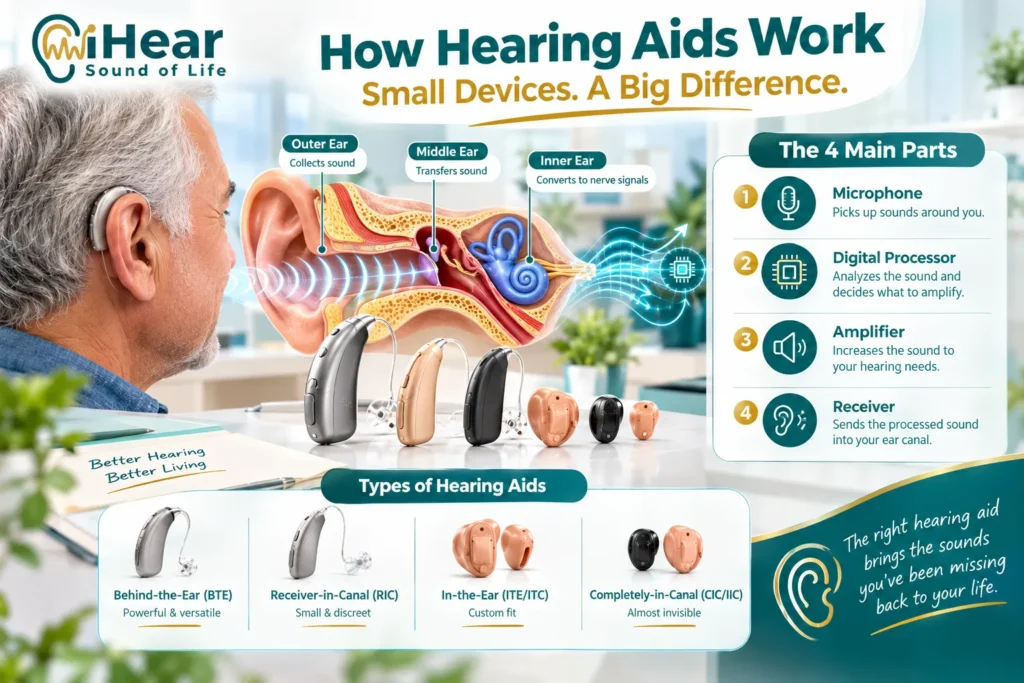
The idea is simple, but the details are clever. A hearing aid has four main parts:
- The microphone: picks up the sounds around you. Many devices have two or more microphones to tell which direction a sound comes from.
- The digital processor: a tiny chip that analyses the sound and decides what to amplify and by how much, and tries to separate speech from noise.
- The amplifier: raises the sounds according to the programming set for your hearing.
- The small speaker (the receiver): sends the processed sound into your ear canal.
Most modern hearing aids are digital. They’re more precise than the older analogue types because they analyse sound and decide what needs amplifying and what doesn’t.
Why Isn’t Turning Up the Volume Enough?
Because hearing loss is rarely the same at every pitch. You may hear low sounds well and lose the high ones. If we raised every sound by the same amount, noise would swamp you and you wouldn’t understand any more. A hearing aid is programmed from your audiogram, the map of your hearing, so it amplifies what you’ve lost more than what you haven’t, and tries to reduce noise and bring speech forward. That’s why a general-purpose amplifier can’t do this job.
Types of Hearing Aids by Style
When people talk about “types of hearing aids,” they usually mean the style: where the device sits and how it looks. These are the most common types, with the names you’ll hear in the clinic:
| Style | How it’s worn | Often suits | Worth knowing |
|---|---|---|---|
| Behind-the-ear (BTE) | The body sits behind the ear and sends sound into the canal through a tube and earmold or a thin tube | Most degrees of hearing loss, from mild to severe, and all ages | Larger, more powerful, and easier to handle |
| Receiver-in-canal (RIC) | A small body behind the ear with a thin wire to a tiny speaker in the ear canal | Mild to severe loss; people who want a discreet look | Popular and compact; the speaker in the canal needs care |
| In-the-ear (ITE, ITC) | Custom-made to the shape of your ear and fills part of the ear and canal | Mild to moderate loss, usually | Smaller buttons and battery; can be affected by wax and moisture |
| Completely-in-canal (CIC, IIC) | Very small and worn deep in the canal | Mild to moderate loss, and people who want the least visible option | Fewer features, usually; hard to handle with limited dexterity |
Behind-the-Ear Hearing Aids (BTE)
These are the oldest and the most versatile, and the style suits most degrees of hearing loss. The larger body allows a bigger battery, more power, and easier controls, which is why they’re often recommended for people who need strong amplification or who have limited finger control or eyesight. Many people think they’re “big,” but modern models are slimmer and lighter than they used to be.
Receiver-in-Canal Hearing Aids (RIC)
These combine small size with flexibility: the body with the microphones and battery sits behind the ear, and the tiny speaker sits in the canal, connected by a thin wire. They’re often used with open fittings for people who lose mainly the high pitches, because the canal isn’t completely blocked, so sound feels more natural. The receiver needs special care because it meets wax and moisture.
In-the-Ear Hearing Aids (ITE and ITC)
They’re made for your ear after an impression or a scan is taken, and they sit inside the ear bowl or canal. Their advantages: they’re less visible and they’re less affected by glasses and face masks than devices behind the ear. On the other hand, the buttons and battery are smaller, so they may not suit people with limited finger movement, and wax can block the microphone opening.
Completely-in-the-Canal Hearing Aids (CIC and IIC)
These are the smallest and the least visible, and they suit people for whom looks come first and who have mild to moderate loss. But the tiny size means fewer features, a smaller battery, and harder handling, and they’re not suitable for severe loss. Ask your audiologist whether your ear canal is suitable, because not every canal fits them.
Types of Hearing Aids by Technology Level and Features
Style doesn’t determine quality by itself. Within each style there are technology levels, from basic to advanced, and this is what affects the price and the performance in difficult places. Level names vary from brand to brand, but the differences usually come down to these features:
Noise Handling and Speech Clarity
The higher the level, the better the device usually is at separating speech from noise, which is what people feel in restaurants and gatherings. Manufacturers now talk about intelligent sound processing. In practice, it means the device recognises the environment (quiet, crowded, in a car) and changes its settings on its own.
Directional Microphones
They focus on sound coming from in front of you and reduce sound from behind and the sides, which helps when you’re talking to one person in a busy place.
Feedback Control
A hearing aid can whistle when a hand or phone comes near, or when you hug someone. Modern hearing aids usually handle it automatically. Some people hear a buzz near a phone with some devices, so ask about that during the trial.
Wireless Connectivity and Apps
Calls, TV, and music can stream straight into the hearing aid over Bluetooth, and you can control volume and programs from a phone app. It’s a great feature for someone who’ll use it, and a burden for someone without a smartphone.
Rechargeable or Replaceable Batteries
Some models are rechargeable (you put them in the charger every night) and others use small batteries that you replace every few days. Decide based on your habits and your hands.
Remote Adjustment
Some devices and apps let the audiologist adjust the settings remotely without a clinic visit. iHear offers this service, so ask whether it’s available for the model you choose.
Programs That Help With Tinnitus
Some devices include sound programs that help draw attention away from tinnitus. They don’t treat the cause of the ringing, but some people find them soothing. If you have tinnitus, tell your audiologist before choosing a device.
Which Hearing Aid for Which Degree of Hearing Loss?
This table is guidance only, and the final decision belongs to your audiologist after your test:
| Degree of hearing loss | Styles usually discussed | Notes |
|---|---|---|
| Mild | In-the-ear, in-the-canal, or RIC | Simple technology levels may be enough |
| Moderate | RIC, BTE, or in-the-ear | The level depends on how active you are |
| Moderately severe | A more powerful RIC or a BTE | Power matters more than size |
| Severe | A high-power BTE | Designed for these degrees |
| Profound | A high-power BTE, or other options assessed by the doctor | Other solutions may be discussed |
What Can You Expect From a Hearing Aid? Common Myths
What disappoints people most is wrong expectations, not the device. Here are the most common myths:
- “A hearing aid will give me my old hearing back.” No. It helps you hear speech and important sounds more clearly, but it doesn’t return the ear to its earlier condition.
- “I’ll hear clearly from day one.” Usually not. The brain needs weeks to adapt to sounds that have come back after being away.
- “The most expensive is always the best.” Not necessarily. The best is the one that meets your needs and is fitted well.
- “One hearing aid is enough.” If both ears are affected, audiologists usually recommend two.
- “A hearing aid will make my hearing worse.” A well-fitted hearing aid doesn’t weaken hearing. The risk lies in over-amplification without proper fitting, which is what happens with general amplifiers.
- “An amplifier and a hearing aid are the same.” No. An amplifier raises all sounds with no adjustment, while a hearing aid is programmed to your hearing.
Beltone Hearing Aids at iHear: A Look at the Models
iHear supplies Beltone hearing aids in the UAE as an authorized distributor. Here’s a brief look at some of the models, with an important note: this isn’t a final recommendation, since the right model is chosen after your hearing test and depends on your situation.
- Commence: on our page it’s described as a practical choice for first-time users, and the manufacturer places it in its simpler, essential level.
- Envision: the manufacturer presents it as one of its newest, with AI-assisted sound processing and wireless connectivity, and on our page we explain that it adapts automatically to your surroundings. Some versions are rechargeable, so ask which one is available.
- Boost Max S: presented on our page as suitable for severe hearing loss, and described by the manufacturer as a rechargeable, high-power behind-the-ear device for severe to profound loss.
- Serene, Boost SP, and Illuminate: you’ll find the details of each on its own page, and your audiologist can tell you whether one of them suits you better.
How Do You Get Hearing Aids? The Journey Step by Step
Many people imagine it’s simply “go and buy one.” In fact it’s a path with six stops, and each one protects your investment:
- The hearing test: with a qualified audiologist, to learn the type and degree of your hearing loss. iHear offers a free hearing test, and you can book through WhatsApp.
- Medical clearance: if there are warning signs (listed below), see an ENT doctor first.
- Choosing: the audiologist suggests two or three models based on your degree of loss, your lifestyle, your hands, and your budget.
- Initial fitting: the hearing aid is programmed from your test results and fitted to your ear, and you’re shown how to put it in, clean it, and charge it.
- The trial: you use it in your real life. iHear lets you try a hearing aid before you buy, so ask about the length and terms of the trial.
- Follow-up and fine-tuning: visits to adjust the settings, some of which can be done remotely. iHear offers remote adjustment, so ask whether it’s available for your model.
Don’t skip the first stop, whatever you’ve seen in ads. And if you’d like to book, you can contact us.
When Should You See an ENT Doctor First?
See a doctor before any device if you notice:
- Sudden hearing loss, especially in one ear. This needs urgent medical attention, because every day of delay can reduce the chance of recovery.
- Hearing that is worse in one ear than the other.
- Ear pain, discharge, or repeated infections.
- Dizziness or problems with balance.
- Ringing in only one ear, or ringing that pulses with the heartbeat.
- A blocked ear that might be wax or something stuck inside.
How Much Do Hearing Aids Cost?
The question that follows “which hearing aid should I choose?” is “how much is it?” We deliberately won’t quote a number here. Price changes with the model, the technology level, and what the offer includes, and any general figure can mislead you. But these things make the difference:
- The technology level and how well the device handles noise.
- The style, the size, and the amplification power.
- Connectivity and charging.
- The number of devices: one or two.
- The services included: testing, fitting, follow-up, and warranty.
Always ask for a written offer showing exactly which model it is, whether the price is for one hearing aid or two, how many follow-up visits are included, the length of the warranty and what it covers, the trial period and return terms, and who handles repairs. And compare offers for real hearing aids only. The cheap amplifiers that are sometimes labelled “medical hearing aids” are not devices fitted to your hearing, and no audiologist follows them up.
Insurance coverage varies from policy to policy, so call your insurer before buying and ask what paperwork is needed. And if you’d like an offer based on your situation, you can message us on WhatsApp.
Hearing Aid Care and Common Problems
A hearing aid is a delicate device that sits against your ear and meets sweat and wax, and in the UAE the heat, humidity, and dust add another load. A simple routine extends its life:
- Wipe it each evening with a soft, dry cloth, and remove wax with the tool supplied.
- Dry it daily in its case, and ask which drying case suits your device.
- Never leave it in a car parked in the sun.
- Take it off before showering or swimming, and if it gets wet, dry it rather than switching it on straight away.
- Keep the serial number, the purchase invoice, and the warranty paperwork.
Common Problems to Check Before Calling the Audiologist
- No sound: check the battery or charge, and whether wax is blocking the opening.
- Weak sound: usually wax or moisture, so clean and dry it.
- Whistling: the earmold may not fit well or the ear may have wax, so ask for an adjustment.
- Frequent cutting out: it may be moisture, so dry it and tell the audiologist if it keeps happening.
- Won’t connect to the phone: pair the device with the phone again or ask the audiologist.
If these steps don’t solve it, contact the provider you bought from, and don’t try to open the device.
What About Children?
Hearing loss in children is different from hearing loss in adults, because early hearing is tied to the development of speech and language. That calls for a specialised assessment and devices fitted carefully to the child. Don’t buy a device for a child without a paediatric audiologist. And if you notice that your child doesn’t respond to sounds or is late in speaking, ask for an early test instead of waiting.
When Isn’t a Hearing Aid Enough?
In some cases, such as very deep hearing loss or when a hearing aid doesn’t give enough benefit, the doctor may discuss other options with the patient, such as a cochlear implant or bone-conduction devices, depending on the case. That’s a medical decision made only after a specialist assessment, and it’s not a reason to postpone the test.
Common Mistakes When Buying Hearing Aids
- Buying without a hearing test. You’re buying a device for a problem nobody has measured.
- Choosing the style before the degree. The degree decides which styles are possible.
- Assuming the most expensive is the best fit. Features you won’t use don’t help you.
- Comparing prices alone. Compare what the offer includes.
- Buying an amplifier as if it were a medical hearing aid. The difference is large.
- Judging on day one. The brain needs weeks.
- Skipping follow-up and fine-tuning. They’re part of the treatment.
- Neglecting care and drying. Moisture and wax are among the most common causes of faults.

Frequently Asked Questions About Hearing Aids for Hearing Loss
Final Thoughts and Your Next Step
Choosing hearing aids for hearing loss doesn’t start with devices. It starts with your own hearing. Test first, learn the type and degree, then choose the style and level that fit your life, try before you buy, and make sure there will be someone to follow up with you afterwards. And if you have just one question, ask your audiologist: “What exactly will change in my hearing with this device?”
If you’re in the UAE and you’d like to start with a free hearing test, message us on WhatsApp to book, explore our Beltone hearing aids, read About us to learn who we are and what we offer, or contact us and our team will help you.

For more information
Feel free to contact us anytime. Our team is always ready to help you.




[…] It is also graded as mild, moderate, severe or profound, according to the level at which a child begins to hear tones in a hearing test. These are the same grades audiologists use when choosing the right solution, and you can read about them in our guide to hearing aids for hearing loss: types, how they work and how to choose. […]