
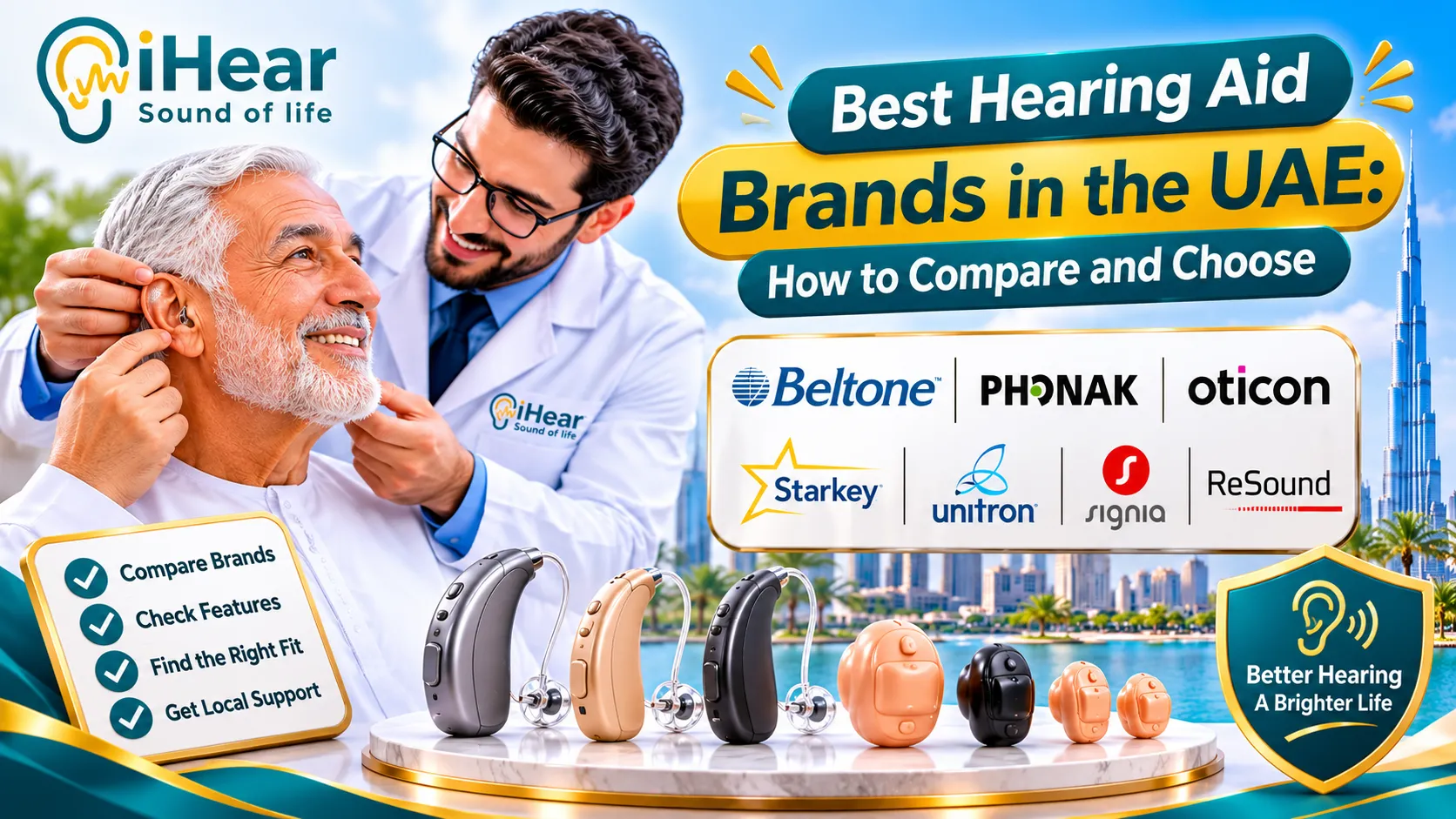
Short answer: There is no single best hearing aid brand for everyone in the UAE. The best choice for you is the device that suits your degree of hearing loss after a hearing test, fits your lifestyle and budget, and comes from an authorized distributor with a local warranty and service, fitted and followed up by an audiologist. Compare two or three models by trying them, not by advertising.
If you search for “best hearing aid brands in the UAE,” you’ll probably find headphones, classified ads, and doctors’ profiles, and very little of what you were actually looking for. That’s understandable. The market is crowded with names, and every seller says their brand is “the best.”
The part many sellers don’t tell you is that the question itself needs rewording. Instead of “which brand is best?”, ask: “which device suits my hearing and my life, and who will provide it here, with a warranty and service I can rely on?” That’s what this guide answers, in plain language: who makes hearing aids, how to compare brands using real criteria, how to check the distributor and the warranty in the UAE, and what we mean when we talk about price.
A note for the reader: iHear is an authorized distributor of Beltone hearing aids in the UAE. We mention other brands in this guide for information only. We don’t rank them or compare them with each other, because the right choice depends on your hearing, not on a company name.

Is There One Best Hearing Aid Brand?
No, and there are practical reasons:
- Your hearing is different from someone else’s. A brand that suits a person with mild loss and a quiet life may not suit someone with severe loss who spends time in busy restaurants and majlis gatherings.
- The big brands offer many levels and styles. Inside each brand there are simple models, advanced models, and high-power models, so comparing two brands means nothing until you specify which model and level.
- Fitting matters more than people think. The best device in the world disappoints if it isn’t fitted well, and an ordinary one can succeed when it’s fitted carefully and followed up with an audiologist.
- Technology changes quickly. What stood out two years ago may be standard today, and every brand releases new platforms regularly.
That’s why you should treat a ready-made list titled “top 5 brands” with caution. Whoever wrote it either sells one of those brands, or is repeating a ranking without knowing what it was built on.
Who Makes Hearing Aids? A Map of the Major Manufacturers and Their Brands
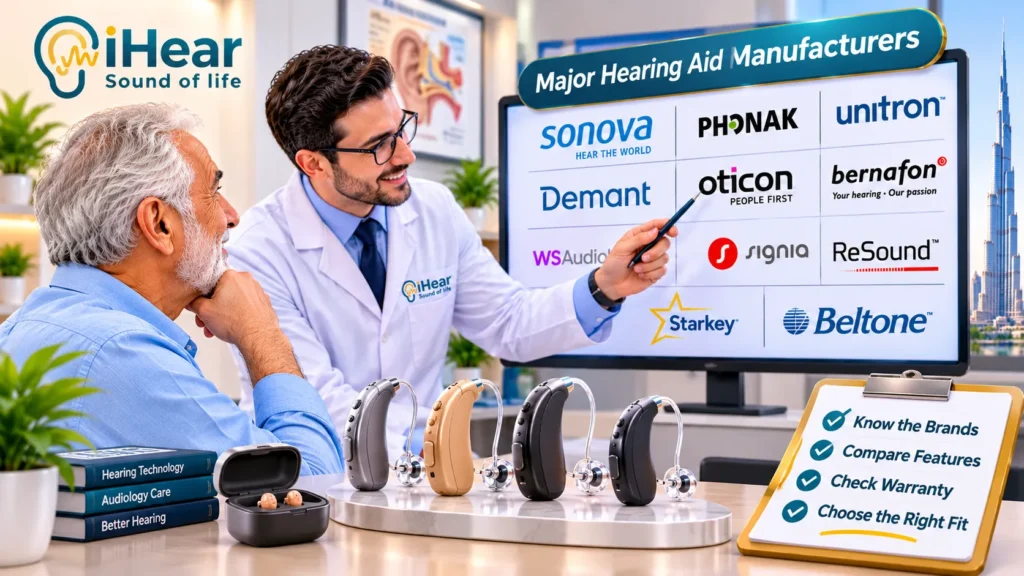
Most of the hearing aid brands you see around the world belong to a small number of large manufacturers, and each owns several brand names at different levels and in different markets. This is a general overview, for information only:
Parent company | Best-known brands | Headquarters |
|---|---|---|
Sonova | Phonak and Unitron | Switzerland |
Demant | Oticon and Bernafon | Denmark |
WS Audiology | Signia, Widex, and Rexton | Germany and Denmark |
GN | ReSound and Beltone | Denmark |
Starkey | Starkey | United States |
A few important notes on this table:
- It isn’t a ranking. The order of the companies doesn’t mean one is better than another.
- Not every brand is available in every market. Whether a brand is available in the UAE depends on its authorized distributor, so always ask before you rely on a name you haven’t seen at a local provider.
- Brands inside one company differ. Two brands may share similar technology but differ in pricing and levels.
- There are smaller brands and consumer products that we don’t list here, and they may or may not be good. Judging them takes a look at the specific model.
Why the Brand Alone Isn’t Enough
Imagine two people who bought the same brand and the same model. The first bought it after a careful hearing test, had it fitted by an audiologist to the results of his hearing, and went back four times in the first weeks. The second bought it from a source that didn’t test him, had it installed with general settings, and nobody followed up. Will their experience be the same? Of course not.
That’s why we say a hearing aid’s success stands on four pillars, and the brand is only one of them:
- The right test: to know the type and degree of the loss, and to rule out anything that needs a doctor.
- The right device: in style, power, and level, not just the name.
- Fitting and follow-up: by a qualified audiologist, and over weeks.
- After-sales service: a warranty recognised locally, repairs, spare parts, and someone you can reach when a problem appears.
If you get all four right, you’ll find that the differences between two good brands are smaller than advertising suggests. And if you lose one of them, no famous name will make up for it.
How to Compare Hearing Aid Brands: 10 Real Criteria
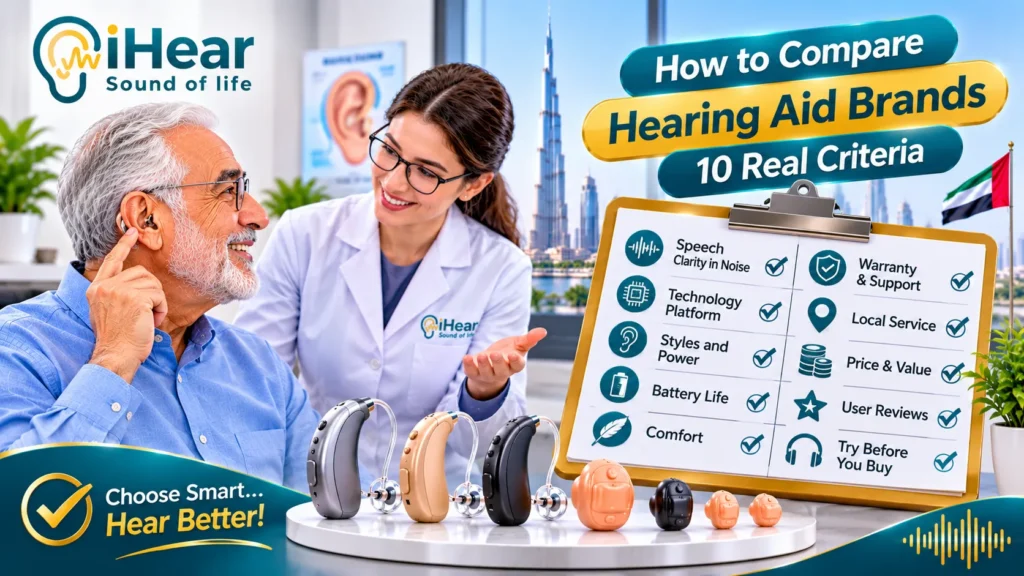
Instead of asking “which brand is best?”, ask these ten questions about every device you’re considering. They work for any brand and any model:
1) Speech Clarity in Noise
This is the most important test. Everyone hears well in a quiet room. The difference appears in the restaurant, the majlis, and the car. Ask for the device to be tried in a place with overlapping voices, and don’t judge a device from a demonstration in a silent clinic. And remember that no hearing aid removes noise completely. It helps you pick out speech from within it.
2) The Technology Platform and How Recent It Is
Manufacturers build their devices on “platforms” (chips and processors) and release a new one every few years. Ask when the device’s platform was released and what it actually adds over the previous one. The newest isn’t always necessary, but you shouldn’t pay the price of a new platform for an old one.
3) The Range of Styles and Power
Is the brand available in the style that suits you: behind-the-ear, receiver-in-canal, or in-the-ear? Does it have a model with enough power for your degree of loss? Some models suit mild to moderate loss, and others are designed for severe loss.
4) Connectivity and the App
Ask whether the device works with your phone (iPhone or Android), whether it streams calls and TV directly, and exactly what the app does. Some newer features, such as public audio broadcasting, depend on places that support them, so ask about that rather than assuming it.
5) Battery and Charging
Is the device rechargeable or does it use small batteries? How long does one charge really last on an ordinary day with wireless streaming? Advertised figures are measured in ideal conditions.
6) Water and Dust Resistance
In the UAE, heat, humidity, and dust play a real part. Ask about the protection rating (usually written as IP followed by two digits) and about the recommended cleaning and drying routine. And avoid assuming that water resistance means the device is fine for swimming.
7) Comfort and Appearance
Try the device for hours, not minutes, and notice pressure, itching, and the feeling of a blocked ear. A hearing aid that hurts stays in the drawer, whatever its specifications.
8) Remote Adjustment and the App
Some devices let the audiologist adjust the settings remotely, without a visit. Ask whether the local distributor offers this, and what can be adjusted remotely and what needs a visit.
9) Warranty, Local Service, and Spare Parts
This criterion separates a calm experience from a stressful one. Ask: how long is the warranty, what does it cover (repair, replacement, loss, damage), where is servicing done, are parts available locally, and do you get a loaner device during a repair?
10) Your Audiologist’s Experience With the Brand
The best brand in the world in the hands of someone who doesn’t know how to fit it well can disappoint. Ask your audiologist: have you fitted this brand for many patients? What do you see as its strengths or limits?
A Comparison Table You Can Fill In Yourself
Copy this table into a file or onto paper, and fill it in for each offer you receive. You may be surprised how much your opinion changes when you look at what the offer includes and not at its name:
Criterion | Offer 1 | Offer 2 | Offer 3 |
|---|---|---|---|
Brand, model, and level |
|
|
|
Style (behind-the-ear, RIC, in-the-ear) |
|
|
|
One hearing aid or two? |
|
|
|
Rechargeable or batteries? |
|
|
|
Phone and TV connectivity |
|
|
|
Water and dust resistance |
|
|
|
Trial period and return terms |
|
|
|
Follow-up visits included |
|
|
|
Remote adjustment |
|
|
|
Warranty length and what it covers |
|
|
|
Where repairs are done, and spare parts |
|
|
|
Does the price include VAT? |
|
|
|
What to Look for Depending on Your Situation, Instead of a Brand Name
Your situation | What to look for | Note |
|---|---|---|
Severe hearing loss | A high-power behind-the-ear device | Ask about maximum amplification power |
An active social life | Advanced noise handling | Try it in a noisy place |
An older adult or weak hands | A simple device, clear buttons, an easy charger | Simplicity matters more than features |
You rely on your phone | Compatibility with your phone, and call and TV streaming | Test the connection yourself |
A first-time user | A simple, essential level | You can upgrade later |
You sweat a lot or live in a humid place | Good resistance and daily drying | Ask about the protection rating |
You want the least visible option | In-the-ear or in-the-canal | Usually fewer features and less power |
Beltone Hearing Aids at iHear: What We Offer
iHear supplies Beltone hearing aids in the UAE as an authorized distributor, under written authorization from the manufacturer. Beltone is a brand that belongs to Denmark’s GN Hearing group. Here’s a quick look at some of its models. This is informational, not a recommendation, because the choice is made after the hearing test:
- Commence: on our page it’s described as a practical choice for first-time users, and the manufacturer places it in its simpler, essential level.
- Envision: the manufacturer presents it as one of its newest, with AI-assisted sound processing and wireless connectivity, and on our page we explain that it adapts automatically to your surroundings. Some versions are rechargeable, so ask which one is available.
- Boost Max S: presented on our page as suitable for severe hearing loss, and described by the manufacturer as a rechargeable, high-power behind-the-ear device for severe to profound loss.
- Serene, Boost SP, and Illuminate: you’ll find the details of each on its own page, and your audiologist can tell you whether one of them suits you better.
iHear offers a free hearing test, lets you try a hearing aid before you buy, and offers remote adjustment. All of these come with terms that vary by model, so ask about them before you decide. And if you’re comparing Beltone with other brands, that’s natural. We’d encourage you to try more than one device and to use the table above.
How to Check the Authorized Distributor and Warranty in the UAE
This is the point most people overlook when they compare brands, and it’s the one that decides how comfortable your experience will be after you buy. An authorized distributor is the company the manufacturer has officially appointed to import and distribute its products in a country, and which takes on responsibilities such as support, servicing, and compliance with local requirements. Someone who buys from an unauthorized source may later find that the warranty doesn’t apply and that servicing isn’t available.
In the UAE, medical devices are regulated by health authorities, including the Ministry of Health and Prevention (MOHAP) and the emirate-level authorities such as the Dubai Health Authority (DHA) and the Department of Health in Abu Dhabi (DOH). You don’t need to know the details, but it’s reasonable to ask the distributor about the registration status of the specific model you’re considering, and to ask what documents they can provide.
Five Steps to Verify
- Ask for proof of authorization. A letter from the manufacturer that names the seller’s official company name, covers the UAE, and is still valid. Don’t feel awkward asking for it. Serious companies provide it.
- Compare the company name with the letter. The seller’s legal name should match the name in the authorization.
- Look for the company on the manufacturer’s website, if it has a distributor page or a store locator.
- Ask about servicing: where is it done, are spare parts available locally, how long does a repair take, and do you get a loaner device?
- Get the warranty in writing: its length and what it covers, and whether it applies if the device was bought elsewhere.
What About Buying Online or From Abroad?
You may find a hearing aid at a tempting price on a foreign website or an unfamiliar online shop. The risks are well known: the warranty may not apply in the UAE, a service centre may not accept the device, and it may never have been programmed to your hearing. A hearing aid isn’t something sold without follow-up. If you buy from a distant source, first ask your audiologist whether they will agree to fit and follow it up, and on what terms.
iHear works as an authorized distributor of Beltone hearing aids in the UAE. You can learn more on our About us page, and you’re welcome to ask us about our authorization documents at any time.
Hearing Aid Prices in the UAE: What Sets the Price?
Many people search for “hearing aid prices in the UAE,” and we deliberately won’t quote a figure here. Price changes with the model, the technology level, and what the offer includes, and any general number can mislead you. But these are the factors that make the difference:
- The brand and model: which reflects part of the price, but not all of it.
- The technology level: noise handling, microphones, and connectivity.
- The style and power: high-power and custom devices cost differently.
- Charging and accessories: a charger, a drying case, earmolds.
- The number of hearing aids: one or two.
- The services included: testing, fitting, follow-up, warranty, and servicing.
- VAT: ask whether the quote includes value-added tax, so you compare like with like.
Ask for a written offer covering all of these, and compare offers for real hearing aids only. Insurance coverage varies from policy to policy, so call your insurer before buying and ask what paperwork is needed. And if you’d like an offer based on your situation, you can message us on WhatsApp or contact us.
Warning: Unknown Products and Amplifiers Sold as “Medical Hearing Aids”
When people search for brands, they sometimes end up with cheap products from makers nobody has heard of, or with “sound amplifiers” carrying glossy brand names. Most of these products aren’t programmed to your hearing and aren’t followed up by an audiologist. They may raise sound more than they should, and they may delay the check-up that would have found a treatable cause. If you can’t find a clear manufacturer, an authorized distributor, and a written warranty, you probably aren’t buying a medical hearing aid in the real sense.
Ten Questions to Ask Any Seller Before You Pay
- Exactly which brand, model, and level is it?
- Are you an authorized distributor, and can I see proof?
- Who fits the device, and what are their qualifications?
- Is the price for one hearing aid or two?
- Does it include the test, the fitting, and follow-up visits? How many?
- Is there a trial period, and what are the return terms?
- How long is the warranty, and what does it cover?
- Where is servicing done, and are parts available locally?
- Can the device be adjusted remotely?
- What happens if I lose the hearing aid or it’s damaged?
Common Mistakes When Choosing a Hearing Aid Brand
- Choosing the brand before the hearing test. The test is what shows what you need.
- Relying on ads or “best” lists. They may be written by a seller or copied by someone who doesn’t know.
- Comparing prices alone. Compare what the offer includes.
- Ignoring the warranty and local servicing. They’re what protect you if something goes wrong.
- Buying from an unauthorized source. You may lose the warranty and the follow-up.
- Skipping the trial. A device that looks excellent in an advert may not suit your ear or your life.
- Judging on day one. The brain needs weeks to adapt.
Frequently Asked Questions About Hearing Aid Brands in the UAE
Final Thoughts and Your Next Step
If you take one idea from this guide, make it this: don’t look for the best brand. Look for the right device for your hearing, from an authorized distributor who will stand behind it after you buy. Get your hearing tested first, compare two or three models by trying them, ask for a written offer showing what the price includes, and make sure of the warranty and local servicing.
If you’re in the UAE, whether in Dubai, Abu Dhabi, Al Ain, or elsewhere, and you’d like to start with a free hearing test, message us on WhatsApp to book, explore our Beltone hearing aids, read About us, or contact us and our team will help you.

For more information
Feel free to contact us anytime. Our team is always ready to help you.


No comment