
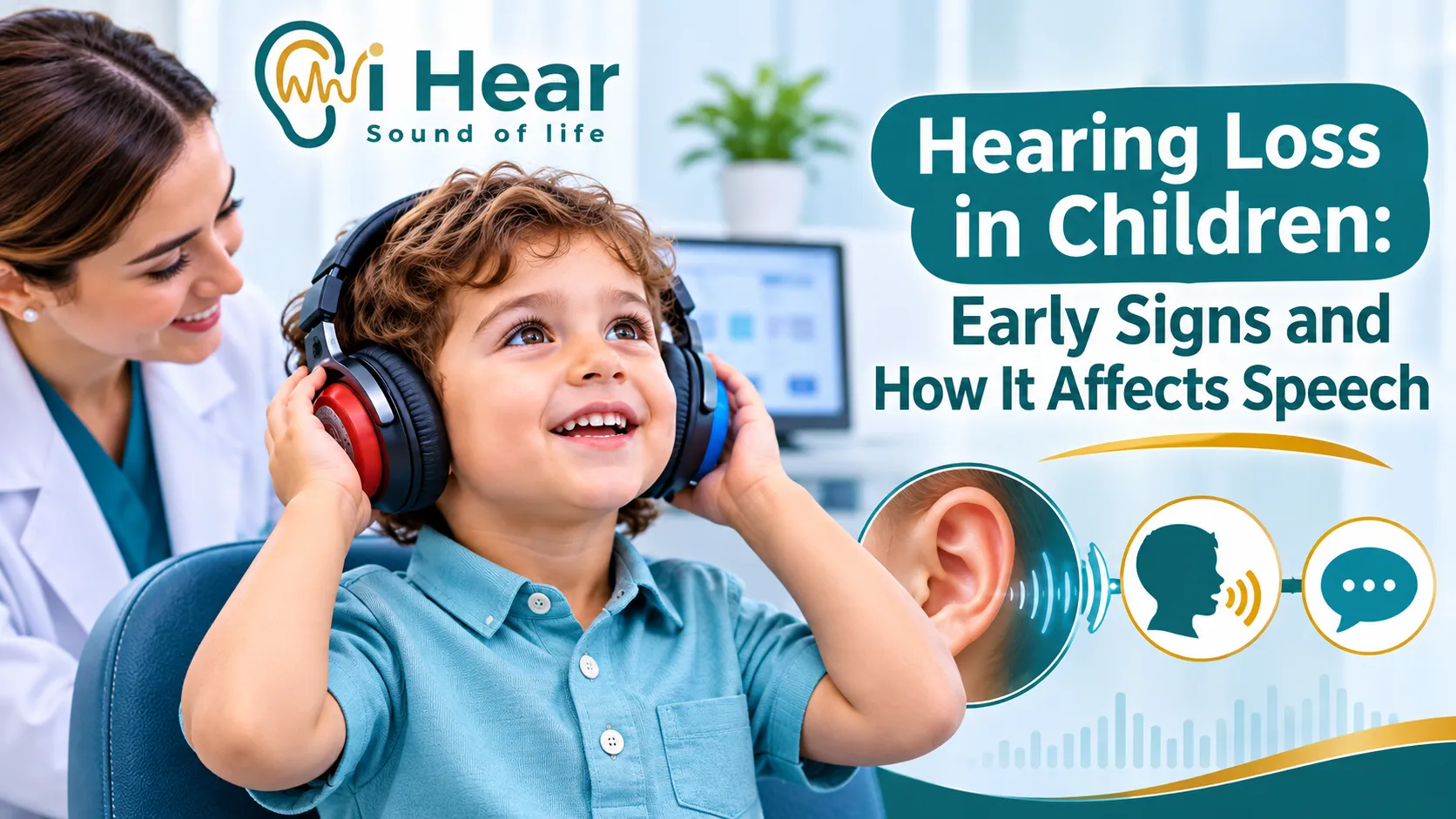
Quick answer: Hearing loss in children is one of the most common conditions present from birth, affecting about 1 to 3 in every 1,000 children according to the US Centers for Disease Control and Prevention (CDC). Early signs include no reaction to loud sounds, not turning toward voices, and delayed babbling, followed by delayed speech. If you suspect a problem, ask for a child hearing test straight away, because early detection is what protects a child’s speech and language.
Most families we meet say the same sentence: “We thought he would talk when he was ready.” It is an understandable thought. Every child develops at their own pace, and grandparents will always reassure a worried mother that a cousin was late to speak and then never stopped talking. But in some cases the cause of the delay is not a slow start. It is hearing loss. A child who cannot hear well cannot copy sounds that never reach them clearly, so speech is delayed, and language, learning and social skills can follow. The good news is that hearing loss in children can be managed very successfully when it is found early.
In this guide we explain in plain language what hearing loss in children is and what causes it, why early detection matters, what the signs of hearing loss in babies and older children look like, how speech delay and hearing loss are connected, how a child hearing test works in the UAE, what happens after a diagnosis, when hearing aids for children become an option, and which Beltone hearing aids we offer at iHear.
We write from daily experience at iHear, the authorised distributor of Beltone hearing aids and BioMed Jena hearing diagnostic devices in the UAE, with a head office in Al Ain and a branch in Abu Dhabi. To be clear from the start: we are not a substitute for your paediatrician, ENT doctor or audiologist. We want to help you know when to ask and who to ask.
Please note: this article is general information and does not replace a medical examination. If your child loses hearing suddenly in one or both ears over hours or days, this is an urgent medical situation and you should see a doctor immediately.
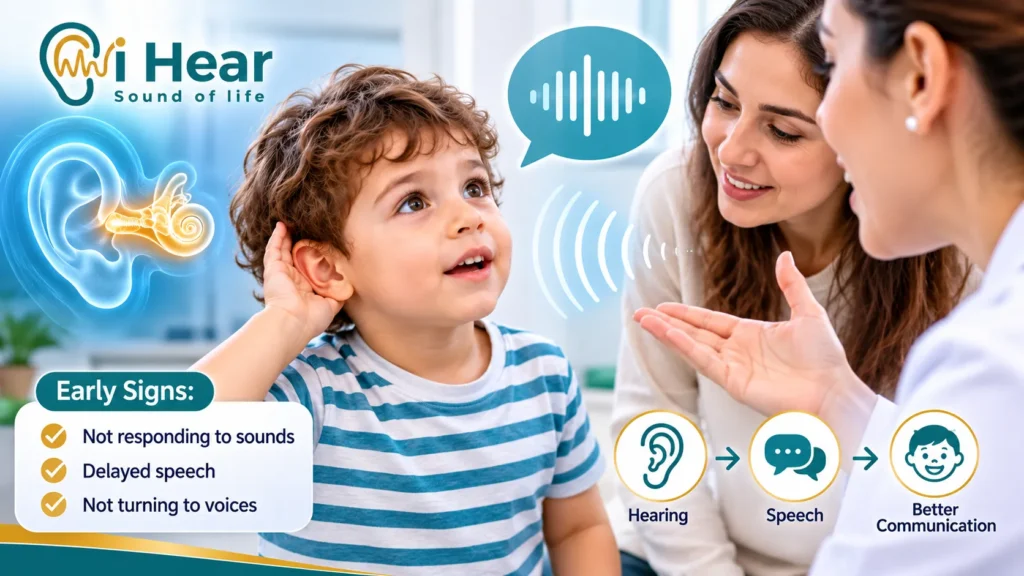
What Is Hearing Loss in Children?
Hearing loss in children means that a child cannot hear sounds at the normal level, whether the loss is mild or severe and whether it affects one ear or both. A child can be born with it, or it can appear later in the first months or years, and it can get worse over time.
It is divided into three main types according to where the problem lies:
Type | Where is the problem? | Examples |
|---|---|---|
Conductive hearing loss | The outer or middle ear, so sound does not pass easily to the inner ear | Fluid behind the eardrum, middle ear infection, ear canal blocked by wax |
Sensorineural hearing loss | The inner ear (cochlea) or the hearing nerve | Genetic causes, infections during pregnancy, certain medicines, premature birth |
Mixed hearing loss | A combination of both | A child with sensorineural loss who also has a middle ear infection |
It is also graded as mild, moderate, severe or profound, according to the level at which a child begins to hear tones in a hearing test. These are the same grades audiologists use when choosing the right solution, and you can read about them in our guide to hearing aids for hearing loss: types, how they work and how to choose.
A common mistake is to think that mild hearing loss, or loss in one ear only, is nothing to worry about. A child who hears well in one ear can still struggle in the classroom and in noisy places, and may be slightly slower to develop language. Every degree deserves to be assessed.
What Causes Hearing Loss in Children?
Doctors cannot find the cause in every case, but several causes and risk factors are well known:
- Genetic causes: a family history of hearing loss is one of the most important factors. Official statements in the UAE have also pointed to marriage between relatives as a genetic risk factor for hearing loss in newborns, which is why you should tell the doctor about any family history.
- Infections during pregnancy: the best known is cytomegalovirus (CMV), considered one of the most common non-genetic causes of hearing loss in children.
- Premature birth and time spent in neonatal intensive care.
- Severe jaundice in the first days after birth.
- Meningitis and some serious childhood infections.
- Repeated middle ear infections and fluid in the ear: the most common cause of temporary hearing loss in children, and often treatable.
- Some medicines that can affect the inner ear, which the doctor decides to use when needed.
- Loud noise in older children, especially headphones at high volume.
- Head injuries and some other rare causes.
In many cases the exact cause is never known, and that does not mean anyone did anything wrong. What matters is finding the problem and treating it.
Why Does Early Detection of Hearing Loss in Children Matter?
A child learns to talk by listening. From the first weeks the brain pays attention to the sounds around it, especially the voices of mum and dad, and gradually builds the connections that will turn into speech and then language. If sound reaches the brain distorted or incomplete, those connections are delayed.
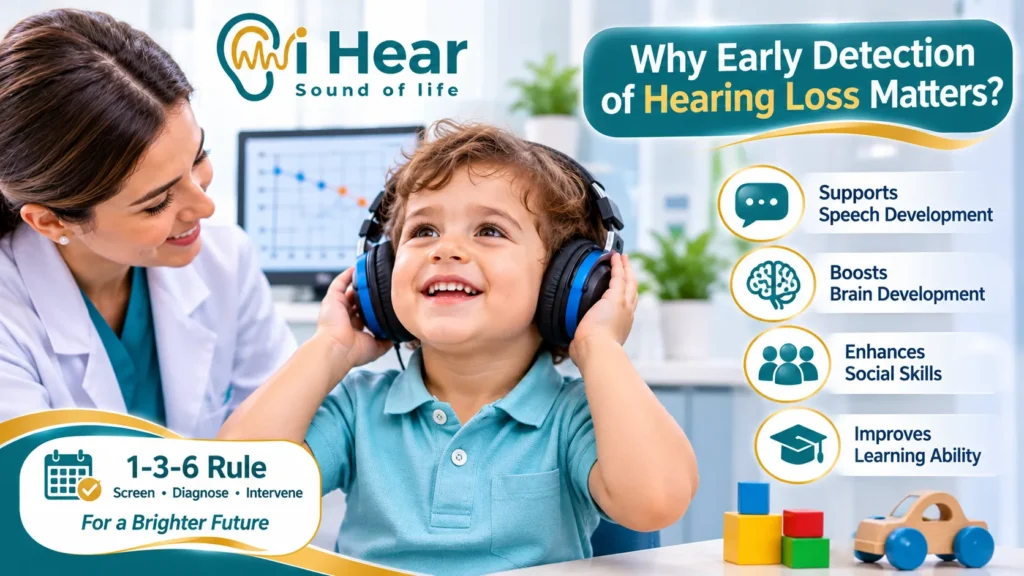
That is why public health bodies around the world follow a rule known as 1-3-6, which the CDC describes as the recommended benchmark:
- By 1 month of age: every baby has a hearing screening.
- By 3 months of age: a baby who does not pass the screening has a full diagnostic evaluation.
- By 6 months of age: a child diagnosed with hearing loss starts early intervention services.
The CDC also notes that without timely screening, diagnosis and intervention, a child can experience significant delays in communication, social development and emotional development. Newborn screening programmes elsewhere add that, without screening, hearing loss may not be identified until somewhere between 18 months and 3 years of age, when parents begin to notice speech problems. That is exactly what we want to avoid: two or three years of incomplete listening.
Newborn Hearing Screening in the UAE: What Happens and What Comes After?
Health facilities in the UAE provide early detection services for newborns, and these include early screening for hearing disorders, according to the UAE government’s official portal. In hospitals the screening is usually done before the baby goes home, using one of two methods: otoacoustic emissions (OAE) or auditory brainstem response (ABR). It is quick, painless and often done while the baby sleeps.
Emirates Health Services reported that its facilities achieved a 97.8% compliance rate for newborn hearing screening in 2025, with 8,377 babies screened out of 8,565 eligible, as reported by Al Bayan. That is a good sign of how widely screening is used. But two points are often missed by parents.
First, not passing the screening does not necessarily mean there is hearing loss. The cause may be fluid in the ear after birth, noise in the screening room, or a baby who was moving. But it does mean your baby needs a repeat test and a diagnostic evaluation on time, and missing that follow-up is the real mistake. The CDC reports that nationally in the United States, 1 in 4 infants who do not pass their newborn hearing screen are missed through loss to follow-up, so do not postpone the repeat appointment.
Second, passing the screening at birth does not guarantee that hearing will stay normal. Some types of hearing loss appear later or get worse over time, and the CDC recommends that children at risk of late-onset or progressive hearing loss have at least one hearing test by 2 to 2½ years of age. So keep watching for signs throughout childhood.
Signs of Hearing Loss in Babies: What to Look for at Each Stage
The signs of hearing loss in babies can be subtle, because a baby cannot complain. These are general guides by age to help you watch, not a diagnostic tool:
Approximate age | Signs that should get your attention |
|---|---|
Birth to 3 months | Does not startle at sudden loud sounds, does not calm or pay attention to mum’s voice, no change in breathing or movement when hearing sounds |
3 to 6 months | Does not turn toward a sound, does not make sounds such as cooing or babbling, does not react to your voice when he cannot see you |
6 to 9 months | Does not respond to his name, does not imitate sounds, does not babble syllables such as “ba” and “ma” |
9 to 12 months | Does not seem to understand simple words such as “no” and “bye-bye”, does not point or respond when asked for something without a gesture |
12 to 18 months | Says no single words, does not try to imitate speech, does not turn toward the source of a sound |
Public health sources highlight specific signs: no startle response to loud noises, not turning toward sounds, delayed babbling, and not responding to their name by 6 months. If you notice any of them, do not wait; ask for a child hearing test.
Beware of a common trap. A baby may look responsive because he sees your face, feels a vibration or catches the movement of air. Turning when you walk into the room does not mean he heard your voice. This is why home tests, such as clapping behind a baby or calling his name, often fail, and we do not recommend relying on them.
Signs of Hearing Loss in Older Children
As a child grows, the signs change, and some are mistaken for stubbornness, shyness or inattention. These are the most common things parents and teachers notice:
- Asks for repetition often: says “what?” or leans in to hear.
- Turns the TV or tablet volume up higher than everyone else in the family.
- Does not respond when called from behind or from another room, but responds at once when he sees you.
- Speech is unclear, or he drops sharp sounds such as s, sh, f and th, or mixes up similar words.
- Speaks too loudly or too softly because he cannot hear his own voice well.
- Struggles to follow conversation in noise, such as a restaurant, playground or crowded classroom.
- Seems distracted in class and falls behind at school for no clear reason.
- Avoids group activities or withdraws because he cannot follow the talk.
- Watches faces and lips closely to work out what is being said.
- Complains of ear pain, ringing or a blocked feeling.
No single sign is conclusive, but two or more together deserve a hearing test. Children with repeated middle ear infections may also have temporary hearing loss that comes and goes, which is why their hearing seems to change from one week to the next.
Speech Delay and Hearing Loss: How Are They Connected?
This is the question that worries parents most. Speech delay and hearing loss are closely connected, because a child learns speech by copying what he hears. If he hears some sounds and misses others, his speech comes out incomplete in the same way. If he cannot hear soft, high-pitched consonants, he cannot tell similar words apart, so his words are unclear or few.
On the other hand, speech delay has many causes besides hearing loss, including developmental language disorders, some developmental conditions, oral-motor difficulties and limited language stimulation. That does not mean hearing can be ignored. Hearing is the first thing to check because it is the easiest cause to detect and often the quickest to address. And in the UAE, where many homes use more than one language, do not put a delay down to multilingualism until you have checked your child’s hearing.
As a general guide, most children begin with single words around the end of the first year and with two-word phrases around age two, with normal individual differences. These are signs that justify talking to your doctor and asking for a hearing test:
- No babbling or variety of sounds by 9 to 12 months.
- No clear words by 15 to 18 months.
- No two-word phrases by age two.
- Speech much harder to understand than that of other children of the same age, even after age three.
- Loss of speech the child already had.
How does hearing loss affect speech and language?
When hearing loss is left untreated, the effects can show on several levels:
- Speech: errors in letter sounds and difficulty producing clear words.
- Language: a smaller vocabulary and difficulty building sentences and understanding grammar.
- Learning: trouble following lessons and learning to read and write.
- Social communication: less interaction with peers and more misunderstandings.
- Emotional wellbeing: frustration, withdrawal and lower confidence.
The CDC notes that the earlier children with hearing loss start getting services, the more likely they are to reach their full potential. In other words, the impact is not inevitable. It depends a great deal on how quickly the problem is found and addressed.
What Should You Do If You Suspect Your Child Has Hearing Loss?
Do not wait, and do not look for home tests. These are the practical steps:
1. Trust your instincts. The CDC advises parents who think their child might have hearing loss to speak to their doctor and ask for a hearing screening as soon as possible. You know your child best.
2. Ask for a child hearing test. Ask your paediatrician, an ear, nose and throat (ENT) doctor or an audiologist. Do not accept “wait until he grows” without a test.
3. Write down what you notice. When the signs began, in which situations, and whether he reacts to some sounds and not others. A short video of your child can help.
4. Share the medical and family history. Premature birth, jaundice, infections, medicines, and any hearing loss in the family.
5. Do not rely on home tests, such as clapping or calling his name. Results are unreliable and can falsely reassure you.
6. Keep the follow-up appointments. Many children fall through the gap between a first screening they did not pass and a diagnostic evaluation that never gets booked.

A Child Hearing Test: How Is It Done at Each Age?
Some parents assume that a hearing test is hard for young children. In fact there are tests designed for every age, even for babies who cannot cooperate. The audiologist chooses what suits your child’s age and condition:
| Child’s age | Usual test | How it works |
|---|---|---|
| Newborns and babies | Otoacoustic emissions (OAE) | A small probe in the ear picks up the inner ear’s response to sounds, and needs no cooperation from the child |
| Babies | Auditory brainstem response (ABR) | Electrodes on the head measure the hearing nerve’s response, usually while the baby sleeps |
| About 6 months to 2 years | Behavioural testing in the free field | Tones are played from loudspeakers, and the child is rewarded with a visual reinforcer when he turns |
| 2 to 5 years | Play audiometry | The child performs a simple action, such as dropping a block in a bucket, whenever he hears a sound |
| 5 years and older | Pure-tone audiometry | The standard test with earphones, as for adults |
| All ages | Tympanometry | Checks for fluid behind the eardrum and how it moves |
Clinics and hospitals use specialised devices for these tests. At iHear we supply German BioMed Jena devices to clinics and hospitals: the eOAE newborn hearing screening device, the eABR auditory brainstem response system, the eTYMP middle ear analyser, the AudioBox free-field amplifier for testing children, and the eAUDIO USB audiometer for pure-tone testing. You can see them all on our audiology diagnostic devices page. If you are a parent, ask the clinic you visit what equipment it has and how experienced the audiologist is with children.
If you would like a first check, iHear offers a free hearing test at its branches in Al Ain and Abu Dhabi, with a referral to a pediatric audiologist where needed. To book, contact us on WhatsApp.
What Happens After a Diagnosis? Treatment Options for Hearing Loss in Children
Once the audiologist confirms hearing loss, the treatment plan begins. It depends on the type and degree of loss and on the child’s age:
- Medical treatment: if the cause is fluid in the middle ear, an infection or a blockage, an ENT doctor may treat it with medicines or a simple procedure, and in many of these cases hearing returns to normal.
- Hearing aids: a core solution for many cases of permanent sensorineural hearing loss, covered in the next section.
- Cochlear implants: an option the medical team discusses when hearing aids are not enough, especially in severe to profound loss.
- Speech and language therapy: delivered by a speech-language pathologist to build speech, vocabulary and understanding, alongside the hearing aid or implant.
- Early intervention and family support: teaches parents how to stimulate their child’s language at home.
- Educational support: as the child starts school, for example sitting near the teacher and coordinating with the class.
The most important message is this: a diagnosis is not the end of the road but the right beginning. A child who starts support early has a much better chance of language development close to that of his peers.
Hearing Aids for Children: When Are They Used and How Are They Chosen?
Hearing aids for children are not smaller versions of adult hearing aids. A child’s ear grows quickly, the device must be fitted precisely to their hearing, and a child cannot always tell you whether a sound is too loud or too quiet. That is why a pediatric audiologist chooses and programmes the device. It should not be left to a parent’s guess or to buying online.
How is the right hearing aid chosen for a child?
The process rests on three linked steps:
- A full hearing assessment first. The child’s hearing is tested with methods suited to their age, and the results guide every later decision.
- A pediatric audiologist chooses and programmes the device. The style, power and battery design depend on the child’s age and degree of hearing loss.
- Profound or congenital hearing loss. A cochlear implant assessment is often considered early, alongside hearing aids, by a medical team.
Behind-the-ear styles are usually preferred for children because the earmould can be replaced as the ear grows without replacing the whole device. For safety with young children, ask about battery safety features and secure fit; we confirm these for each model according to the child’s age. The younger the child, the more frequent the follow-up needed to adjust settings and earmoulds.
Beltone hearing aids at iHear
At iHear we are the authorised distributor of Beltone hearing aids in the UAE. This table sorts the models by degree of hearing loss, with the reminder that whether any model suits a particular child is decided by a pediatric audiologist after the assessment:
| Model | Degree of hearing loss | Style | What parents should know |
|---|---|---|---|
| Beltone Boost Max S | Severe to profound | Rechargeable power behind-the-ear | High amplification, up to 140 dB maximum output |
| Beltone Boost SP | Profound | Ultra-power behind-the-ear | Replaceable battery; for children under pediatric audiologist guidance |
| Beltone Commence | Mild to moderate | Five styles | Everyday durability and IP68 protection |
| Beltone Envision | Mild to moderate | Small behind-the-ear | AI-powered sound processing |
| Beltone Illuminate | Mild to severe, depending on receiver | Behind-the-ear and in-the-ear, plus CROS | Speech clarity in noise |
| Beltone Serene | Mild to severe, depending on receiver | Custom in-the-ear | Made to the shape of the ear, so whether it suits a growing ear is the audiologist’s call |
The main thing to notice is that the choice starts with the degree of hearing loss. A child with a severe loss will not be helped by a low-power hearing aid, however attractive its features. To understand the differences between styles, read our guide to types of hearing aids, and for the buying steps see how to choose the right hearing aid.
iHear offers a free hearing test before any decision, with a referral to a pediatric specialist where needed, and follow-up as your child grows, including adjustments to settings and earmoulds. We also have demo hearing aids that may be used as a temporary replacement during servicing, subject to availability.
Practical tips for making hearing aids work for your child
- Wear them consistently: a child benefits most when hearing aids are worn during all waking hours, and he needs time to get used to them.
- Do a quick daily check: make sure the battery, tubing and earmould are in good condition and the sound is clear.
- Watch for heat, humidity and sweat, which are common in the UAE. The Beltone models we offer are rated IP68 for dust and water resistance, but they are not for swimming and should be dried and removed at bath time.
- Keep the earmould clean and replace it when it gets tight or starts to whistle.
- Encourage with talking: speak to your child face to face, read to him and name things. The hearing aid opens the door, but language is built through interaction.
- Keep follow-up appointments: children need regular checks because their hearing and ear growth change.
Health insurance coverage for hearing aids in the UAE varies by insurer and policy, so check before you buy. Our team can help you enquire and prepare the documents.
How Can You Support Your Child’s Speech at Home?
Nothing at home replaces medical assessment, but some habits help any child:
- Talk face to face at his eye level, so he can see your lips and face.
- Reduce background noise while you talk: turn the TV off.
- Repeat and expand: if he says “water”, say “yes, cold water”.
- Read to him every day, pointing to pictures and naming them.
- Sing together and let him join the rhythm.
- Give him time to answer, and do not finish his sentences.
- Avoid pressure and comparison. Encouragement works better than constant correction.
Frequently Asked Questions About Hearing Loss in Children
Conclusion: Do Not Wait, Because Hearing Is the Foundation of Speech
Hearing loss in children is more common than many parents realise, and it is one of the causes of speech delay that can be found and treated. The key message is early detection: a screening at birth, a diagnosis by 3 months if the screening is not passed, support by 6 months, and watching for signs throughout childhood. If you doubt your child’s hearing, do not wait and do not rely on home tests. Ask a specialist for a child hearing test.
Whether you are in Abu Dhabi, Al Ain or any other emirate, we are happy to welcome you for a free hearing test, point you to the next step, and help you find the right solution, whether that is medical treatment or hearing aids for your child.
Book your free hearing test now on WhatsApp, or visit one of our branches:
- Abu Dhabi: Sultan Bin Zayed the First Street (Muroor Road), Building 1210, Offices M6, tel. 02 681 3841
- Al Ain: Al Humaireh, 136 Khalifa Bin Zayed Street, Mezzanine 2, Office 3, tel. 03 768 5563
Further reading: hearing aids for hearing loss: types, how they work and how to choose and best hearing aids for seniors.
For more information
Feel free to contact us anytime. Our team is always ready to help you.

[…] Children learn to speak by hearing, so early support makes a real difference to speech and language development. If you notice a child not responding to their name, speaking unclearly or turning up devices very loud, ask for a hearing assessment. Newborns in the UAE are usually screened at birth, but some hearing loss develops later. Children's hearing aids are chosen and programmed by a paediatric audiologist, with tamper-resistant battery doors and earmoulds that are remade as the child grows. For profound congenital loss, a cochlear implant assessment is often considered as well. Read more in our article on hearing loss in children. […]