
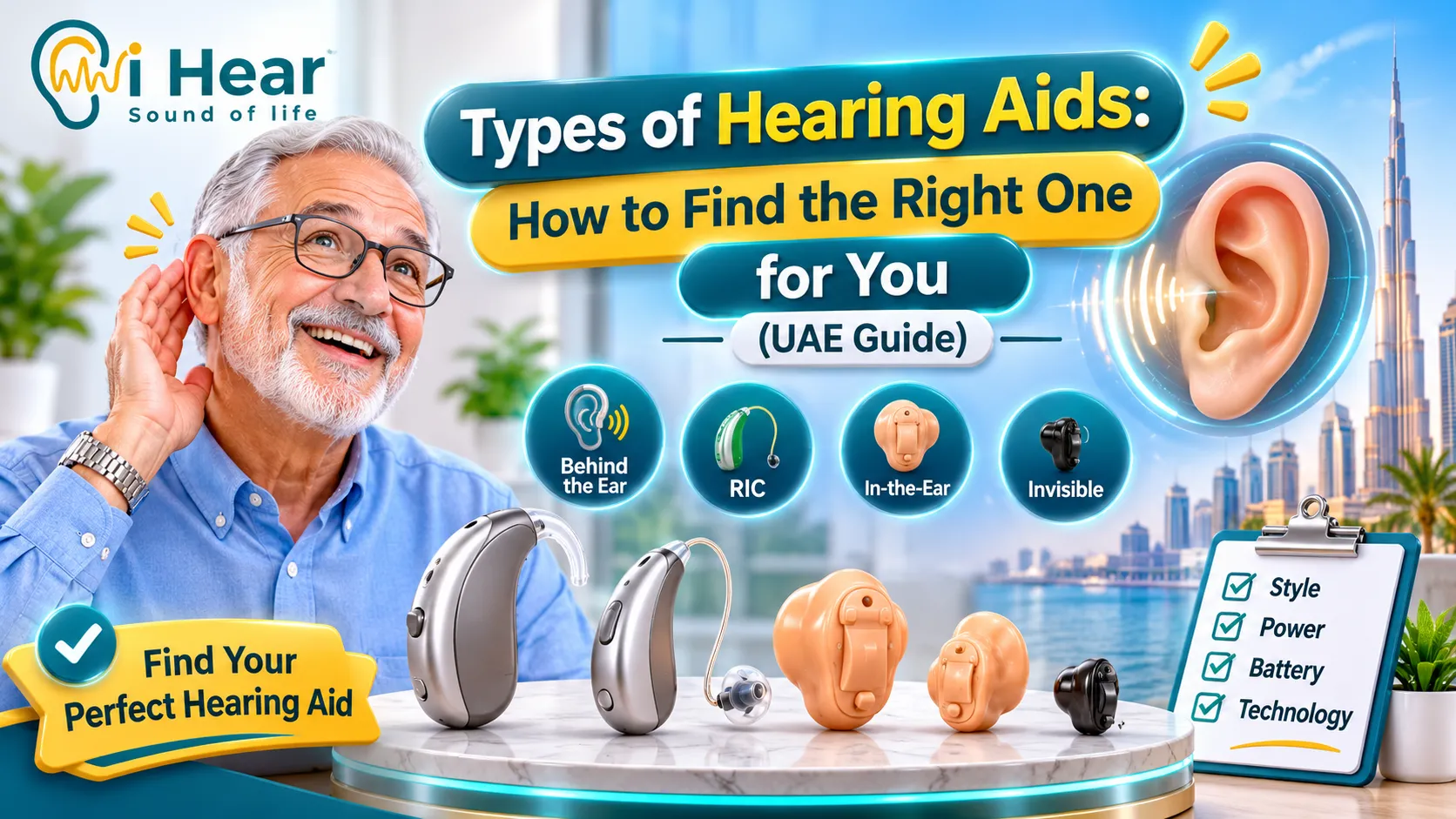
Quick answer: Hearing aids come in several types, grouped by where you wear them (behind the ear or inside the ear), how much power they provide, what battery they use and which features they offer. The right type depends on your hearing test results, ear shape and lifestyle, not on size alone. An audiologist should always make the final recommendation.
When you start looking into hearing aids, you quickly meet a long list of names and abbreviations: BTE, RIC, ITE, CIC, “invisible” hearing aids, “rechargeable” hearing aids and “AI-powered” hearing aids. One advert says a model is the most powerful, another says it is the smallest, and most people finish their research more confused than when they started. The reason is simple. The question sounds easy (which hearing aid should I buy?), but the answer depends on things you cannot see in a photo: your degree of hearing loss, the shape of your ear canal, how you spend your day, and even how comfortable your fingers are with small parts.
This guide puts the picture in order. Instead of only describing hearing aids by style, we look at them from four angles: where they sit, how powerful they are, what battery they use and what technology they offer. We then cover special solutions such as single-sided hearing loss and tinnitus, explain how medical hearing aids differ from products that only sound similar, and walk through the Beltone hearing aids available in the UAE. We finish with practical steps to help you decide.
We write this from daily experience at our Abu Dhabi and Al Ain branches, where the purchases people regret most are usually the ones made before a hearing test and based on appearance alone.
Please note: this article is general information and does not replace a hearing test. The final choice of hearing aid type and model is made by your audiologist after assessing your hearing.
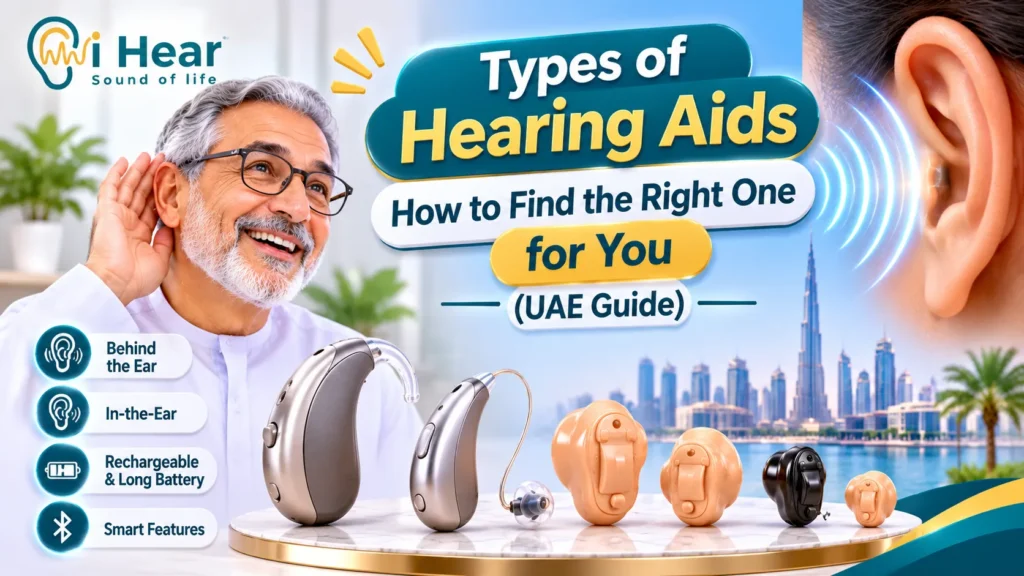
What Are Hearing Aids? Are They the Same as Medical Hearing Devices?
A hearing aid is a small electronic device worn in or behind the ear to help people with hearing loss hear sounds and understand speech more clearly. “Hearing aids”, “hearing devices” and “medical hearing aids” all describe the same thing. In everyday speech people in the UAE often just say “hearing aid” or “ear device”, while clinics and official bodies prefer the term hearing aids.
All hearing aids work on the same basic principle. A microphone picks up sound around you, a digital processor analyses it and decides what to amplify and what to reduce, an amplifier raises the level according to your own hearing test results, and a tiny speaker called the receiver delivers the sound to your ear. Because the processor is programmed to your audiogram, a hearing aid is fundamentally different from a personal sound amplifier (PSAP), which simply makes everything louder by the same amount. We return to this difference later.
How Many Types of Hearing Aids Are There? Four Ways to Classify Them
When people ask about the “types of hearing aids”, they are usually mixing four different questions into one. Separating them makes the decision much easier:
Classification | The question it answers | Examples |
|---|---|---|
By style | Where is the hearing aid worn? | Behind-the-ear (BTE, RIC) and in-the-ear (ITE, ITC, CIC) |
By power | Which degree of hearing loss does it suit? | Mild, moderate, severe, profound |
By battery | How is it powered? | Rechargeable or replaceable zinc-air batteries |
By technology | Which features does it offer? | Bluetooth, app, remote adjustment, AI sound processing |
You will notice that style, which is what most people think about first, is usually the result rather than the starting point. Your degree of hearing loss decides the power you need, the power decides which styles are possible, and only then do you choose among those styles according to comfort, appearance and budget.
Types of Hearing Aids by Style
This is the best-known classification. Hearing aids fall into two families: those worn behind the ear and those custom-made to sit inside it. We explain both in detail in our guide to types of hearing aids: BTE, RIC and in-the-ear, and here is a summary to complete the picture.
Behind-the-ear hearing aids (BTE)
A BTE hearing aid sits behind the ear and sends sound into the ear canal through a thin tube or a custom earmould. It is the most powerful, durable and easy-to-handle style, which makes it the usual choice for severe and profound hearing loss. It also suits children, because replacing an earmould as the ear grows is easier than replacing a whole custom device, and it suits seniors because the buttons and battery are larger. Its main drawback is that it is the most visible, although modern designs are far slimmer than older ones.
Receiver-in-canal hearing aids (RIC, called RIE by Beltone)
A RIC hearing aid has a small, discreet body behind the ear and a tiny speaker that sits in the ear canal, connected by a very thin wire. Its strength is balance: small size, natural sound and plenty of features. That is why RIC hearing aids have become one of the most popular types, suiting mild to severe hearing loss depending on the receiver power chosen. They need regular cleaning because the speaker in the canal is exposed to earwax and moisture.
In-the-ear hearing aids (ITE, ITC and CIC)
These are made as a single piece to the shape of your ear, from an impression or a 3D scan, so nothing shows behind the ear. ITE is the largest and fills part of the outer ear, ITC is smaller, and CIC sits almost entirely inside the canal. The smaller the device, the less room there is for battery, buttons and features.
Invisible hearing aids (IIC)
The deepest and smallest style, practically invisible from outside. It is a real option for people who value discretion and who have mild to moderate hearing loss and a suitable ear canal, but it does not suit everyone and is not usually recommended for severe loss. Before deciding, ask your audiologist to show you a modern RIC on your ear in the mirror. The difference in visibility is often smaller than people expect.
Types of Hearing Aids by Degree of Hearing Loss
This is the most important classification. Not every hearing aid can serve every degree of loss, and a low-power device will not help a severe loss however much you like its appearance. The table below gives an approximate guide. Boundaries vary slightly between references, and your audiogram has the final say:
Degree | Approximate level | What becomes hard to hear | Closest hearing aid types |
|---|---|---|---|
Mild | 20 to 40 dB | Whispers and soft sounds | Small RIC or in-the-ear |
Moderate | 41 to 60 dB | Normal conversation at a distance | RIC, in-the-ear or BTE |
Severe | 61 to 80 dB | A large part of speech | Powerful BTE or RIC with a strong receiver |
Profound | 81 dB and above | Most speech | High-power BTE, with a doctor’s assessment |
In very profound cases, if hearing aids do not give enough benefit, your doctor may discuss other options such as a cochlear implant. If you do not know your degree of hearing loss, that is perfectly normal. It can only be measured with a hearing test, and iHear offers a free hearing test at its Al Ain and Abu Dhabi branches. You can book your appointment on WhatsApp.

Types of Hearing Aids by Battery: Rechargeable or Replaceable?
One question comes up again and again: should I buy rechargeable hearing aids? Both kinds are good, and the difference lies in your lifestyle rather than in quality.
Rechargeable hearing aids contain a built-in lithium battery that you charge overnight in a case or base, so you start each day with a ready device and never handle a tiny battery. They suit people who find small parts difficult, seniors, and anyone who wants a simple routine. Some rechargeable Beltone models run for up to about 30 hours according to the manufacturer, and real-life time falls with phone streaming.
Hearing aids with zinc-air batteries use small batteries in sizes such as 312, 13 and 10A, and the larger 675 in powerful devices. Swapping takes seconds, and you can carry a spare in your pocket, which helps if you travel a lot or forget to charge. The downsides are the recurring cost of batteries and the difficulty of changing them if you have a hand tremor.
Because both options exist in many styles, treat the battery as one criterion among several, not the first one.
Types of Hearing Aids by Technology and Connectivity
Within a single model you will often find several technology levels, such as 17, 9, 6 and 4 for Beltone Envision and Serene, or ILU17, ILU9, ILU6 and ILU4 for Illuminate. A higher number usually means more processing channels and more advanced features, such as stronger focus on speech in noise. But the highest level is not always the best fit. Someone with a quiet lifestyle who mostly talks to one or two people may be well served by an entry level, while someone who attends meetings, family gatherings and busy restaurants gets more from a higher level. You decide this with your audiologist according to how you live.
These are the main features that distinguish modern hearing aids:
- Phone connectivity: stream calls and music directly to your hearing aids from compatible iPhone and Android devices. Hands-free call support varies by model and phone, so ask about compatibility before buying.
- Auracast broadcast audio: a newer Bluetooth technology that lets hearing aids receive audio from compatible sources such as TVs and equipped public venues. It only works where a broadcast is available.
- App and remote adjustment: your audiologist can adjust your hearing aid settings over the internet so you do not need to visit the branch every time, which is practical if you live far away or have a busy schedule.
- Artificial intelligence: some models use deep neural networks (DNN) that classify the sound environment within fractions of a second to enhance speech and reduce noise.
- Telecoil: picks up sound from hearing loop systems in some equipped halls and public places.
- Tinnitus support: some hearing aids include therapeutic sounds, such as Tinnitus Breaker Pro, that help you pay less attention to tinnitus. They relieve the annoyance but do not treat its cause.
- Water and dust resistance: the Beltone models we offer carry an IP68 rating according to the manufacturer, which is useful in our hot, humid climate, although they are not swimming devices.
Special Types of Hearing Aids for Specific Needs
Some situations are not well served by a standard hearing aid, and that is where other types of hearing aids come in.
Hearing loss in one ear: CROS and BiCROS hearing aids
Sometimes one ear cannot benefit from any amplification. A standard hearing aid does not help in that case, so a CROS system is used: a small transmitter on the poorer ear sends sound wirelessly to a hearing aid in the better ear. If the better ear also needs amplification, a BiCROS system is used. This solution is available with Beltone Illuminate. An important warning: sudden hearing loss in one ear over hours or days is a medical emergency, so see an ear, nose and throat doctor first, before thinking about any device.
Hearing aids for tinnitus with hearing loss
Many people with hearing loss also have ringing in the ears. Some hearing aids include a tinnitus programme that generates soothing sounds to help the brain pay less attention to the ringing, and often the hearing aid itself eases tinnitus because it restores sounds the brain was missing. This relieves the annoyance but does not cure the cause. If your tinnitus is constant or affects only one ear, have your hearing tested and see a doctor.
Hearing aids for children
Hearing loss in a child needs early intervention, because the early years are when the brain builds its pathways for language. Behind-the-ear styles are usually preferred for children because the earmould is easy to replace as the ear grows. For mild to moderate loss, Beltone Commence may be considered; for severe to profound loss, Beltone Boost Max S; and for very profound loss, Beltone Boost SP, with the medical team assessing options such as a cochlear implant. The decision always rests with the team following the child.
Hearing aids for seniors
For families of older adults, ease of use matters most: buttons that can be held, a battery that does not need delicate fingers, and a device that does not fall out easily. That is why behind-the-ear styles and rechargeable options suit many seniors. We cover this in a separate guide to the best hearing aids for seniors.
Devices That Sound Like Hearing Aids but Are Not
People often confuse medical hearing aids with other devices that have similar names. The confusion can cost money, time and hearing.
Personal sound amplifiers (PSAPs): devices sold online that raise all sound by the same amount without considering the shape of your hearing loss. They are not medical devices programmed to your test results, and they may be uncomfortable with loud sounds while still not enough for soft ones. A real hearing aid needs a hearing test, programming and follow-up.
Bone conduction devices: they carry vibrations through the skull bone to the inner ear and are used in specific cases decided by a doctor, such as certain outer or middle ear problems where air conduction is not suitable.
Cochlear implants: not hearing aids but a surgical solution in which a device stimulates the hearing nerve directly. They are considered when hearing aids do not help enough in severe to profound loss, and your doctor decides after a full assessment.
Assistive listening devices: such as school FM systems, hearing loop systems in halls and TV streamers. They work alongside hearing aids to improve listening in specific situations and do not replace them.
Beltone Hearing Aids Available in the UAE
At iHear we are an authorised distributor of Beltone hearing aids, which cover most of the types discussed above. This table summarises our Beltone hearing aids in the UAE:
| Model | Degree of hearing loss | Style | Key feature |
|---|---|---|---|
| Beltone Envision | Mild to moderate | Small behind-the-ear (microRIE and RIE) | Smallest in the Beltone range, with an AI chip |
| Beltone Illuminate | Mild to severe, depending on receiver | Behind-the-ear and in-the-ear, plus CROS | Speech clarity in noise |
| Beltone Commence | Mild to moderate | Five styles | Style variety and everyday durability |
| Beltone Serene | Mild to severe, depending on receiver | Custom in-the-ear | Rechargeable with nothing behind the ear |
| Beltone Boost Max S | Severe to profound | Rechargeable power BTE | Up to 140 dB maximum output |
| Beltone Boost SP | Profound | Ultra-power BTE | Replaceable battery and Telecoil |
Most of them share Auracast, IP68 protection, a phone app and remote adjustment, and differ in power, style and battery. Your audiologist will narrow these down after your hearing test, so do not rely on the table alone.
How to Choose the Right Hearing Aids in the UAE
Now that you know the types, here are the factors we actually look at when we help someone choose. You will notice that style comes late in the list.
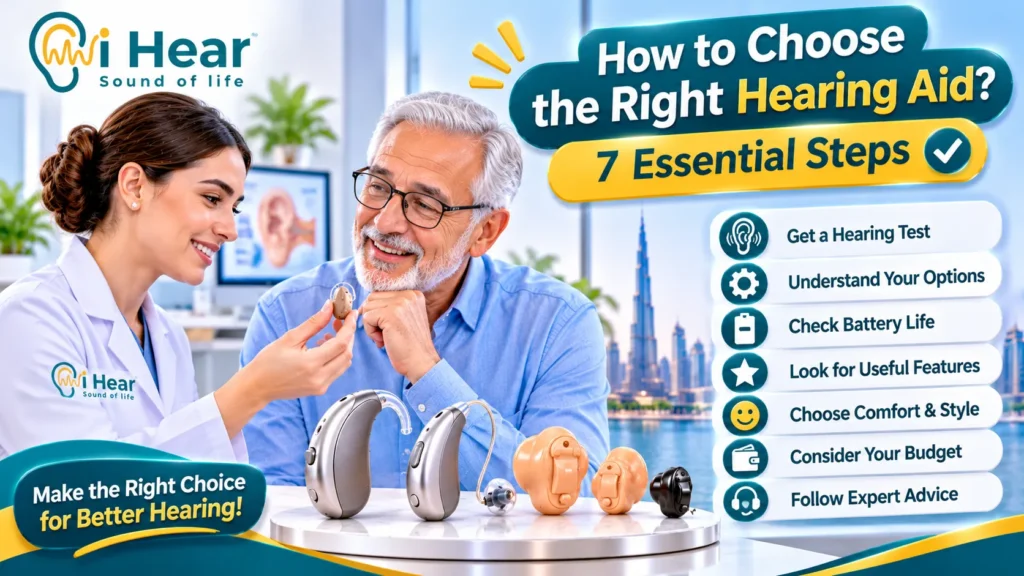
1. A hearing test first. It determines the degree and type of hearing loss, and therefore the power needed and the types that are possible. That is why we always start with a free test before talking about any model. You can read our seven steps in how to choose the right hearing aid.
2. Your ear and ear canal. Some canals are narrow or curved and do not fit the smallest styles.
3. Your hands and eyesight. If small objects or small buttons are difficult, a larger device is more comfortable and less frustrating.
4. The UAE climate and your lifestyle. Heat, humidity, dust and sweat are hard on tiny electronics. If you work outdoors or exercise, look for good water and dust resistance such as IP68, and build a daily cleaning and drying habit. If you spend your day in meetings, majlis gatherings and restaurants, strong noise-handling matters more than invisibility.
5. Privacy and appearance. It is fine for discretion to matter to you, but make it one criterion among several, not the only one.
6. The features you really need. Do you want phone connectivity and an app? Do you need Telecoil for mosques and equipped halls? Do you have tinnitus? The smaller the device, the fewer the options.
7. Trial and follow-up. What matters most comes after purchase: adjustment, maintenance and cleaning. iHear lets you try your hearing aids before you buy, after they are programmed to your test results, and offers remote adjustment through the app, with branches in Abu Dhabi and Al Ain and service across the other emirates. Health insurance coverage for hearing aids varies by insurer and policy, so ask us before you buy and we can help you enquire and prepare the documents.
Common Mistakes When Buying Hearing Aids
- Choosing size before a hearing test. Some people arrive at the clinic having decided they want the smallest device, then find that their hearing loss needs a different type.
- Buying a sound amplifier online instead of a medical hearing aid. It saves money at first, then costs time and comfort.
- Judging on day one. The brain needs weeks to get used to sounds it has not heard for a while. Many people adjust within two to four weeks, and it can take longer with powerful devices.
- Skipping cleaning. Earwax and moisture are the first cause of weak or lost sound.
- Comparing on price alone. Hearing aid prices vary with the model, technology level and battery type, and what matters more is how well the device fits you and the care you receive afterwards.
- Putting off the test. The longer hearing loss goes unaddressed, the longer the brain may need to adapt later.
Frequently Asked Questions About Types of Hearing Aids
Conclusion: There Is No Best Type, Only the Best Fit
To sum up: hearing aids are classified by style, power, battery and technology. BTE hearing aids are the most powerful and easiest to handle and suit severe loss, children and seniors; RIC hearing aids offer the best balance of size and quality; in-the-ear hearing aids are less visible and suit mild to moderate loss. There are special solutions such as CROS for one ear and tinnitus programmes, and some devices, like sound amplifiers, are not medical hearing aids at all. Above everything else, the first step is not choosing a style but taking a hearing test.
Whether you are in Abu Dhabi, Al Ain or any other emirate, the easiest start is to book a free hearing test, talk to an audiologist, and then explore Beltone hearing aids in the UAE and compare models on your own ear.
Book your free hearing test now on WhatsApp, or visit one of our branches:
- Abu Dhabi: Sultan Bin Zayed the First Street (Muroor Road), Building 1210, Offices M6, tel. 02 681 3841
- Al Ain: Al Humaireh, 136 Khalifa Bin Zayed Street, Mezzanine 2, Office 3, tel. 03 768 5563
Further reading: Hearing aids for hearing loss: types, how they work and how to choose and best hearing aid brands in the UAE.
For more information
Feel free to contact us anytime. Our team is always ready to help you.




)
[…] For a deeper comparison, read our guide to types of hearing aids: BTE, RIC and in-the-ear and the wider UAE guide to hearing aid types. […]
[…] لمقارنة أعمق، اقرأ دليلنا عن أنواع السماعات الطبية: خلف الأذن وداخل القناة وداخل الأذن ودليل أنواع السماعات في الإمارات. […]
[…] however attractive its features. To understand the differences between styles, read our guide to types of hearing aids, and for the buying steps see how to choose the right hearing […]