
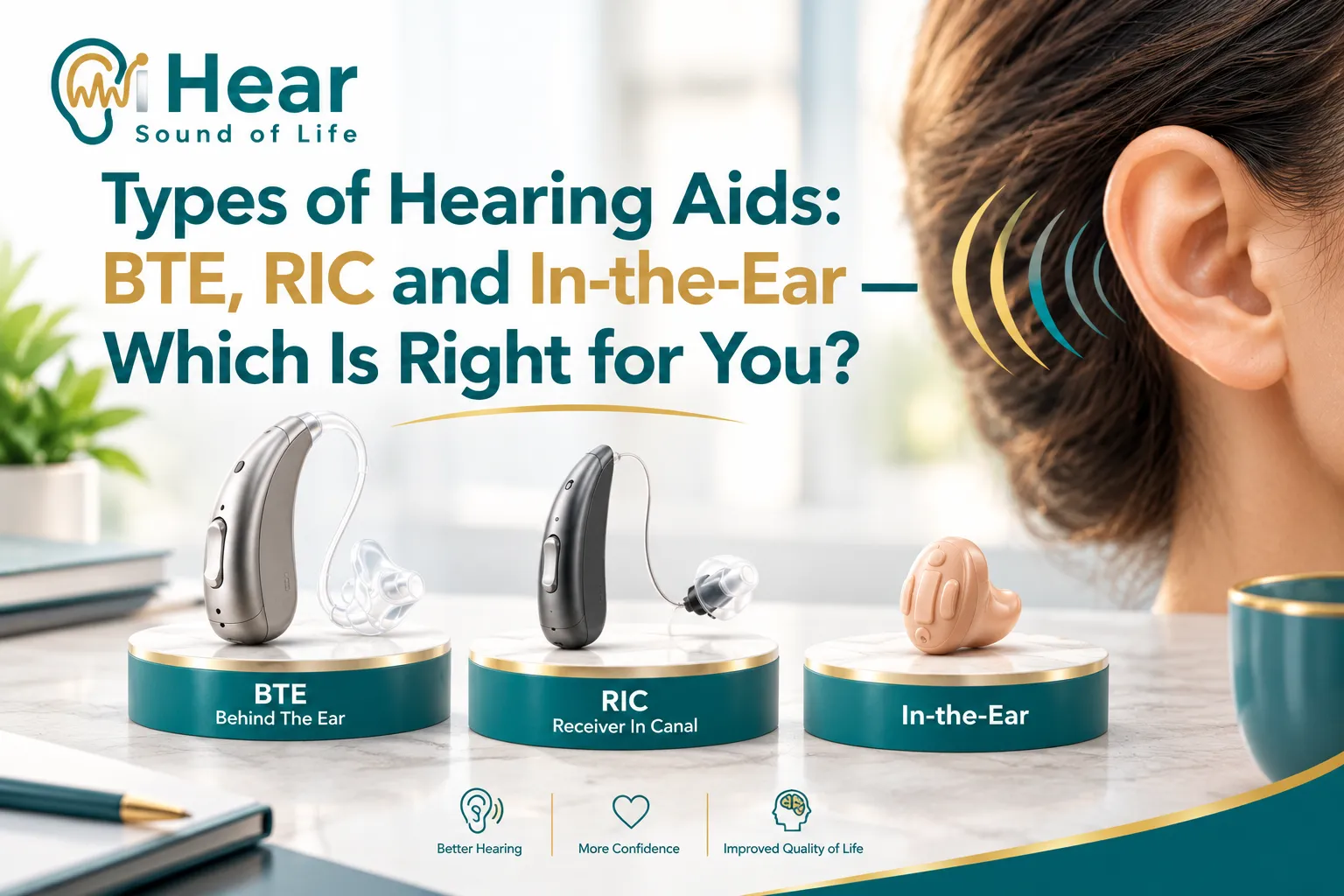
Quick answer: There are three main types of hearing aids: behind-the-ear (BTE), receiver-in-canal (RIC), and in-the-ear styles (ITE, ITC, CIC and IIC). BTE is the most powerful and usually the best fit for severe hearing loss. RIC balances size, sound quality and features. Smaller in-the-ear and invisible models suit mild to moderate loss. A hearing test decides which one is right for you.
If you have ever started searching for a hearing aid, you know how quickly the vocabulary piles up. BTE. RIC. ITE. CIC. IIC. Then come the promises: “nearly invisible,” “most powerful,” “smartest ever.” Most people finish that first hour of research more confused than when they began.
That confusion is understandable, because the question sounds simple (which type should I buy?) while the answer depends on things you cannot see from the outside: the shape of your hearing loss, the size and curve of your ear canal, how comfortable your fingers are with tiny buttons, and even how you spend your day. A style that is perfect for your neighbour can be a poor choice for you.
This guide walks through every major style of hearing aid in plain language. You will see how each one looks and works, who it suits, what you gain and what you give up. We also answer the questions we hear most often at our clinics in Abu Dhabi and Al Ain: which type is best for severe hearing loss, whether truly hidden hearing aids exist, and whether rechargeable hearing aids are worth choosing.
We are iHear, an authorized Beltone distributor in the UAE, so we fit these devices every day. Use this article to get oriented, then let a hearing test confirm the details.
Important: This article is general information and does not replace a hearing test. The final choice of style and model should be made by a hearing care professional after examining your ears and measuring your hearing. If you lose hearing suddenly in one or both ears, see a doctor urgently rather than shopping for a device.
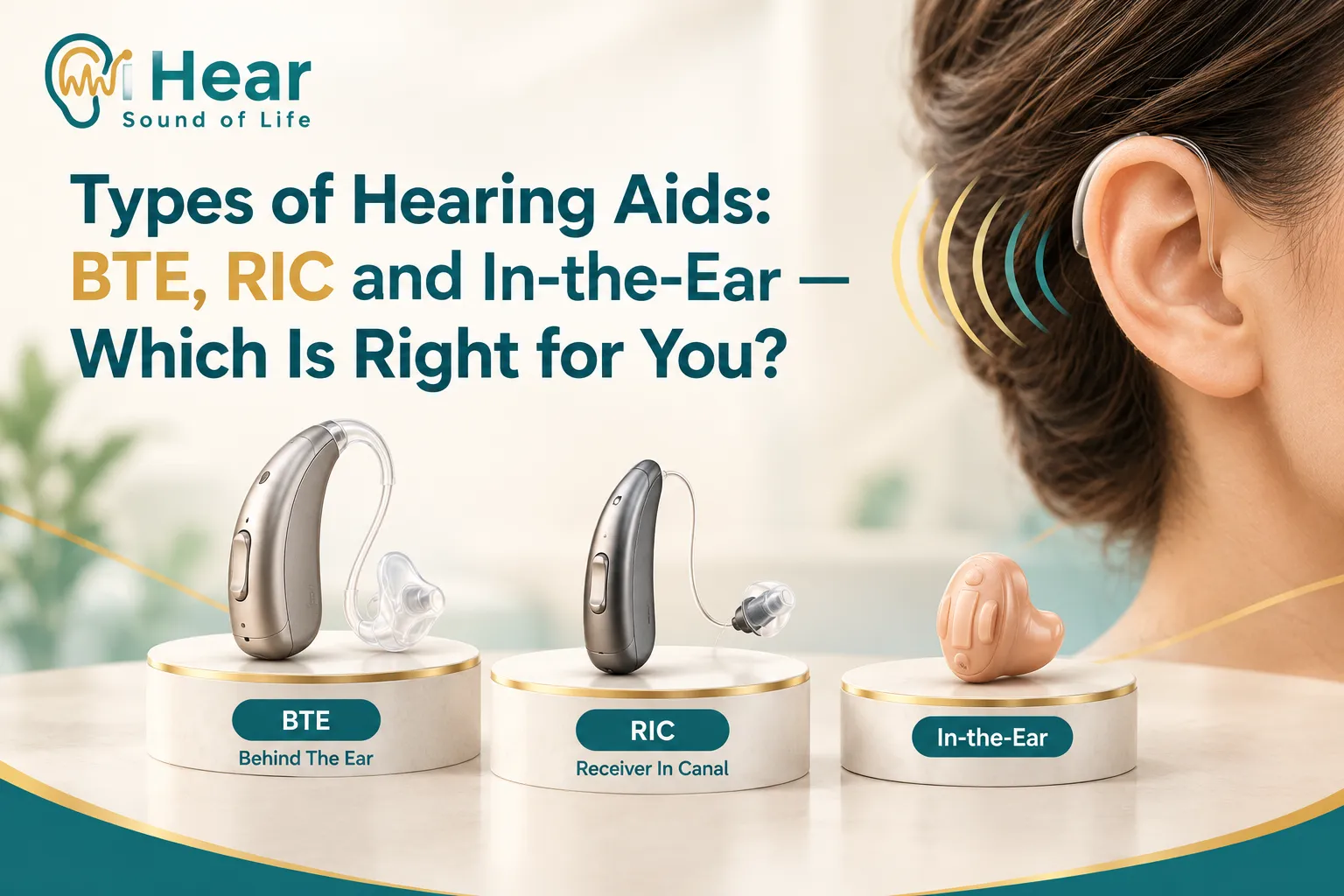
What are the main types of hearing aids?
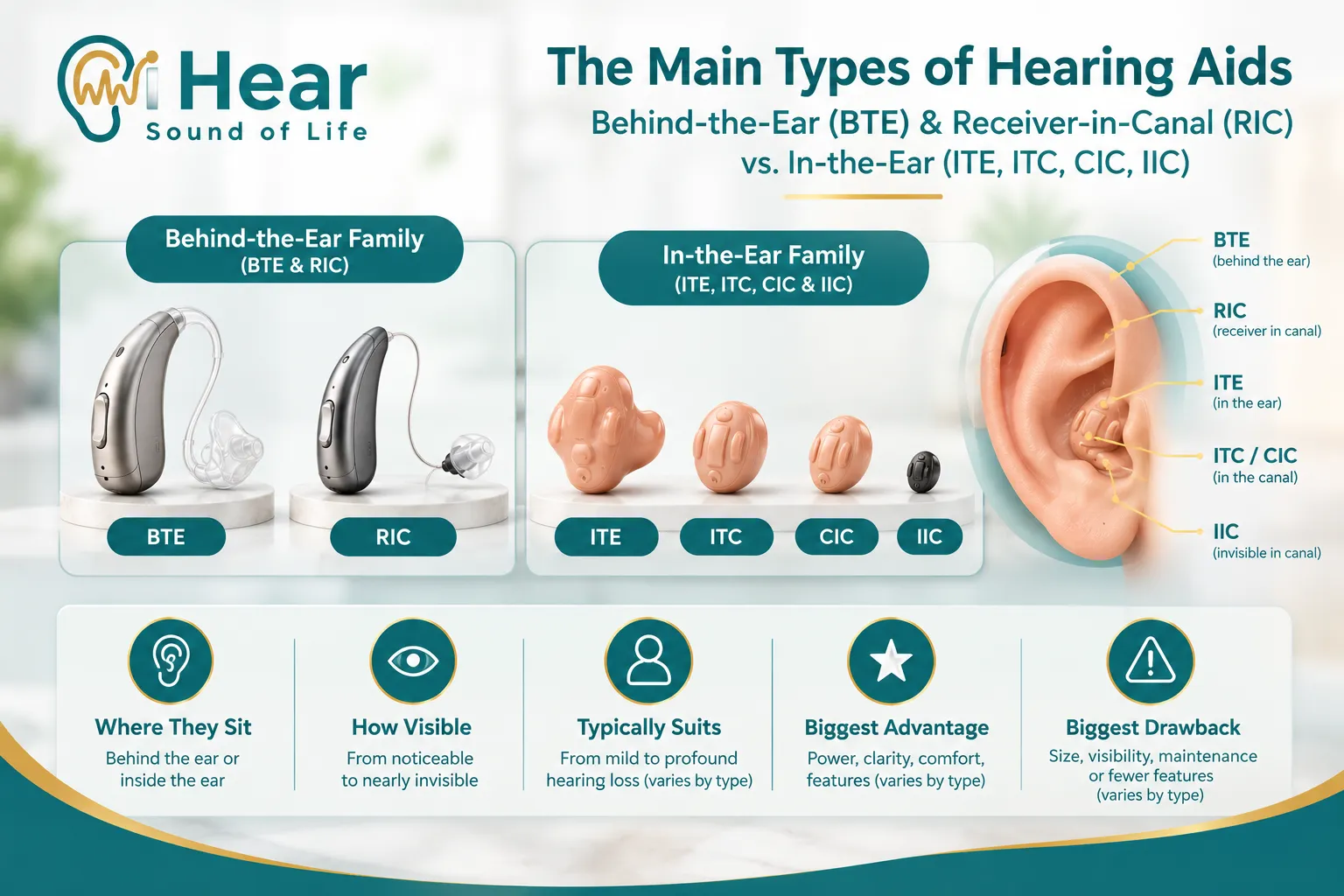
Whatever brand names you see, hearing aids fall into two broad families. The first family sits behind the ear and includes BTE and RIC. The second family sits inside the ear and includes ITE, ITC, CIC and IIC. The key difference is where the electronics live. In the first family most of the electronics stay behind your ear. In the second family everything is built into one small custom piece that sits in your ear.
The table below gives you the overview before we go into detail.
Type | Where it sits | How visible | Typically suits | Biggest advantage | Biggest drawback |
|---|---|---|---|---|---|
BTE (behind-the-ear) | Behind the ear, joined to the ear canal by a tube or earmold | Most visible, though modern ones are slim | Mild to profound loss; the most powerful style | Power, durability, easy handling | Larger than other styles |
RIC (receiver-in-canal) | Behind the ear, with a tiny speaker inside the canal | Low visibility | Mild to severe loss, depending on receiver power | Natural sound in a small, light body | The in-canal speaker needs regular cleaning |
ITE (in-the-ear) | Fills part of the outer ear | Low | Mild to moderate, sometimes more | Easy to insert, room for more features | More visible than canal styles |
ITC / CIC (in-the-canal) | In the ear canal | Very low | Mild to moderate | Very small | Fewer features, small battery |
IIC (invisible-in-canal) | Deep inside the canal | Almost invisible | Mild to moderate | Smallest option | Does not fit every ear and is hard to handle |
These are general patterns. Individual models vary by manufacturer, so treat the table as a starting point rather than a rule.
How do hearing aids work, and why do styles differ?
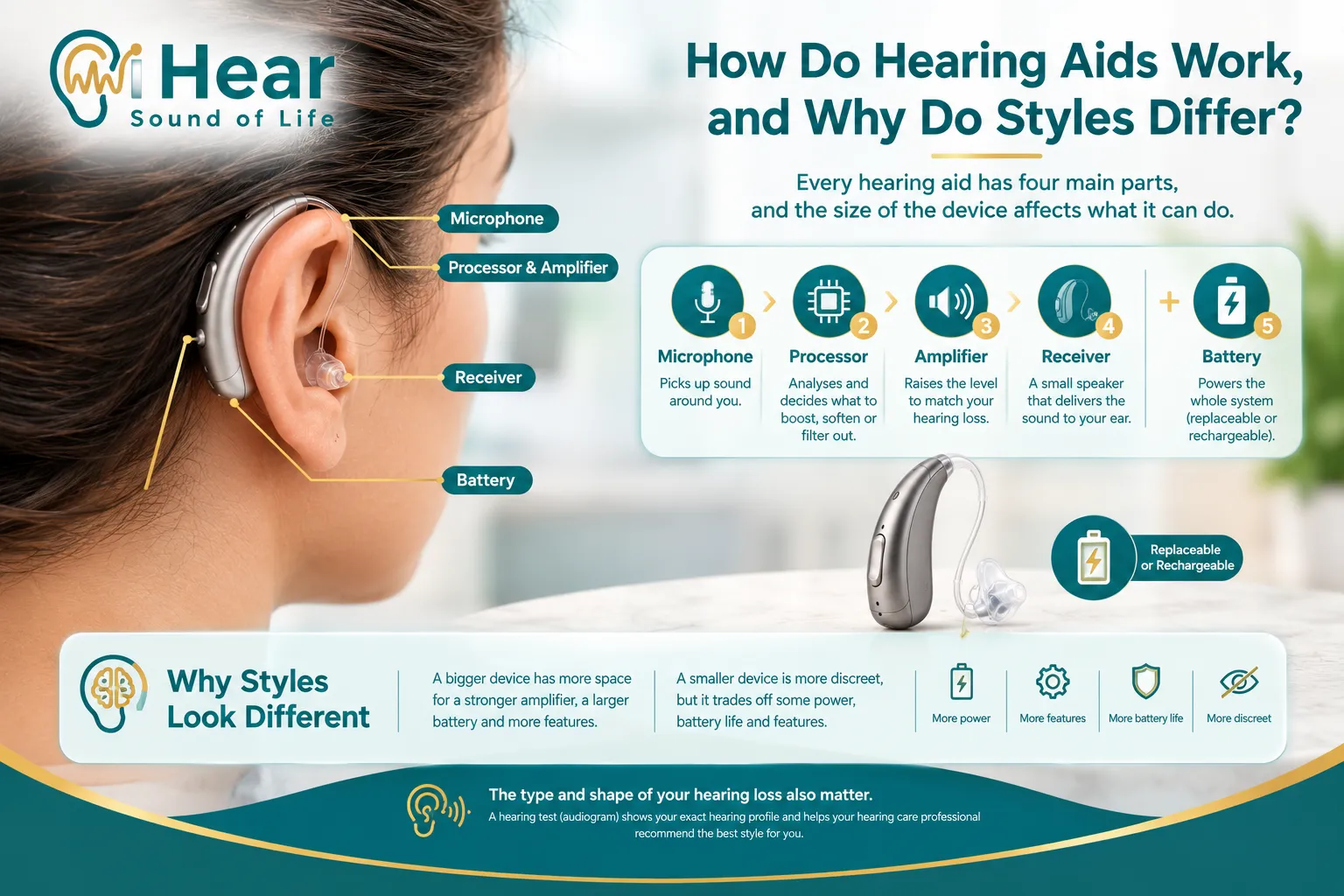
Every hearing aid has the same four basic parts. A microphone picks up sound around you. A processor analyses that sound and decides what to boost, soften or filter out. An amplifier raises the level to match your hearing. A receiver (a very small speaker) delivers the result into your ear. All of it runs on a battery, either a replaceable one or a rechargeable one.
Think of those parts as things that must fit inside a box. A bigger box has room for a stronger amplifier, a larger battery, more controls and more advanced features such as wireless streaming. A smaller box is more discreet, but you trade away some power, battery life and features. That single idea explains most of the differences between styles. A device that sits behind your ear has more space than a device that disappears into your canal.
There is a second factor that matters just as much: the type and shape of your hearing loss. Some people hear low-pitched sounds well but lose high-pitched sounds such as consonants. Others lose hearing evenly across all pitches. Some have worse hearing in one ear than the other. All of this shows up on your audiogram, the chart produced during a hearing test, and it is the main thing a hearing care professional uses to recommend one style over another.
What is a BTE hearing aid?
A BTE hearing aid, short for behind-the-ear, is the classic style. A curved case rests behind your ear and holds the microphone, processor, amplifier and battery. A clear tube carries sound from the case to your ear canal, where it ends in either a custom earmold or a small soft dome.
BTE aids have been around for decades, and they remain popular for a good reason: they do certain jobs better than any other style.
Earmold or slim tube: two ways to connect a BTE
Many people assume all BTE hearing aids are the same. In practice they connect to your ear in two different ways.
- Custom earmold. A hearing professional takes an impression or scan of your ear, and a lab makes a mold that fits it exactly. The mold seals the canal and holds the aid firmly in place. Because it blocks sound from leaking back out, it allows strong amplification without whistling. This is the standard choice for severe loss.
- Slim tube with a dome. A very thin tube ends in a soft silicone dome that sits in the canal. It is lighter, less visible and leaves the ear more open, which suits people who need less amplification and want a natural feel.
Who is a BTE hearing aid best for?
- People with severe or profound hearing loss who need maximum power.
- Children, because their ears keep growing and replacing an earmold is far cheaper and quicker than replacing a whole device.
- Older adults and anyone who finds tiny parts hard to handle. The controls and battery door are larger and easier to use.
- People who sweat a lot or work in humid or dusty places. The electronics stay outside the canal, away from moisture and earwax.
- Anyone who wants extra options, such as a manual control button or a telecoil, where the model offers them.
Advantages of BTE hearing aids
The biggest advantage is power. The case has room for a strong amplifier and a bigger battery, so BTE covers the widest range of hearing loss. The second advantage is durability and easy maintenance: most minor problems can be fixed without touching the part that sits in your ear. Third, handling is simple: bigger buttons, an easier battery door and a secure fit. Fourth, BTE styles often carry the most advanced features, since there is space for them. Finally, the earmold or dome is easy to replace if your ear changes or it becomes worn.
Disadvantages of BTE hearing aids
The obvious drawback is size. A BTE is more visible than most other styles, although today’s designs are far slimmer and more elegant than the bulky models many people picture. Some wearers find that glasses, face masks or a headband compete for the same space behind the ear. And a closed earmold can create a blocked, “speaking in a barrel” feeling at first, known as the occlusion effect. This is usually reduced by adjustments from your hearing professional.
What is a RIC hearing aid?
RIC stands for receiver-in-canal. You will also see it called RITE (receiver-in-the-ear). It blends two ideas: a small, slim body behind the ear, and a tiny speaker, called the receiver, placed inside your ear canal. A thin, almost transparent wire joins the two.
Why does that matter? Because the speaker sits close to your eardrum, sound reaches you cleanly and feels natural. Meanwhile the battery and electronics stay behind the ear, which keeps the part in the canal small and comfortable. That combination of small size, good sound and plenty of features is why the RIC hearing aid has become one of the most common styles in clinics today.
RIC aids usually come with receivers of different strengths, so your hearing professional can match the power to your loss. That means RIC is not limited to mild hearing loss. With the right receiver it can cover a wide range, up to severe loss in many cases.
Who is a RIC hearing aid best for?
- First-time users who want a balanced starting point.
- People who want a discreet device without giving up sound quality or features.
- People with mild to severe loss, depending on the receiver power chosen.
- Frequent phone users who want wireless streaming and an app. Many current RIC models offer these.
- People who like an open, natural feeling in the ear, using an open dome.
Advantages of RIC hearing aids
Sound quality is the headline benefit, because the speaker is so close to the eardrum. RIC aids are also comfortable and light, and an open dome reduces the blocked feeling. They are widely available in rechargeable versions. They offer rich features in a small body. And if the receiver fails, in many cases only the receiver and wire need replacing, not the whole hearing aid.
Disadvantages of RIC hearing aids
The speaker in the canal is exposed to earwax and moisture, which are the most common reasons for a RIC aid to sound weak or stop working. That means regular cleaning and occasional replacement of small wax filters. In hot, humid weather, or if you sweat heavily, you will need to be more careful with daily care. The thin wire is also a delicate part that needs gentle handling. And at the extreme end, very severe or profound loss, a BTE with a custom earmold may still outperform it.
What are in-the-ear hearing aids (ITE, ITC, CIC and IIC)?
In-the-ear hearing aids are built as a single piece, custom-made from an impression or 3D scan of your ear. Nothing sits behind the ear. The family includes several sizes, and as the size shrinks, discretion goes up and features go down.
- ITE (in-the-ear): fills the bowl of the outer ear. It is the largest of the group, with room for a bigger battery, controls and extra features.
- ITC (in-the-canal): smaller, sitting at the entrance of the ear canal and part of the outer ear.
- CIC (completely-in-canal): sits almost entirely inside the canal, with only a small part visible.
- IIC (invisible-in-canal): the smallest of all, placed deep in the canal so it is usually not visible from the outside.
Advantages of in-the-ear hearing aids
The main attraction is appearance. There is nothing behind the ear, and these aids are easy to wear with glasses, masks, hats and headphones. Because the microphone sits in or near the canal, sound is collected in a way that is close to how the natural ear collects it. Many people also find phone calls easier. And the larger styles, such as ITE, are straightforward to insert and handle.
Disadvantages of in-the-ear hearing aids
Smaller means more compromises. The battery is tiny, so it is changed or recharged more often. The controls are small and can be fiddly for older adults or anyone with reduced finger dexterity. The smaller the aid, the fewer features it can carry. In-the-ear aids are more exposed to earwax, because the sound outlet sits right in the canal. They do not suit every ear, since some canals are too narrow or too curved. And their power is limited, so they are rarely recommended for severe hearing loss.
Are there small, hidden hearing aids?
Yes. Invisible hearing aids exist, mainly in the IIC category and the smallest CIC sizes. Sitting deep in the canal, they are often impossible to spot from a normal distance. If you are searching for “invisible hearing aids” or a “small hidden hearing aid,” these are what the search is pointing to.
But “invisible” does not mean “right for everyone.” Before you decide, understand the conditions that come with them:
- Your ear canal must be the right size and shape. A narrow or sharply curved canal may not fit one comfortably.
- Your hearing loss usually needs to be mild to moderate. The size leaves no room for a powerful amplifier.
- You need steady hands. Inserting and removing a tiny device, and changing or charging its battery, takes dexterity.
- Features are limited. Advanced wireless streaming and remote controls often need space that the tiniest aids do not have.
- Maintenance is more frequent. Wax can block the small sound outlet quickly.
There is also an option many people overlook: modern RIC hearing aids are so slim that they are barely noticeable. Many wearers find that a thin RIC gives them the discretion they wanted, along with better power and features. If you care about looks, ask your hearing professional to show you both options on your ear in a mirror. The real-life difference is often smaller than you expect.
Which type of hearing aid is best for severe hearing loss?
In severe hearing loss, the question changes. It stops being “which one is smallest?” and becomes “which one delivers enough clear sound without whistling or distortion?” For most people in that situation, the best choice is a BTE hearing aid with a custom earmold, for three main reasons.
- Power. The larger body holds a stronger amplifier that can deliver the volume severe loss requires.
- Feedback control. The sealed earmold keeps amplified sound from leaking back to the microphone, which is what causes whistling at high power.
- Battery capacity. Powerful devices use more energy, and the larger battery keeps up through a full day.
Does that rule out RIC? Not always. Some RIC models are available with high-power receivers and can suit certain people with severe loss, depending on the exact pattern of their hearing. The decision belongs to your audiologist after testing. In-the-canal styles such as CIC and IIC are generally not recommended for severe loss, because their size cannot support the power needed.
If you want a model to ask about, our range of Beltone hearing aids includes the Boost Max S, which we present as suited to severe hearing loss. Your test results decide whether it is the right one for you.
Three things matter just as much as the style when loss is severe:
- Programming is as important as the hardware. A powerful aid with poor settings can sound harsh or muddled. Plan for follow-up adjustments.
- Realistic expectations help. A hearing aid improves how much you hear and understand, but it does not restore normal hearing. Adapting can take weeks.
- Other options exist. In very profound loss where hearing aids provide limited benefit, a doctor may discuss other solutions such as cochlear implants.
Are rechargeable hearing aids worth it?
Rechargeable hearing aids contain a built-in battery that you charge, usually overnight, in a small case or dock. You start the day with a charged aid and never touch a tiny battery. Rechargeable options are offered in many RIC and BTE models and in some in-the-ear styles, although this varies by model.
| Rechargeable | Disposable batteries |
|---|---|---|
Ease of use | No tiny batteries to change | Battery changed every few days, which can be hard for some people |
Routine | Needs a daily charging habit | Quick swap in seconds, anywhere |
Travel and emergencies | You must carry a charger | Spare batteries fit in a pocket |
Cost over time | Saves the cost of repeated batteries | Ongoing battery purchases |
Battery lifespan | Capacity declines gradually over years | Fresh battery each time |
Rechargeable hearing aids suit people who find small batteries fiddly, who like a simple routine, and who wear their aids all day. Disposable batteries may suit people who travel to places where charging is inconvenient, who often forget to charge, or who want the option of a quick swap in the middle of the day. Run time differs from model to model and depends on how you use the aid (streaming from your phone uses more power), so ask for the real-world battery life of the model you are considering.
How do you choose the right type? Seven factors that decide it
Here are the questions a hearing care professional works through with you. Notice that appearance comes late in the list.
1. The degree and pattern of your hearing loss. This comes first, because it sets the power you need and therefore which styles are possible at all.
2. The shape and size of your ear canal. Some canals are narrow or curved and cannot take the smallest styles. A look inside the ear and an impression or scan show what will fit.
3. Dexterity and eyesight. If small buttons and tiny batteries are a struggle, a larger style or a rechargeable model will frustrate you far less.
4. Your daily life and work. Do you spend long days in meetings, in noisy places, on the phone, or outdoors in the heat? Your routine affects which features and which style make sense.
5. How much discretion matters. It is perfectly reasonable to want a discreet device. Just treat it as one factor among several, not the only one.
6. The features you want. Phone streaming, an app, directional microphones, a telecoil: smaller styles have less room for these.
7. Budget and aftercare. Price matters, but so does what comes after the purchase: fitting, adjustments, cleaning and repairs. An excellent device without proper follow-up will never perform at its best.
Quick guide: if this is you, this style is usually the closest fit
Your situation | Style that usually fits | Why |
|---|---|---|
Severe hearing loss | BTE with custom earmold, or a high-power RIC if testing supports it | More power and better control of whistling |
First hearing aid, want balance | RIC | Small, natural sound, good features |
Child who is still growing | BTE | Earmolds are easy to replace as the ear grows |
Mild to moderate loss, want it hidden | CIC or IIC, if your canal allows | Barely visible |
Hand tremor or limited vision | BTE or ITE | Larger controls and battery |
Heavy sweating or humid conditions | BTE or RIC with careful maintenance | Electronics stay outside the canal |
Want to avoid small batteries | Rechargeable RIC or BTE | Overnight charging instead of swapping |
This table is a guide, not a prescription. Your test results may point somewhere else, and that is perfectly normal.
What to expect when you first wear hearing aids
Choosing a style is only the first step. Setting realistic expectations for the first weeks will make the whole experience smoother.
On day one, the world may sound strange. Your own voice may seem loud or hollow, footsteps and rustling paper may sound sharp, and background noise may feel overwhelming. That is not a sign the aid is wrong. After years of reduced hearing, your brain has to relearn how to interpret sounds that it has not heard in some time. Most people need a few weeks to adjust, so wear your aids for a few hours at first and build up gradually.
Expect follow-up appointments. Your hearing professional will fine-tune the settings based on how the aids feel in real life: restaurants, the car, the office, family gatherings. Bring specific examples. “Voices sound thin at work” is far more useful than “it doesn’t sound right.” At iHear, we also offer remote adjustment, so some changes can be made without a trip to the clinic.
Lastly, give yourself a trial period. Wearing a device at home and outdoors, in quiet rooms and noisy ones, is the only reliable way to know whether a style truly suits you.
Common mistakes when choosing a hearing aid type
Choosing the size before the test. We often meet people who have already decided they want the smallest possible aid. Then the test shows that their hearing loss needs more power than that size can offer.
Choosing on price or advertising alone. A hearing aid is not an ordinary gadget that you compare on a spec sheet. How well it works depends on how well it fits your ears, how well it is programmed and how well it is followed up.
Buying a generic sound amplifier without a test. Some inexpensive devices simply make everything louder. They do not shape sound to your specific loss, and they are no substitute for an evaluation.
Neglecting daily care. Wiping the device, keeping it dry and checking wax filters protects sound quality and extends its life.
Skipping the trial. You cannot judge comfort by looking at a device. Try it in your real life.
Expecting perfect results on day one. Adaptation takes time. Be patient and keep going to your adjustment visits.
Looking after your hearing aids in the UAE climate
Heat, humidity, dust and sweat are part of daily life here, and all of them are hard on small electronics. A few habits make a big difference, whichever style you wear.
- Wipe your hearing aids with a dry, soft cloth every evening and open the battery door overnight if yours has one.
- Store them somewhere dry and cool, never on a car dashboard or in direct sun.
- Remove them before swimming, showering or heavy exercise unless your model is designed for it.
- Check and clean the wax guard or filter regularly. In-canal styles and RIC receivers are the most affected by wax.
- Keep a routine of professional cleaning and check-ups, as your clinic recommends.
If your day involves a lot of sweating or time outdoors, mention it during your fitting. It can influence which style and which protective accessories are best for you.
How iHear helps you choose the right type
We are an authorized Beltone distributor in the UAE, with clinics in Abu Dhabi and Al Ain. We start with a free hearing test, because the right type comes from your results, not from a catalogue. After you choose, you can try the hearing aid before you buy to confirm it feels right in your everyday life, and we offer remote adjustment so settings can be refined without always visiting us.
You can explore the Beltone range we offer on ihear.ae: Envision, Boost Max S, Commence, Serene, Boost and Illuminate. Your hearing care professional will guide you to the model that matches the style you choose together.
- Abu Dhabi: Al Murror Street, Building 1210, M6 — 02 681 3841
- Al Ain: Al Hamira, Khalifa Bin Zayed Street — 03 768 5563
- WhatsApp booking: 050 208 4569
Frequently asked questions about types of hearing aids
Conclusion: there is no “best” type, only the right type for you
To sum up: BTE is the most powerful and sturdy style, and the usual choice for severe hearing loss, children and anyone who wants easy handling. RIC offers the best balance of discretion, sound quality and features for many people. In-the-ear styles are less visible and suit mild to moderate loss and a suitable ear canal. Invisible hearing aids are real but limited. Rechargeable models add convenience for those who want it.
What does not change is the first step: it is not choosing a shape, it is having a hearing test. Once you know your results, the decision becomes much simpler.
Book your free hearing test at iHear on WhatsApp, or visit us in Abu Dhabi or Al Ain.

For more information
Feel free to contact us anytime. Our team is always ready to help you.


No comment