
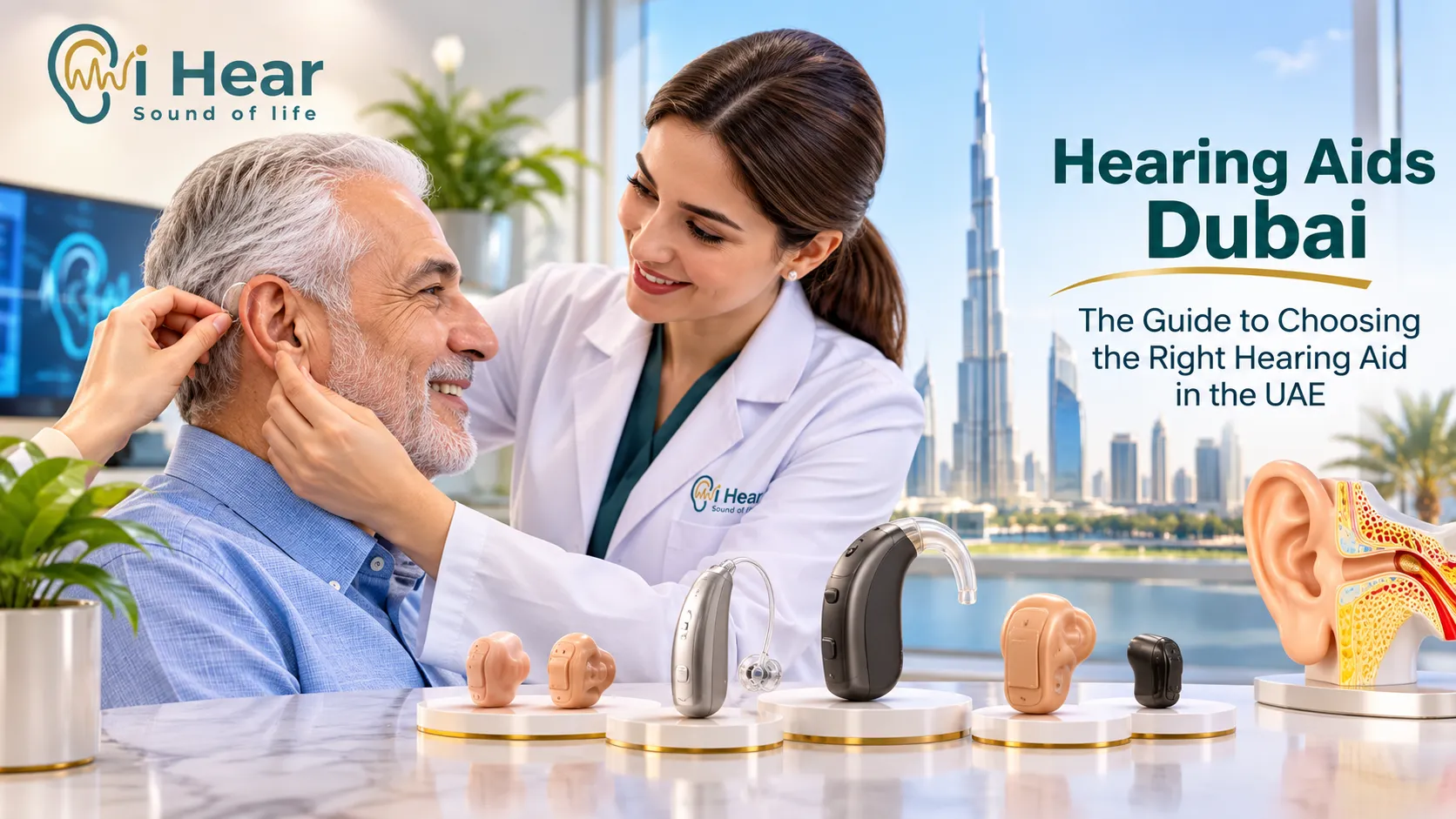
If you are searching for hearing aids in Dubai, you have probably noticed two things already. There are a lot of options, and almost nobody tells you a straight price. One clinic in Jumeirah offers a "free consultation", a marketplace lists a pair of used devices, and a website overseas promises half the price with delivery in a week. It is hard to know who to trust.
This guide is written to fix that. We will walk you through how hearing aids in Dubai are tested, chosen, priced and looked after, in plain language. You will see what each style is good for, what really drives the price, how insurance works in the UAE, and how the Beltone range compares for different degrees of hearing loss.
You are far from alone. The World Health Organization estimates that more than 1.5 billion people live with some degree of hearing loss, and that nearly 2.5 billion will by 2050. Among people over 60, more than a quarter have disabling hearing loss. WHO also links unaddressed hearing loss in older adults with faster cognitive decline, and notes that it can be managed well with hearing aids.
Dubai adds its own challenges. Life here is loud: open-plan offices, busy malls, family majlis gatherings, traffic on Sheikh Zayed Road. The climate is hot and humid, which is hard on electronics worn against the skin. And many residents are expats juggling insurance plans, work schedules and family abroad. The best hearing aids in Dubai are not simply the most expensive ones. They are the ones that are tested properly, fitted to your audiogram, and supported when something needs adjusting.
A quick note on who we are. iHear is an authorized Beltone hearing aid distributor in the UAE, with branches in Abu Dhabi and Al Ain and customers across every emirate, including Dubai. We also supply BioMed Jena diagnostic equipment to clinics and hospitals, so testing hearing properly is something we care about deeply.

Do You Need Hearing Aids? Signs to Watch For, and Why a Hearing Test Comes First
Hearing loss usually creeps in slowly, so the people around you often notice it before you do. Watch for these everyday signs:
- You understand people well at home but struggle in restaurants, malls or family gatherings.
- You ask people to repeat themselves, especially women and children, whose voices are higher-pitched.
- Family members say the TV is too loud.
- Phone calls feel harder than face-to-face conversation.
- You hear ringing, buzzing or hissing in your ears (tinnitus).
- You feel tired after long conversations because listening takes so much effort.
- You avoid social events because keeping up feels embarrassing.
If two or more sound familiar, book a hearing test before you look at any device. This is the single most important step in buying hearing aids in Dubai, and it is the one most often skipped by people who buy online.
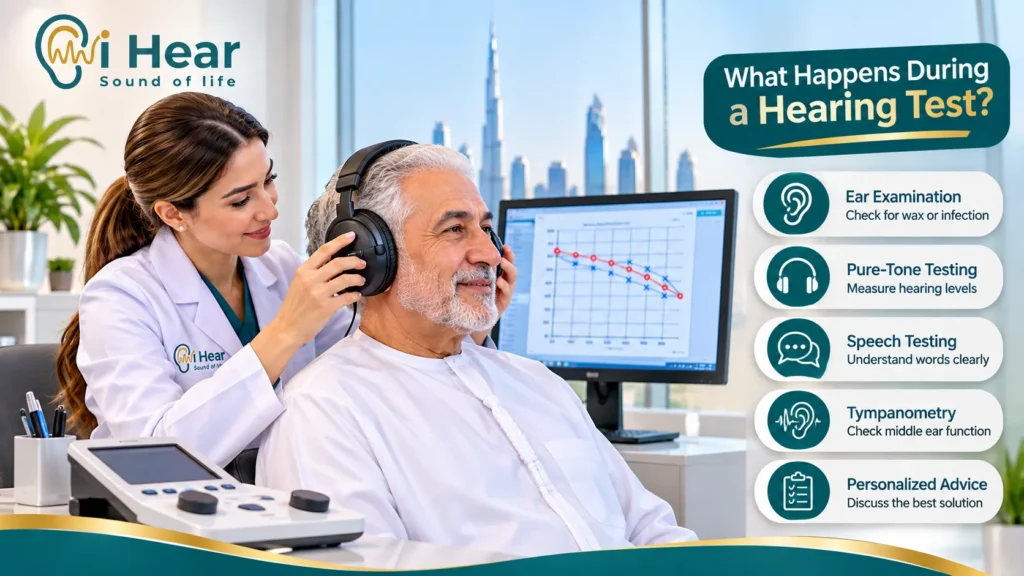
What happens during a hearing test
A proper hearing test, often called an audiogram or pure-tone audiometry, measures the softest sounds you can hear at different pitches in each ear. It usually takes 30 to 45 minutes and is painless. A good assessment also includes:
- A look inside your ears, to rule out wax or infection.
- Pure-tone testing through headphones, and often bone-conduction testing.
- Speech testing, to see how well you understand words at comfortable volumes.
- Middle-ear testing (tympanometry) when needed.
- A conversation about your lifestyle, work and the situations where you struggle most.
The result tells your audiologist the type of hearing loss (sensorineural, conductive or mixed) and its degree, from mild (20–40 dB) to profound (81 dB and above). That audiogram is what your hearing aid is programmed to. Without it, even a premium device is just guessing.
Hearing test in Dubai: what it costs
In Dubai, hearing tests are offered by hospitals, ENT clinics and hearing aid centres. Prices vary widely: some hospitals charge a few hundred dirhams for an ENT consultation with audiometry, while some hearing aid providers include the test free when you are considering a device. At iHear, the hearing test is free and carries no obligation to buy, at our Abu Dhabi and Al Ain branches. Many Dubai residents combine it with a trip to the capital, then handle most follow-up adjustments remotely.
Important: sudden hearing loss in one or both ears, ear pain, discharge or sudden dizziness is a medical matter, not a hearing aid matter. See an ENT doctor promptly, ideally within 24 to 48 hours.
Types of Hearing Aids Available in Dubai: Which Style Suits You?
All modern hearing aids in Dubai are digital. The real choice is the style, which affects comfort, visibility, power and how easy the device is to handle. Here is how the main styles compare.
| Style | Where it sits | Suits (degree of loss) | Strengths | Trade-offs |
|---|---|---|---|---|
| RIC / RIE (receiver-in-canal) | Small case behind the ear, thin wire to a speaker in the canal | Mild to severe | Discreet, natural sound, usually rechargeable and Bluetooth | Receiver can be affected by wax and moisture |
| BTE (behind-the-ear) | Larger case behind the ear, tube to an earmould | Moderate to profound | Most power, durable, easy to handle | More visible |
| ITE (in-the-ear) | Custom shell filling the outer ear | Mild to severe | Easy to insert, nothing behind the ear | Visible from the side |
| ITC (in-the-canal) | Custom shell in the lower ear | Mild to moderately severe | Discreet, can include Bluetooth | Smaller batteries, fewer controls |
| CIC / IIC (completely or invisible in canal) | Deep in the ear canal | Mild to moderate | Almost invisible | Usually no wireless streaming, small batteries, needs good dexterity |
For a deeper comparison, read our guide to types of hearing aids: BTE, RIC and in-the-ear and the wider UAE guide to hearing aid types.
Invisible hearing aids in Dubai
Invisible hearing aids in Dubai are popular with professionals who do not want the device to show. They are a good fit for many people with mild to moderate loss and healthy ear canals. But they are not for everyone. Very small or curved canals, heavy wax, frequent ear infections or severe loss can rule them out. And the smallest styles usually give up Bluetooth and rechargeability. A modern micro-RIC with a skin-tone or hair-colour case is often just as discreet in daily life, and much more capable.
Rechargeable vs battery hearing aids
Rechargeable hearing aids now dominate new fittings. You place them in a charger overnight and get a full day of use. They are ideal for seniors and anyone who finds tiny batteries fiddly. Replaceable zinc-air batteries still make sense for very powerful devices, for people who travel to places without reliable charging, or when the smallest custom styles are needed.
Bluetooth and smart features
Most current hearing aids stream calls, music and video directly from iPhone and many Android phones. Look for:
- Direct streaming and hands-free calls, so your phone sounds come straight to both ears.
- App control, to change volume and programmes discreetly.
- Remote adjustment, so your audiologist can fine-tune settings over the internet. This is a big advantage for busy Dubai schedules.
- Auracast, a new Bluetooth LE Audio standard that lets compatible hearing aids receive public audio broadcasts where venues offer them.
- Noise handling and AI processing, which classify the scene around you and bring speech forward in noisy places.
Not sure where to begin? Our 7 steps before you buy a hearing aid is a useful checklist.
Beltone Hearing Aids in Dubai and the UAE: Six Models Compared
Beltone is part of Denmark's GN group, the same group behind ReSound and Jabra. Rather than one device for everyone, Beltone offers six product lines for different degrees of loss and lifestyles. Here is how they compare. Specs are from each model's page on ihear.ae, and features vary by technology level.
| Model | Degree of loss | Style | Battery | Stand-out feature |
|---|---|---|---|---|
| Beltone Envision | Mild to moderate | microRIE / RIE | Rechargeable, up to 30 hours, or zinc-air 312/13 | Dedicated AI (DNN) chip for speech in noise |
| Beltone Illuminate | Mild to severe | microRIE, RIE, ITC, ITE, CIC, plus CROS | Rechargeable or zinc-air | True Directionality (top ILU17 level) and a solution for one-sided hearing loss |
| Beltone Commence | Mild to moderate | 5 styles: miniRIE, RIE 63, RIE 64, ITC, CIC | Rechargeable (miniRIE) or zinc-air | Choice of styles, IP68, good first hearing aid |
| Beltone Serene | Mild to severe | Custom ITE | Rechargeable, up to 30 hours | Custom in-the-ear and rechargeable |
| Beltone Boost Max S | Severe to profound | Super Power BTE | Rechargeable, up to 28 hours | Up to 140 dB output (2cc coupler) |
| Beltone Boost SP | Profound | Power BTE | Zinc-air 675, replaceable | Up to 141 dB output, telecoil in all levels |
You can compare all six in detail on our Beltone hearing aids guide.
Which Beltone hearing aid fits your situation?
- "I want small, smart and discreet." Beltone Envision is a compact behind-the-ear device whose AI chip classifies sounds in a fraction of a second. It suits professionals who spend their days in meetings and their evenings in busy restaurants.
- "Noise is my biggest problem." Beltone Illuminate is Beltone's newest AI family, announced in August 2026. At its top level, it combines sound-scene detection, four-microphone focus and neural-network noise reduction. It also includes a CROS option for people with little or no hearing in one ear.
- "I want something practical and tough." Beltone Commence comes in five styles on one platform, with IP68 protection against sweat and dust. It is a sensible choice for a first hearing aid or an active outdoor life.
- "I don't want anything behind my ear." Beltone Serene is made from a mould of your ear and is rechargeable, which is rare in custom in-the-ear devices.
- "Standard hearing aids are not loud enough." Beltone Boost Max S delivers super-power amplification in a rechargeable body, with feedback control so it does not whistle.
- "I prefer batteries I can swap." Beltone Boost SP uses large size 675 batteries and suits profound loss. It is sometimes worn alongside a cochlear implant in the other ear, as decided by the medical team.
Features shared across the range
Whichever Beltone model you choose, several technologies come with it:
- Tinnitus Breaker Pro on several models, which plays soothing sounds to make ringing less noticeable.
- IP68 dust and water resistance on many models, helpful in the UAE's heat and humidity.
- The Beltone HearMax app on wireless styles, for control, streaming and remote care.
- Auracast on most wireless styles, ready for venues and TVs that broadcast it.
- iPhone and Android compatibility, with direct streaming on compatible phones.
Hearing Aid Price in Dubai: What You Are Really Paying For
"How much do hearing aids cost in Dubai?" is the question we hear most. The honest answer is that it depends, but not in a vague way. A handful of clear factors set the price.
As a rough market guide, the UAE health directory MediFinder reports basic hearing aids in Dubai starting from around AED 1,500, with receiver-in-canal models listed at roughly AED 3,000 to 8,000. Advanced pairs from major brands can cost considerably more. Treat these as indicative only: prices change with every product generation and every clinic.
Five things that decide the price
- Technology level. Each model comes in several tiers. Higher tiers add more processing channels, better noise handling and more automatic features. Beltone, for example, offers Envision and Serene in levels 17, 9, 6 and 4. The shell can look identical while the chip inside differs a lot.
- One or two devices. Most people with hearing loss in both ears need a pair. Two hearing aids help with direction, balance of sound and understanding speech in noise.
- Style and power. Custom in-the-ear shells, rechargeable systems and super-power devices each change the cost.
- What is included. Ask whether the price covers the hearing test, fitting, follow-up adjustments, cleaning, domes and filters, a charger, and the warranty period. A cheaper device with no aftercare often costs more over three to five years.
- Where you buy. A device bought online or second-hand may look cheaper, but it comes with no programming, no follow-up and sometimes no valid warranty in the UAE.
Why online and second-hand hearing aids rarely save money
You will find used hearing aids on classifieds sites in Dubai, and overseas sellers promising big discounts. The problem is not the hardware. It is everything around it. A hearing aid has to be programmed to your audiogram using the manufacturer's fitting software, then fine-tuned over several weeks as your brain adapts. Custom devices are shaped to someone else's ears. Warranties are often tied to the original buyer or region. Without an audiologist, much of the benefit you paid for is lost.
Does insurance cover hearing aids in the UAE?
Sometimes, partially. Coverage depends on your insurer and your specific plan, not on the emirate's health authority. DHA in Dubai, DOH in Abu Dhabi and MOHAP regulate insurers, but they do not pay for devices themselves. Before you buy:
- Call your insurer and ask whether hearing aids are covered, up to what limit, and how often.
- Ask which documents they need. Usually that is an audiogram and a medical report or prescription.
- Check whether you must buy from an approved provider.
The iHear team can help you check your coverage and prepare the documents your insurer asks for. For an accurate quote on hearing aids in Dubai, the fastest route is a free hearing test and a short call on WhatsApp.
How to Choose a Hearing Aid Provider in Dubai
The provider matters as much as the device. Two people can wear the same model and have completely different results, depending on how well it was fitted and followed up. Use these questions when comparing hearing aid centres in Dubai and across the UAE:
- Is the audiologist licensed? In Dubai, healthcare professionals are licensed by the Dubai Health Authority (DHA); in Abu Dhabi, by the Department of Health. Ask.
- Is the hearing test thorough? You want pure-tone and speech testing, not a quick app check.
- Can I try before I buy? A trial in your real environment, at home, at work and in a noisy café, tells you more than any brochure.
- Is the brand authorized? Buying from an authorized distributor means genuine stock, manufacturer software for programming, and a valid warranty in the UAE.
- What follow-up is included? Ask how many adjustment sessions are included, whether remote adjustments are possible, and who handles repairs.
- What happens if it breaks? Find out about repair times, and whether a loaner device is available while yours is being serviced.
- Do they explain, or just sell? A good audiologist listens to how you live, sets realistic expectations, and does not push the most expensive tier by default.
Why Dubai residents choose iHear
iHear is an authorized Beltone distributor in the UAE, headquartered in Al Ain with a second branch in Abu Dhabi. We do not have a Dubai branch, and we will not pretend otherwise. What we offer Dubai residents is this:
- A free hearing test with no obligation, at our Abu Dhabi branch (Muroor Road) or Al Ain branch.
- Audiologists trained by Beltone in programming and fitting.
- A demo hearing aid trial before you decide.
- Remote fine-tuning through the Beltone HearMax app on supported models, so most follow-up adjustments happen without driving back.
- Manufacturer warranty and after-sales service, with support for customers across all seven emirates.
- Clinical depth. We also supply hospitals and audiology centres with German BioMed Jena audiology diagnostic devices, so precise testing is part of who we are.
You can learn more about iHear, or message the team on WhatsApp at +971 50 208 4569 to book.
Fitting, Getting Used to and Caring for Hearing Aids in Dubai's Climate
Buying hearing aids in Dubai is the start, not the finish. The first few weeks decide whether they end up in your ears or in a drawer.
Your first weeks with new hearing aids
At the fitting, your audiologist programmes the devices to your audiogram, checks the physical fit and shows you how to insert, charge and clean them. Expect the world to sound sharper at first: the hum of the AC, the rustle of paper, your own voice. That is normal. Your brain has been missing these sounds and needs time to filter them again.
Most people adjust within two to four weeks; powerful devices can take longer. A few habits help a lot:
- Wear them through all your waking hours from the start, not only for special occasions.
- Begin in quieter settings, then build up to malls and gatherings.
- Note down situations that feel too loud or unclear, and share them at follow-up.
- Book at least one or two follow-up adjustments. With remote care, many of these can be done from your sofa in Dubai.
Hearing aid care in heat, humidity and sand
The UAE climate is tough on hearing aids. Sweat, humidity, sudden temperature swings between 45°C outside and an air-conditioned office, plus fine dust, all take their toll. IP68-rated devices resist much of this, but care still matters:
- Wipe daily with a dry, soft cloth. Remove sweat and earwax from the device and the dome or earmould.
- Change wax filters and domes as your audiologist advises, often every few weeks.
- Dry them overnight. Rechargeable chargers help; for battery models, a drying box is worth having in summer.
- Keep them out of the car. A parked car in Dubai can reach extreme temperatures that damage batteries and electronics.
- Take them off for showers, swimming, saunas, hair spray and sunscreen application.
- Book a professional clean and check every few months, sooner in peak summer.
If a device sounds weak, whistles or cuts out, the cause is often a blocked filter, not a fault. Before you search for hearing aid repair in Dubai, contact your provider. Many issues are solved in minutes, and iHear can arrange a temporary demo device, subject to availability, if yours needs servicing.
Hearing Aids for Seniors, Children and Tinnitus in Dubai
Hearing aids for seniors and elderly parents
Many searches for hearing aids in Dubai come from adult children helping a parent. For older users, the easiest device is often the best one. Rechargeable models remove tiny batteries from the routine. Slightly larger RIC or BTE styles are easier to hold and insert than deep-canal devices. A simple remote or app that a family member can set up helps too. Patience matters just as much: older adults may need more follow-up visits and gentle encouragement through the first month. Our guide to the best hearing aids for seniors covers this in detail.
Hearing aids for children in the UAE
Children learn to speak by hearing, so early support makes a real difference to speech and language development. If you notice a child not responding to their name, speaking unclearly or turning up devices very loud, ask for a hearing assessment. Newborns in the UAE are usually screened at birth, but some hearing loss develops later. Children's hearing aids are chosen and programmed by a paediatric audiologist, with tamper-resistant battery doors and earmoulds that are remade as the child grows. For profound congenital loss, a cochlear implant assessment is often considered as well. Read more in our article on hearing loss in children.
Tinnitus treatment in Dubai: can hearing aids help?
Tinnitus, the ringing or buzzing heard when there is no outside sound, very often comes with hearing loss. Hearing aids help in two ways. First, by restoring the background sounds you have been missing, they make the tinnitus less noticeable. Second, many models include sound generators. Beltone's Tinnitus Breaker Pro, for example, plays soothing sounds that help the brain pay less attention to the ringing. This eases the distress; it does not cure the cause. Persistent tinnitus in one ear only, or with pulsing, should be checked by an ENT doctor.
When dizziness is part of the picture
The inner ear handles both hearing and balance. Some people with hearing loss also have vertigo or unsteadiness, especially after an ear infection or with conditions like Ménière's disease. These need proper vestibular assessment, not just a hearing aid. Clinics in the UAE use systems such as video nystagmography and the video head impulse test, which iHear supplies through its vestibular diagnostic devices range, along with PhysioSensing Otoneuro for balance rehabilitation.

Hearing Aids Dubai: Frequently Asked Questions
Your Next Step Toward Better Hearing in Dubai
Choosing hearing aids in Dubai comes down to three things, in this order: an accurate hearing test, a device matched to your hearing and your life, and a provider who stays with you after the sale. Get those right and the brand, the style and the price fall into place.
If you have been putting it off, you are not alone, and it is never too late. Many of our customers say their only regret is waiting so long.
Book your free hearing test with iHear today. Message us on WhatsApp at +971 50 208 4569, call our Abu Dhabi branch on 02 681 3841 or our Al Ain branch on 03 768 5563, or visit the contact page.
Whether you are in Downtown Dubai, Al Barsha, Deira or Dubai Marina, the iHear team will help you hear the details again, clearly and comfortably.

For more information
Feel free to contact us anytime. Our team is always ready to help you.




No comment