
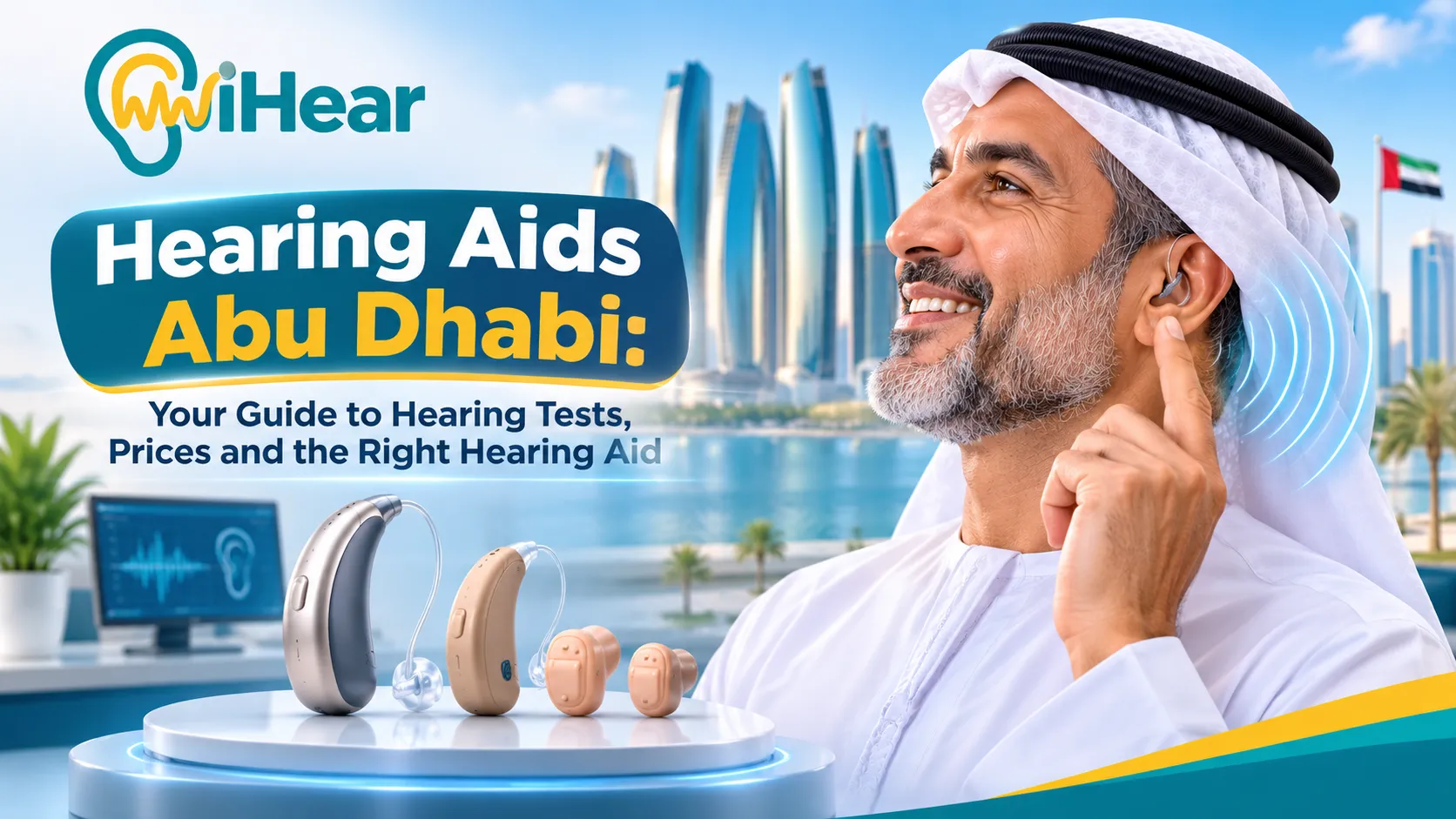
Looking for Hearing Aids in Abu Dhabi? Start Here
Maybe your father keeps turning the TV up during the evening news. Maybe you nod along in meetings on Al Reem Island without catching every word. Or maybe a friend in Khalifa City finally admitted that family dinners have become exhausting. However you arrived here, you are looking for hearing aids in Abu Dhabi, and you want to get it right the first time.
That is a smart instinct. Hearing aids are not a gadget you pick off a shelf. The right device depends on your hearing test, your ears, your daily life and the support you get after the fitting. This guide walks you through all of it: where to get a hearing test in Abu Dhabi, which hearing aid styles suit which needs, how prices are set, what Daman and other insurers usually cover, and how to choose a hearing aid centre you will still be happy with in three years.
Hearing loss is far more common than most people think. The World Health Organization estimates that over 1.5 billion people have some degree of hearing loss worldwide, rising to nearly 2.5 billion by 2050. More than 25% of people over 60 are affected by disabling hearing loss. And when it goes untreated in older adults, WHO links it with isolation, depression and faster cognitive decline. The encouraging part: hearing aids are one of the most effective tools available.
Abu Dhabi is a good place to deal with it. The emirate has a strong, well-regulated health system under the Department of Health (DOH), widespread health insurance, and a growing number of hearing care providers. The challenge is choosing well among them.
A quick introduction: iHear is an authorized Beltone hearing aid distributor with a branch in Abu Dhabi on Muroor Road and another in Al Ain. We offer a free hearing test, a hearing aid trial before you buy, and after-sales care for customers in Abu Dhabi city, Al Ain, Al Dhafra and across the UAE. We also supply German BioMed Jena hearing and balance diagnostic equipment to clinics and hospitals, so accurate testing is close to our hearts.

Hearing Test in Abu Dhabi: The First Step Before Any Hearing Aid
Signs it is time to get your hearing checked
Hearing loss is sneaky. It usually builds over years, and the brain fills in the gaps until it can't anymore. These are the signs we hear about most often from people walking into our Abu Dhabi branch:
- Conversations in cafés, malls or wedding halls feel like hard work.
- You keep asking people to repeat themselves, or you guess at what they said.
- Children's and women's voices are harder to follow than men's.
- Others comment that the TV or phone volume is very loud.
- You hear ringing, humming or hissing in one or both ears.
- You avoid gatherings because following the conversation is tiring or embarrassing.
- You struggle to hear the imam during prayers or a speaker at an event.
Two or more of these? Book a hearing test before you shop for hearing aids in Abu Dhabi. It is the foundation for everything that follows.
What happens at a hearing test, step by step
At iHear, the free hearing test at our Abu Dhabi branch usually takes 30 to 45 minutes. It runs roughly like this:
- A short conversation. Your audiologist asks where you struggle, about your health history, noise exposure, work and lifestyle.
- Ear examination. A look into the ear canal to check for wax, infection or anything blocking sound.
- Pure-tone audiometry. You listen through headphones and respond to soft beeps at different pitches. This maps the quietest sounds you can hear in each ear.
- Speech testing. Words at comfortable volume, to measure how clearly you understand speech, not just whether you hear it.
- Explaining the results. You see your audiogram and learn the type of hearing loss (sensorineural, conductive or mixed) and its degree, from mild to profound.
- Recommendations. If hearing aids will help, your audiologist explains which styles suit your loss, and you can try a programmed hearing aid before deciding.
If the test shows something that needs medical attention, such as a perforated eardrum, an infection or loss in only one ear, we will recommend an ENT specialist first. Abu Dhabi has strong ENT departments across hospitals such as those run by SEHA, Mediclinic and NMC.
Sudden hearing loss, ear pain with discharge, or sudden dizziness are urgent. See an ENT doctor within 24 to 48 hours rather than waiting for a hearing aid appointment.
Hearing test cost in Abu Dhabi
Hearing tests in Abu Dhabi are offered by hospitals, ENT clinics and hearing aid centres. Hospital audiometry is often billed as part of an ENT consultation and may be covered by insurance when referred by a doctor. Many hearing aid providers, including iHear, offer the test free for people considering a hearing aid. The free hearing test at iHear carries no obligation to buy.
Hearing Aid Styles in Abu Dhabi: Matching the Device to Your Life
Every hearing aid sold today is digital, so the question is less "analogue or digital" and more "which style, and which features". Think about it through your own daily routine.
Receiver-in-canal (RIC): the everyday favourite
A small case sits behind the ear, with a thin wire carrying sound to a tiny speaker in the canal. RIC hearing aids suit mild to severe loss, sound natural, and usually come rechargeable with Bluetooth. They are the most popular choice for working adults in Abu Dhabi who move between the office, the car and the family majlis in one day.
Behind-the-ear (BTE): power and durability
Larger cases with an earmould, built for moderate to profound loss. BTE devices are robust, easy to handle with less nimble fingers, and deliver the most amplification. Children and people with severe loss often wear them.
In-the-ear and in-the-canal (ITE, ITC): nothing behind the ear
Custom shells made from an impression of your ear. They suit people who wear glasses or a ghutra and prefer nothing resting behind the ear. Easy to insert, though slightly more visible from the side.
Invisible hearing aids (CIC and IIC)
Invisible hearing aids in Abu Dhabi sit deep in the ear canal and are almost impossible to spot. They are a good option for mild to moderate loss in people with roomy, healthy ear canals. The trade-offs: they usually lack Bluetooth streaming and rechargeable batteries, and small canals or frequent wax build-up can rule them out.
For a full side-by-side comparison, see our guide to types of hearing aids: BTE, RIC and in-the-ear, or the broader explainer hearing aids for hearing loss: how they work and how to choose.
Features worth paying attention to
Feature | Why it matters in Abu Dhabi |
|---|---|
Rechargeable battery | One overnight charge for a full day; no tiny batteries for seniors to handle |
Bluetooth streaming | Calls, Quran recitation, podcasts and navigation straight to both ears |
Noise management and AI | Clearer speech in busy places like Marina Mall, Yas Mall or a crowded wedding hall |
Remote fine-tuning | Adjustments over the internet, so a commute from Al Reem or Yas does not cost you an afternoon |
IP68 rating | Better resistance to sweat, humidity and dust in the summer months |
Tinnitus sound generator | Soothing sounds that make ringing less noticeable |
Auracast | Ready for the new Bluetooth LE Audio broadcasts in venues that offer them |
Not every feature is right for every person. A retired grandparent may value simplicity over app control; a young professional may care most about streaming and discretion. Our 7 steps before you buy a hearing aid checklist helps you sort your priorities.
Beltone Hearing Aids in Abu Dhabi: Which Model Fits Which Person?
Beltone has made hearing aids for more than 80 years and is part of Denmark's GN group, alongside ReSound and Jabra. At our Abu Dhabi branch, we fit six Beltone families. Instead of listing specs, here is how they map to the people we actually see. Full specifications are on each model page and in our Beltone hearing aids guide.
The busy professional: Beltone Envision
You work in ADGM or a government office, sit in meetings all morning and take calls in the car. Beltone Envision is a small, rechargeable receiver-in-ear hearing aid for mild to moderate loss, with a dedicated AI chip that separates speech from background noise. Up to 30 hours per charge and direct phone streaming make it an easy everyday companion.
The social one in noisy places: Beltone Illuminate
Weddings, family gatherings, restaurants on the Corniche. Noise is your enemy. Beltone Illuminate, Beltone's newest AI family, combines scene detection, multi-microphone focus and neural-network noise reduction at its top level. It covers mild to severe loss in several styles, and offers a CROS solution for people with little or no hearing in one ear.
The first-time user: Beltone Commence
New to hearing aids and want something simple, sturdy and affordable to start? Beltone Commence comes in five styles, from a rechargeable mini behind-the-ear to a nearly invisible CIC. Its IP68 rating handles sweat and dust, which helps if you spend time outdoors, at the beach or in the desert.
The "nothing behind my ear" wearer: Beltone Serene
If you wear glasses or a headdress, or simply prefer a custom fit, Beltone Serene is a rechargeable in-the-ear hearing aid made from an impression of your ear. Custom and rechargeable is still a rare combination.
Severe to profound loss: Beltone Boost Max S and Boost SP
When standard hearing aids are no longer loud enough, power matters. Beltone Boost Max S is a rechargeable super-power behind-the-ear device with up to 140 dB output and up to 28 hours per charge. Beltone Boost SP uses replaceable size 675 batteries with up to 141 dB output, and includes a telecoil, useful in mosques and halls fitted with hearing loops.
What comes with every Beltone hearing aid from iHear
- Programming to your audiogram by a Beltone-trained audiologist in Abu Dhabi.
- A trial with a programmed demo device before you commit.
- The Beltone HearMax app on wireless models, for control and remote adjustments.
- Manufacturer warranty and local after-sales service.
- Follow-up appointments at our Muroor Road or Al Ain branch.
Comparing brands as well as models? Our article on the best hearing aid brands in the UAE explains what to look at beyond the logo.
Hearing Aid Prices in Abu Dhabi, and What Insurance Really Covers
Why there is no single price tag
Search for the price of hearing aids in Abu Dhabi and you will find everything from a used device on a classifieds site to premium pairs costing many thousands of dirhams. Both can be "right" for someone. What separates them:
- Technology level. The same model usually comes in several tiers. Higher tiers process sound in more channels, handle noise better and adapt automatically to more situations.
- One or two hearing aids. Most people with hearing loss in both ears do far better with a pair, especially for direction and speech in noise.
- Style. Custom in-the-ear shells, rechargeable systems and power devices each change the cost.
- The service around it. Hearing test, fitting, follow-up visits, cleaning, spare parts, remote adjustments and warranty. Two quotes that look different are often covering very different amounts of care.
As a broad UAE market reference, the health directory MediFinder reports entry-level hearing aids starting at around AED 1,500, with receiver-in-canal models commonly between AED 3,000 and 8,000. Advanced pairs can cost more. Use these numbers as orientation only. For a real figure, the answer depends on your audiogram.
Cheaper online or second-hand? Think twice
Overseas sellers advertise big savings to Abu Dhabi residents, and used hearing aids appear on classifieds. The device may be genuine, but a hearing aid only works well when it is programmed to your hearing with the manufacturer's software, checked in your ear, and fine-tuned over weeks. Imported devices may also carry a warranty that is hard to use in the UAE. The low price often ends up being the most expensive choice.
Do Daman, Thiqa and other insurers cover hearing aids?
In Abu Dhabi, health insurance is mandatory, and many people are insured with Daman, which also manages the government Thiqa programme for UAE nationals. Hearing aid coverage depends entirely on your plan:
- Daman's own published hearing aid adjudication guideline states that hearing aids are not covered on visitor plans or on plans without a durable medical equipment or hearing aid benefit. Where a benefit exists, coverage follows the policy's terms and conditions.
- Basic and entry-level plans often exclude hearing aids, while some enhanced and premium plans include an allowance.
- Thiqa members should check their eligibility and the approval steps directly with Daman, since coverage rules and approved providers can change.
Before buying hearing aids in Abu Dhabi, ask your insurer three things: is there a hearing aid or medical equipment benefit, what is the limit and how often can it be used, and which documents and providers are required. Usually you will need an audiogram and a doctor's report. The iHear team can help you prepare your test results and paperwork for the insurer.
For an accurate quote, start with the free hearing test and message us on WhatsApp.
How to Choose a Hearing Aid Centre in Abu Dhabi
Hearing aids are a relationship, not a one-time purchase. You will see your provider for the fitting, for fine-tuning, for cleaning, and whenever something feels off. So choose the centre as carefully as the device. Here is a practical checklist for comparing hearing aid centres in Abu Dhabi:
- Licensed professionals. Audiologists in Abu Dhabi are licensed by the Department of Health. Ask who will test and fit you.
- A complete hearing test. Pure-tone and speech testing at minimum, explained clearly, with a copy of your audiogram.
- Authorized brands. Buying from an authorized distributor means genuine devices, access to the manufacturer's fitting software and a warranty that works in the UAE.
- A real trial. You should be able to hear the difference in your own life before deciding.
- Transparent quotes. Ask exactly what is included: follow-ups, cleaning, spare domes and filters, charger, warranty length.
- Easy follow-up. A convenient location, parking, and remote adjustments for minor tweaks.
- Repairs and loaners. Find out what happens if your hearing aid needs repair, how long it takes, and whether a temporary device is available.
- Honest advice. A good audiologist matches the device to your needs and budget rather than steering everyone to the top tier.
Why choose iHear for hearing aids in Abu Dhabi
iHear is an authorized Beltone distributor in the UAE, with two branches: one in Abu Dhabi and one in Al Ain. For residents of the capital, here is what that means in practice:
- A central Abu Dhabi location. Our branch is on Sultan Bin Zayed the First Street (Muroor Road), Building 1210, Offices M6, easy to reach from downtown, Al Reem, Khalifa City and Mohammed Bin Zayed City.
- A free hearing test, no obligation. You leave with your results and honest advice, whether or not you buy.
- Try before you buy. We programme a demo hearing aid to your hearing so you can test it in daily life.
- Beltone-trained fitting with the manufacturer's software, and the full range of six Beltone families in one place.
- Remote care. Many adjustments happen through the Beltone HearMax app, so you do not always need to come in.
- Local after-sales service and warranty support, plus a second branch in Al Ain for families who split time between the two cities.
- Clinical background. We supply BioMed Jena audiology diagnostic devices and vestibular diagnostic devices to hospitals and clinics across the UAE.
Learn more about iHear, or call our Abu Dhabi branch on 02 681 3841.

Life with New Hearing Aids in Abu Dhabi: Fitting, Adjusting and Care
The fitting appointment
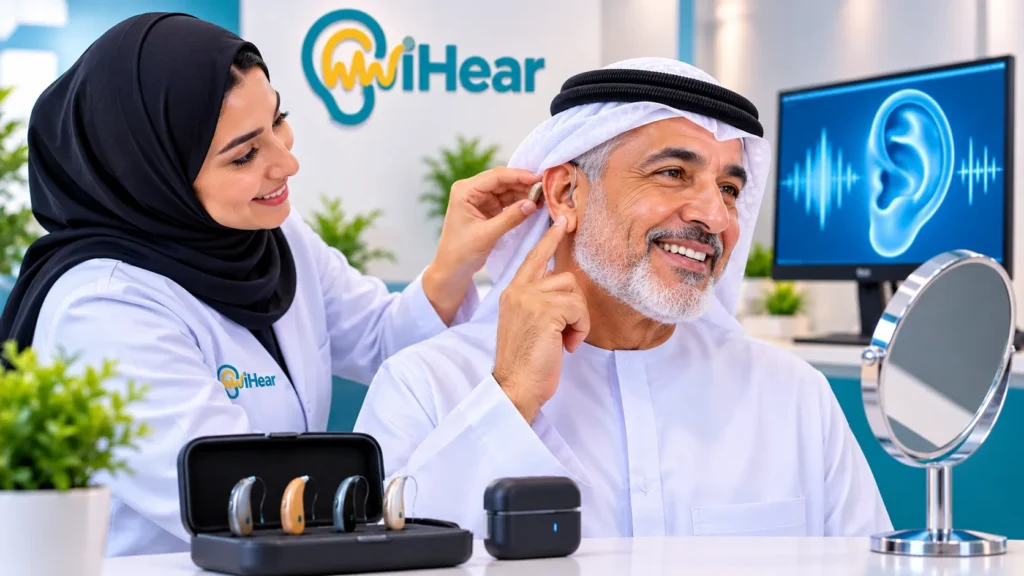
Once you choose your hearing aids in Abu Dhabi, the fitting is where they become yours. Your audiologist programmes them to your audiogram, checks the fit in your ear, measures how they perform, and teaches you the basics: how to put them in, charge or change batteries, clean them, and use the app if you have one. Bring a family member if you like. A second pair of ears for the instructions helps.
The first month: give your brain time
Many new users are surprised by how much they hear: the AC, footsteps, the indicator ticking in the car, their own voice. Your brain has not processed these sounds for a while and needs a few weeks to put them back into the background. To get through this smoothly:
- Wear your hearing aids from morning to night, every day, rather than only "when needed".
- Start with quiet rooms at home, then build up to busier places.
- Keep a short note on your phone of moments that felt too loud, tinny or unclear.
- Come back for your follow-up, or book a remote session. Small changes make a big difference.
Most people feel settled within two to four weeks. Those with longer-standing or more severe loss may need a little longer.
Looking after hearing aids in Abu Dhabi's climate
Summer in Abu Dhabi means heat, humidity near the coast, sweat and fine dust, then a sudden chill in air-conditioned buildings. Hearing aids handle a lot, especially IP68 models, but a few habits extend their life:
- Wipe them every evening with a soft, dry cloth to remove sweat and earwax.
- Replace wax filters and domes on the schedule your audiologist gives you.
- Keep them dry. Charge rechargeable models overnight in their case; use a drying box for battery models during the humid months.
- Never leave them in a parked car. Cabin temperatures in summer can damage batteries and electronics.
- Remove them before showers, swimming, saunas and applying hairspray or sunscreen.
- Book a professional clean every few months at the branch, and more often in summer.
If a hearing aid suddenly sounds weak or whistles, check the filter and dome first. Most "faults" are blocked wax guards. If that does not help, contact us before searching for hearing aid repair in Abu Dhabi elsewhere: many issues are fixed during a short visit, and we can arrange a temporary demo device, subject to availability, while yours is serviced.
Hearing Aids for Every Generation in Abu Dhabi
Hearing aids for elderly parents and grandparents
A large share of the people we fit with hearing aids in Abu Dhabi come in with a son or daughter. For older adults, ease of use is everything. Rechargeable hearing aids remove fiddly batteries. Slightly larger receiver-in-canal or behind-the-ear styles are easier to hold and insert than deep-canal devices. A simple remote, or an app set up on a family member's phone, keeps adjustments stress-free. And patience matters: the first month may need extra encouragement and an extra follow-up visit. Treating hearing loss can help older adults stay connected to family conversations, which WHO identifies as important for wellbeing in later life. Our guide to the best hearing aids for seniors goes further.
Children with hearing loss
Children need to hear well to develop speech, language and learning. Newborn hearing screening is routine in the UAE, but hearing loss can appear later, after infections or for other reasons. Signs to watch for include not responding to their name, delayed or unclear speech, sitting very close to the TV, or struggling at school. Children's hearing aids are selected and programmed by paediatric audiologists, usually as behind-the-ear devices with earmoulds that are replaced as the child grows. For profound loss, Abu Dhabi hospitals such as Mediclinic run cochlear implant programmes. You can read more in our article on hearing loss in children.
Tinnitus treatment in Abu Dhabi: where hearing aids fit in
Tinnitus, a ringing, buzzing or hissing sound with no outside source, very often appears alongside hearing loss. Hearing aids help in two ways: they bring back the background sounds that mask the ringing, and many include built-in sound generators, such as Beltone's Tinnitus Breaker Pro, which play soft, soothing sounds. Most people find their tinnitus less intrusive as a result. Hearing aids do not cure the underlying cause, so tinnitus in one ear only, pulsing tinnitus, or tinnitus with dizziness should be checked by an ENT specialist.
Dizziness and balance problems
Your inner ear controls balance as well as hearing. Vertigo, unsteadiness or repeated falls alongside hearing loss call for a vestibular assessment, not just a hearing aid. Clinics in Abu Dhabi and across the UAE use tools such as video nystagmography and the video head impulse test, which iHear supplies through its vestibular diagnostic devices range, along with the PhysioSensing Otoneuro System for vestibular rehabilitation.
Hearing Aids Abu Dhabi: Frequently Asked Questions
Ready to Hear Better? Visit iHear in Abu Dhabi
The path to the right hearing aids in Abu Dhabi is simpler than it looks: an accurate hearing test, an honest recommendation, a real-life trial, and a team that stays with you after the fitting. Everything else, the brand, the style, the price, falls into place once those are right.
If you or someone you love has been missing parts of conversations, there is no better time to act. Most people tell us they wish they had come in sooner.
Book your free hearing test today.
| iHear Abu Dhabi | iHear Al Ain | |
|---|---|---|
| Address | Sultan Bin Zayed the First St (Muroor Rd), Building 1210, Offices M6 | Al Humaireh, 136 Khalifa Bin Zayed St, Mezzanine 2, Office 3 |
| Phone | 02 681 3841 | 03 768 5563 |
| +971 50 208 4569 | +971 50 208 4569 |
You can also reach the team through our contact page or email Info@ihear.ae.
This article is for general information and does not replace an assessment by a licensed audiologist or ENT doctor.
For more information
Feel free to contact us anytime. Our team is always ready to help you.




No comment